

Table of Contents
Clicker Training Cats
Most people think cats cannot be trained. Wrong. Cats can be trained. Very well actually. The secret is clicker training. A simple. Humane. Effective method that uses positive reinforcement. To teach your cat almost anything. Sit. Stay. Come. High five. Jump through hoops. You name it.
As a certified veterinary expert and professional cat behaviorist. I have used clicker training with hundreds of cats. And I can tell you. It works. Every time. The key is understanding how cats learn. And using the right technique. Clicker training is the gold standard. For feline behavior modification. And it is endorsed by veterinary behaviorists worldwide.
This guide teaches you everything. From what a clicker is. To advanced tricks. By the end. You will have a trained cat. And a stronger bond than ever before.
📚 Recommended Cat Guides
🐱 The Trainable Cat Book
Learn proven methods to train your cat and stop unwanted behaviors.
View Book →❤️ Complete Cat Care Manual
Your complete guide to cat nutrition, health, grooming, behavior, and daily care.
Get the Manual →What Is Clicker Training
Clicker training is a form of positive reinforcement. You use a small device. Called a clicker. That makes a distinct clicking sound. When your cat does something right. You click. Then treat. The click marks the exact moment of correct behavior. The treat rewards it.
This is called operant conditioning. The cat learns that certain behaviors earn rewards. So they repeat those behaviors. The clicker is not a tool of dominance. It is a communication tool. It tells your cat. Yes. That was right. Here is your reward.
Clicker training was originally developed for dolphins. Then dogs. Now it is widely used for cats. Because it works. Cats respond exceptionally well to clicker training. Because they are intelligent. Food-motivated. And capable of learning complex behaviors.
Why Clicker Training Works for Cats
Cats learn through association. When something good follows a behavior. They repeat it. Clicker training accelerates this process. Because the click provides immediate. Precise feedback.
Without a clicker. You might say good cat. By the time you speak. The behavior is already over. The cat does not connect the praise with the action. With a clicker. The sound happens in the exact moment. Of the correct behavior. The cat knows exactly what earned the reward.
According to veterinary behaviorists. Clicker-trained cats learn faster. Retain behaviors longer. And show less stress during training. Compared to other methods. The clicker creates clarity. And cats thrive on clarity.
How to Get Started with Clicker Training

Step 1: Get a Clicker
Clickers are cheap. You can buy them at pet stores. Or online. There are two main types. Box clickers. And button clickers. Both work. It is personal preference. Some cats prefer the softer sound of a button clicker. Try both. See what your cat responds to.
Step 2: Charge the Clicker
Before you train. You need to charge the clicker. This means teaching your cat that click equals treat. Click once. Give a treat. Wait five seconds. Click again. Give another treat. Do this ten to fifteen times. Your cat will learn the association quickly. Usually within one session.
This is the most important step. Do not skip it. If your cat does not understand click equals treat. The clicker is useless. Charge it first. Then train.
Step 3: Start Simple
Begin with easy behaviors. Things your cat already does naturally. Like touching a target stick. Or sitting. Do not start with complicated tricks. Build confidence first. Success breeds success.
Step 4: Keep Sessions Short
Cats have short attention spans. Keep training sessions to five minutes. Maximum. Two to three sessions per day is ideal. Short. Frequent sessions work better than long. Infrequent ones. End every session on a success. So your cat feels good about training.
Step 5: Be Patient
Cats learn at different speeds. Some cats get it in minutes. Others take days. Do not get frustrated. If your cat does not understand. Go back to basics. Make it easier. Click and treat for small steps. Shaping behavior takes time.
Basic Clicker Training Commands

Sit
To teach sit. Hold a treat above your cat’s nose. Move it slowly backward over their head. Their bottom will naturally lower. When it touches the ground. Click. Treat. Repeat. Your cat will learn that butt on ground equals click. This usually takes three to five sessions.
Touch
Touch is one of the easiest behaviors. Hold out your finger. Or a target stick. When your cat touches it with their nose. Click. Treat. This is useful for directing your cat. Moving them without picking them up. And building focus.
Come
Teaching come is valuable. Start in a small room. Say your cat’s name. Then come. When they walk toward you. Click. Treat. Gradually increase distance. Our complete come when called guide covers this in detail.
Stay
Stay is harder. Because it requires impulse control. Ask your cat to sit. Hold your hand up. Say stay. Wait one second. Click. Treat. Gradually increase the time. Start with one second. Build to two. Then five. Then ten. Then thirty. Patience is key.
Down
To teach down. Start with your cat sitting. Hold a treat at their nose. Lower it to the ground. Then slowly pull it along the floor. Your cat will follow. And lie down. When their body is flat. Click. Treat. This takes practice. But cats learn it well.
Intermediate Clicker Training
High Five
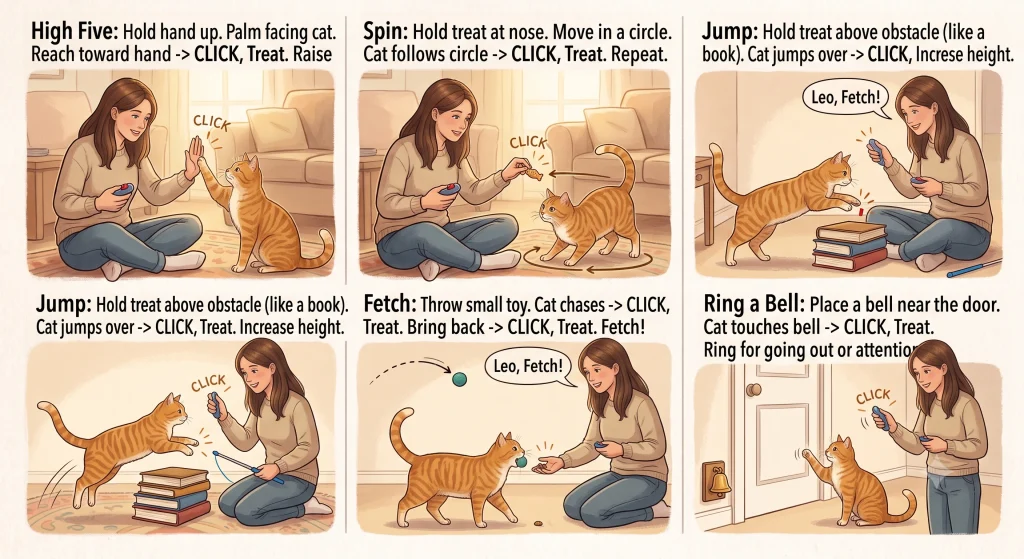
High five builds on touch. Hold your hand up. Palm facing your cat. When they reach toward your hand. Click. Treat. Gradually raise your hand. So they have to lift their paw. Eventually. They will lift their paw to touch your hand. That is a high five.
Spin
To teach spin. Hold a treat at your cat’s nose. Slowly move it in a circle. Your cat will follow. When they complete the circle. Click. Treat. Start with small circles. Then make them bigger. Cats catch on fast. Because they love following food.
Jump
Jump is fun. Hold a treat above a small obstacle. Like a book. When your cat jumps over it. Click. Treat. Gradually increase the height. Cats are natural jumpers. They enjoy this. It is physical. And mental stimulation.
Fetch
Yes. Cats can fetch. Start by throwing a small toy. When your cat chases it. Click. Treat. Then encourage them to bring it back. When they do. Click. Treat. This takes longer. But some cats learn it naturally. Especially if they are playful.
Ring a Bell
Place a bell near the door. When your cat touches it. Click. Treat. Eventually. They will ring the bell when they want to go out. Or when they want attention. This is practical. And fun.
Advanced Clicker Training

Target Training
Target training teaches your cat to follow a target. Like a stick. Or your finger. This is the foundation for many advanced behaviors. Agility. Walking on a leash. Going to specific spots. Target training is versatile. And powerful.
Agility
Cat agility is a real thing. And clicker training makes it possible. Teach your cat to jump through hoops. Run through tunnels. Walk on balance beams. Weave through poles. Start small. Build gradually. Cats love agility. It challenges them physically. And mentally.
Toilet Training
Some people toilet train their cats. Using clicker training. This involves gradually moving the litter box to the toilet. Then using a special insert. Clicker training makes this process smoother. Because you can reward each small step. Our litter box guide covers alternatives to toilet training.
Carrier Training
Many cats hate carriers. Clicker training can fix this. Reward your cat for approaching the carrier. Then for entering. Then for staying. Gradually build duration. Your cat will learn that the carrier is a good place. Not a scary one. This makes vet visits. And travel. Much easier.
Clicker Training Tips

- Timing is everything. Click at the exact moment of correct behavior. Not after. Not before. The precision of the click is what makes it work.
- Always follow click with treat. The click is a promise. If you click without treating. The click loses meaning. Always deliver. No exceptions.
- Use high-value treats. Small pieces of chicken. Tuna. Or commercial training treats. The better the treat. The harder your cat will work.
- Train before meals. A slightly hungry cat is a motivated cat. Train when your cat is hungry. Not after a big meal.
- End on a success. Always end training sessions with a successful behavior. This leaves your cat feeling good. And wanting more.
- Do not punish. Clicker training is positive. Never punish during training. It destroys trust. And makes your cat afraid of training.
- Be consistent. Use the same commands. Same signals. Same rewards. Consistency helps cats learn faster.
- One behavior at a time. Do not teach multiple behaviors simultaneously. Focus on one. Master it. Then move to the next.
- Keep it fun. Training should be enjoyable. For both of you. If it feels like work. Take a break. Come back later.
- Read your cat. If your cat seems bored. Or frustrated. Stop. Try again later. Cats tell you when they have had enough.
Expert Tips From My Practice
The most important thing I tell cat owners about clicker training is this. Patience is everything. Cats are not dogs. They do not work to please you. They work for themselves. The clicker makes training work because it benefits the cat. Not you. Understand that. And your training will succeed.
- Start when young. Kittens learn faster. But adult cats can learn too. Age is not a barrier. Consistency is.
- Use a training space. Pick a quiet room. Free from distractions. Where you and your cat can focus. No other pets. No loud noises.
- Track progress. Keep notes. What behaviors you are working on. How many sessions. What is working. What is not. This helps you adjust.
- Celebrate small wins. Every successful click is progress. Even small steps forward are wins. Celebrate them.
- Share the joy. Show others what your cat can do. Post videos. Share with friends. This motivates you. And shows that cats can be trained. Resources like our complete cat care books provide advanced training techniques and behavior modification strategies.
FAQ
Can all cats be clicker trained?
Most cats can be clicker trained. But some are more food-motivated than others. Which makes training easier. Shy cats. Rescue cats. And senior cats can all learn. It may take longer. But patience and consistency work.
How long does clicker training take?
Basic behaviors like sit and touch usually take three to five sessions. Intermediate behaviors like high five and spin take five to ten sessions. Advanced behaviors like agility can take weeks. Every cat is different. Be patient.
What treats are best for clicker training?
Small. Soft. High-value treats work best. Pieces of cooked chicken. Tuna. Commercial training treats. Or small bits of cheese. The treat should be something your cat loves. But does not get regularly. This makes it special.
How often should I clicker train my cat?
Two to three short sessions per day is ideal. Five minutes maximum per session. Short. Frequent sessions work better than long. Infrequent ones. Always end on a success.
Do cats get tired of clicker training?
Yes. Cats have short attention spans. They get bored or tired. Watch for signs. Yawning. Looking away. Walking off. These mean your cat has had enough. Stop the session. Try again later.
Can clicker training stop bad behavior?
Yes. Clicker training can redirect unwanted behaviors. Instead of punishing bad behavior. Reward good behavior. The cat learns that good behavior gets rewards. Bad behavior gets nothing. Over time. Good behavior replaces bad.
Is clicker training safe for cats?
Yes. Clicker training is completely safe. It uses positive reinforcement only. No punishment. No fear. No force. It is endorsed by veterinary behaviorists. As one of the safest training methods available.
My cat is afraid of the clicker. What do I do?
Some cats are startled by the click sound. Try a softer clicker. Or muffle the sound with tape. You can also use a verbal marker like yes instead. The important thing is a consistent. Distinct sound that marks correct behavior.
Can I clicker train multiple cats at once?
It is better to train cats individually. Training multiple cats at once causes confusion. Each cat needs to learn the click-treat association separately. Once they are trained. You can do group sessions.
What age can I start clicker training?
You can start clicker training kittens as young as eight weeks old. Their young brains learn fast. But adult cats can learn too. Age is not a barrier. Motivation is what matters.
Does clicker training work for shy cats?
Yes. Clicker training is excellent for shy cats. It builds confidence. Because the cat is in control. They choose to participate. No force. No pressure. Many shy cats blossom with clicker training.
How do I know if my cat is learning?
You will see progress. Even small steps. Your cat will start offering the behavior more often. They will look at you expectantly after clicking. They will engage with training eagerly. These are signs of learning.