

Cat heart disease is common, but it is often hard to spot. Many cats with heart disease look completely normal for a long time, and the first sign may be fast breathing at rest, sudden breathing difficulty, or a blood clot that causes sudden hind-leg paralysis. Hypertrophic cardiomyopathy (HCM) is by far the most common type.
This guide explains the main types of heart disease in cats, the signs to watch for, how vets diagnose and treat it, how to monitor a cat with heart disease at home, the emergency signs that need immediate care, and what affects life expectancy.
Table of Contents
Types of Heart Disease in Cats
Most heart disease in adult cats is cardiomyopathy, a disease of the heart muscle. Congenital heart defects present from birth are less common. Veterinary cardiologists classify feline cardiomyopathies by how the heart looks and works, as set out in the 2020 ACVIM consensus guidelines on cardiomyopathies in cats.
- Hypertrophic cardiomyopathy (HCM) is the most common heart disease in cats, according to the Cornell Feline Health Center. The wall of the left ventricle becomes abnormally thick and stiff, so the heart cannot relax and fill properly. Over time the left atrium may enlarge, which raises the risk of heart failure and blood clots. HCM has a genetic basis in some breeds, including Maine Coons, Ragdolls, British Shorthairs, Persians and Sphynx cats. The UC Davis Veterinary Genetics Laboratory offers tests for specific mutations, such as A31P in Maine Coons and R820W in Ragdolls, but a negative result does not rule out HCM, and many affected cats are mixed-breed.
- Restrictive cardiomyopathy (RCM) involves stiffening and scarring of the heart muscle or its inner lining, which restricts filling of the heart.
- Dilated cardiomyopathy (DCM) causes a thin, weak heart muscle that pumps poorly. It used to be common in cats because of taurine deficiency, but the Merck Veterinary Manual notes that it became much less common after taurine was added to commercial cat foods following its discovery in 1987.
- Other forms, including arrhythmogenic right ventricular cardiomyopathy and cardiomyopathies that do not fit neatly into one category.
Some conditions outside the heart can also thicken the heart muscle, especially hyperthyroidism and high blood pressure. High blood pressure in cats is most often linked to kidney disease or hyperthyroidism. Treating these conditions can improve the heart changes, so vets usually check for them.
Signs of Heart Disease in Cats
Many cats with heart disease show no signs for months or years. When signs do appear, they may include:
- Fast or labored breathing at rest. This is often the most important early sign of heart failure. VCA Animal Hospitals notes that a sleeping or resting breathing rate that is consistently above 30 breaths per minute is worth a vet check.
- Open-mouth breathing or breathing with obvious effort. This is an emergency.
- Reduced appetite, lethargy or hiding.
- Weight loss in some cats.
- Sudden hind-leg weakness or paralysis, often with pain, crying and cold paws, caused by a blood clot (aortic thromboembolism).
- Fainting or collapse, which is less common.
Unlike dogs, cats with heart failure rarely cough, and coughing in cats is more often caused by airway disease. Your vet may first suspect heart disease after hearing a heart murmur, a gallop sound or an irregular rhythm during a routine check, even if your cat seems well.
Diagnostic Tests for Heart Disease
- Echocardiography (heart ultrasound) is the most important test. It shows the thickness of the heart walls, the size of the chambers and how well the heart is working, and helps judge the risk of complications.
- Chest X-rays show heart size and whether there is fluid in or around the lungs, which indicates heart failure.
- NT-proBNP blood test. This cardiac biomarker can help show whether the heart is under strain. The EveryCat Health Foundation reports that it is helpful in distinguishing heart-related from non-heart-related causes of breathing difficulty.
- Electrocardiogram (ECG) to assess abnormal heart rhythms.
- Blood pressure and blood tests, including thyroid and kidney values, to look for underlying causes.
Treatment Options for Heart Disease
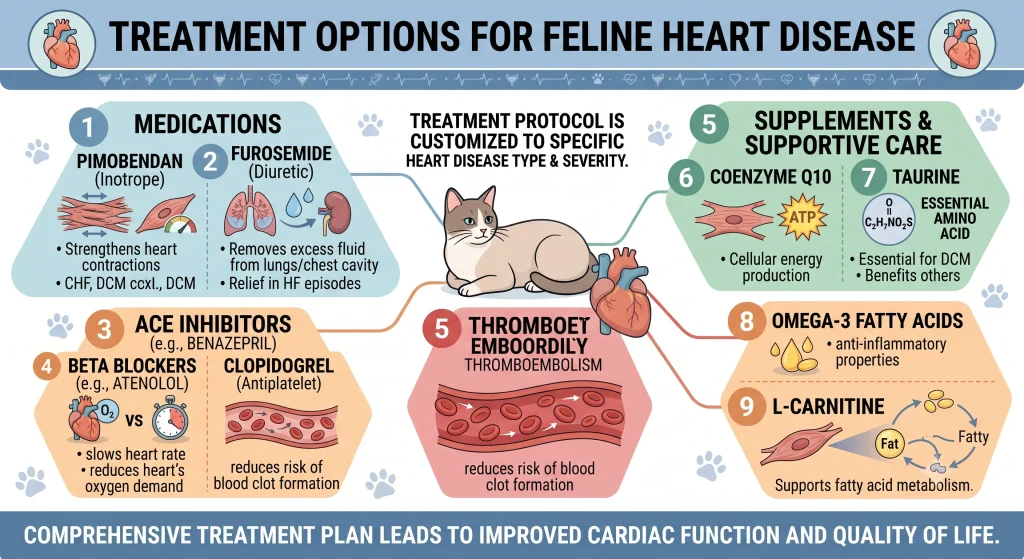
There is no cure for cardiomyopathy in cats, but treatment can manage heart failure, reduce the risk of blood clots and improve quality of life. The right plan depends on the type and stage of disease, so treatment is always tailored by your vet. This article does not give doses.
Medications
- Furosemide, a diuretic, is the main treatment for congestive heart failure. It removes excess fluid from the lungs and helps breathing.
- Clopidogrel reduces the risk of blood clots. In the FAT CAT trial, clopidogrel was more effective than aspirin at preventing recurrence of clots in cats that had survived an arterial thromboembolism (Hogan et al., Journal of Veterinary Cardiology). Vets often recommend it for cats at higher risk, such as those with an enlarged left atrium.
- Pimobendan strengthens heart contractions. It is used off-label in some cats with heart failure, as described by VCA Animal Hospitals, but it is not suitable for every cat with HCM, for example some cats with an obstruction to blood flow out of the heart.
- ACE inhibitors such as benazepril are sometimes added for cats with heart failure, although evidence of their benefit in cats is limited.
- Atenolol, a beta-blocker, may be used to slow the heart rate or reduce outflow obstruction in some cats with HCM. Studies have not shown that it prolongs life in cats without symptoms.
Give all medications exactly as prescribed and do not stop or change them without talking to your vet.
Supplements and Supportive Care
Taurine supplementation is important for cats with DCM caused by taurine deficiency. For other supplements often marketed for heart health, such as coenzyme Q10, L-carnitine and omega-3 fatty acids, there is little evidence of benefit in cats with cardiomyopathy. Ask your vet before giving any supplement, as some can interact with medications. Cats in heart failure may also benefit from a diet with moderate sodium, chosen with your vet, and from keeping a healthy weight and good appetite.
Emergency Signs Requiring Immediate Veterinary Care
📚 Recommended Cat Guides
🐱 The Trainable Cat Book
Learn proven methods to train your cat and stop unwanted behaviors.
View Book →❤️ Complete Cat Care Manual
Your complete guide to cat nutrition, health, grooming, behavior, and daily care.
Get the Manual →Go to a vet or emergency clinic immediately if your cat has:
- Open-mouth breathing or obvious effort to breathe
- A resting breathing rate that is much higher than usual, especially with restlessness or distress
- Pale, grey or blue gums
- Sudden weakness, paralysis or pain in one or both back legs, often with cold paws
- Collapse or fainting
Keep your cat calm and transport them in a carrier. Do not wait to see whether the signs improve.
Managing Heart Disease at Home
The most useful thing you can do at home is to monitor your cat’s sleeping breathing rate:
- Wait until your cat is sound asleep or resting quietly, not purring or dreaming.
- Count each rise and fall of the chest as one breath for 30 seconds, then multiply by two.
- Record the number regularly, as often as your vet recommends.
A rate that rises above your cat’s normal, or above about 30 breaths per minute, should be reported to your vet promptly, because it can be an early sign of fluid build-up before obvious distress develops.
Other helpful steps include giving medications consistently, keeping your cat’s environment calm and predictable, letting your cat choose their own activity level rather than forcing exercise, and keeping up with recheck visits. Many cats with heart disease are rechecked every few months, depending on how stable they are.
Life Expectancy With Heart Disease
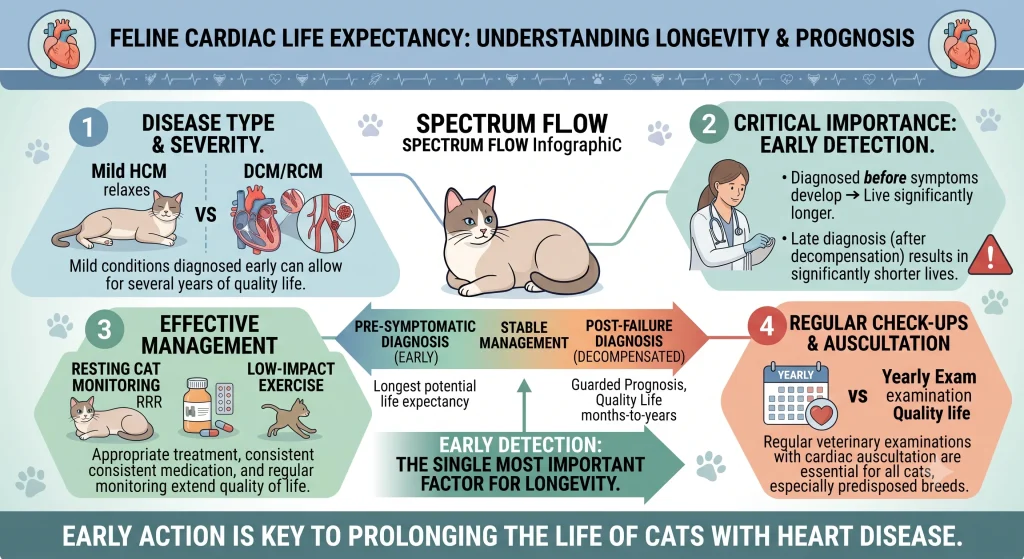
Life expectancy varies widely. Some cats with mild HCM and no enlargement of the left atrium live for many years and may never develop heart failure. Cats that have already developed heart failure or a blood clot generally have a more guarded outlook, although some live comfortably for months or longer with treatment. Factors that affect prognosis include how enlarged the heart is, whether heart failure or clots have occurred, response to treatment, and other illnesses such as kidney disease.
Regular check-ups give your vet the chance to hear a murmur or abnormal rhythm before signs appear. If your cat belongs to a predisposed breed, or your vet hears an abnormality, ask whether screening with an echocardiogram is appropriate.
Key Takeaways
- HCM is the most common heart disease in cats. Many affected cats look healthy until complications develop.
- Count sleeping breaths. A sleeping breathing rate consistently above about 30 per minute needs a vet check.
- Breathing difficulty and sudden back-leg paralysis are emergencies. Go to a vet immediately.
- Echocardiography is the key diagnostic test. Blood tests and X-rays add information.
- Treatment is tailored to each cat. Medications can manage heart failure and lower clot risk, but there is no cure.
- Check for underlying causes. Hyperthyroidism and high blood pressure can affect the heart and are treatable.
FAQ
What is the most common heart disease in cats?
Hypertrophic cardiomyopathy (HCM), in which the heart muscle becomes abnormally thick and stiff.
How do I know if my cat has heart disease?
Often you cannot tell at home in the early stages. Your vet may hear a murmur, gallop or irregular rhythm, and an echocardiogram confirms the diagnosis. Signs that need prompt attention include fast breathing at rest, breathing difficulty, lethargy, poor appetite and sudden back-leg weakness.
Can heart disease be cured in cats?
Cardiomyopathy cannot be cured, but it can often be managed. Heart changes caused by hyperthyroidism or high blood pressure may improve when the underlying condition is treated, and taurine-deficiency DCM can improve with taurine.
What breeds are prone to heart disease?
Maine Coons, Ragdolls, British Shorthairs, Persians and Sphynx cats are among the breeds predisposed to HCM. Any cat can develop it, including mixed-breed cats.
What is a heart murmur in cats?
A murmur is an extra sound caused by turbulent blood flow. Some murmurs are caused by heart disease, while others are “innocent” or caused by things like stress, anemia or hyperthyroidism. Your vet may recommend further tests to find out which.
What is aortic thromboembolism?
It happens when a blood clot forms in the heart, usually in an enlarged left atrium, and travels to block an artery, most often where the aorta divides to supply the back legs. It causes sudden pain and paralysis and is an emergency.
Should I restrict my cat’s activity with heart disease?
Most cats self-regulate their activity. Let your cat play and move as they choose, avoid forcing exercise, and minimize stressful situations.
This article is for general information and is not a substitute for advice from your veterinarian. If your cat is breathing fast or with effort, or suddenly cannot use its back legs, seek emergency veterinary care.
Sources & References
- Luis Fuentes V, et al. (2020) — ACVIM consensus statement guidelines for the classification, diagnosis, and management of cardiomyopathies in cats, Journal of Veterinary Internal Medicine
- Cornell Feline Health Center — Hypertrophic Cardiomyopathy
- Merck Veterinary Manual — Dilated Cardiomyopathy in Dogs and Cats
- UC Davis Veterinary Genetics Laboratory — Hypertrophic Cardiomyopathy (HCM) in Maine Coons
- EveryCat Health Foundation — Utility of Cardiac Biomarkers in Cats
- Hogan DF, et al. — FAT CAT: Clopidogrel vs. Aspirin Trial for Feline Arterial Thromboembolism, Journal of Veterinary Cardiology
- VCA Animal Hospitals — Home Breathing Rate Evaluation
- VCA Animal Hospitals — Pimobendan
[…] Weight gain leads to obesity, which causes diabetes, joint problems, heart disease, and liver disease. Learn more about the signs and management of heart-related illness in our Cat Heart Disease Complete Guide. […]