

Table of Contents
How to Tell If Your Cat Is Bored: 15 Signs & Easy Solutions
The clearest signs your cat is bored are excessive sleeping, destructive scratching, sudden attention-seeking, and fascination with random objects instead of toys — here’s how to recognize each one and what to do about it.
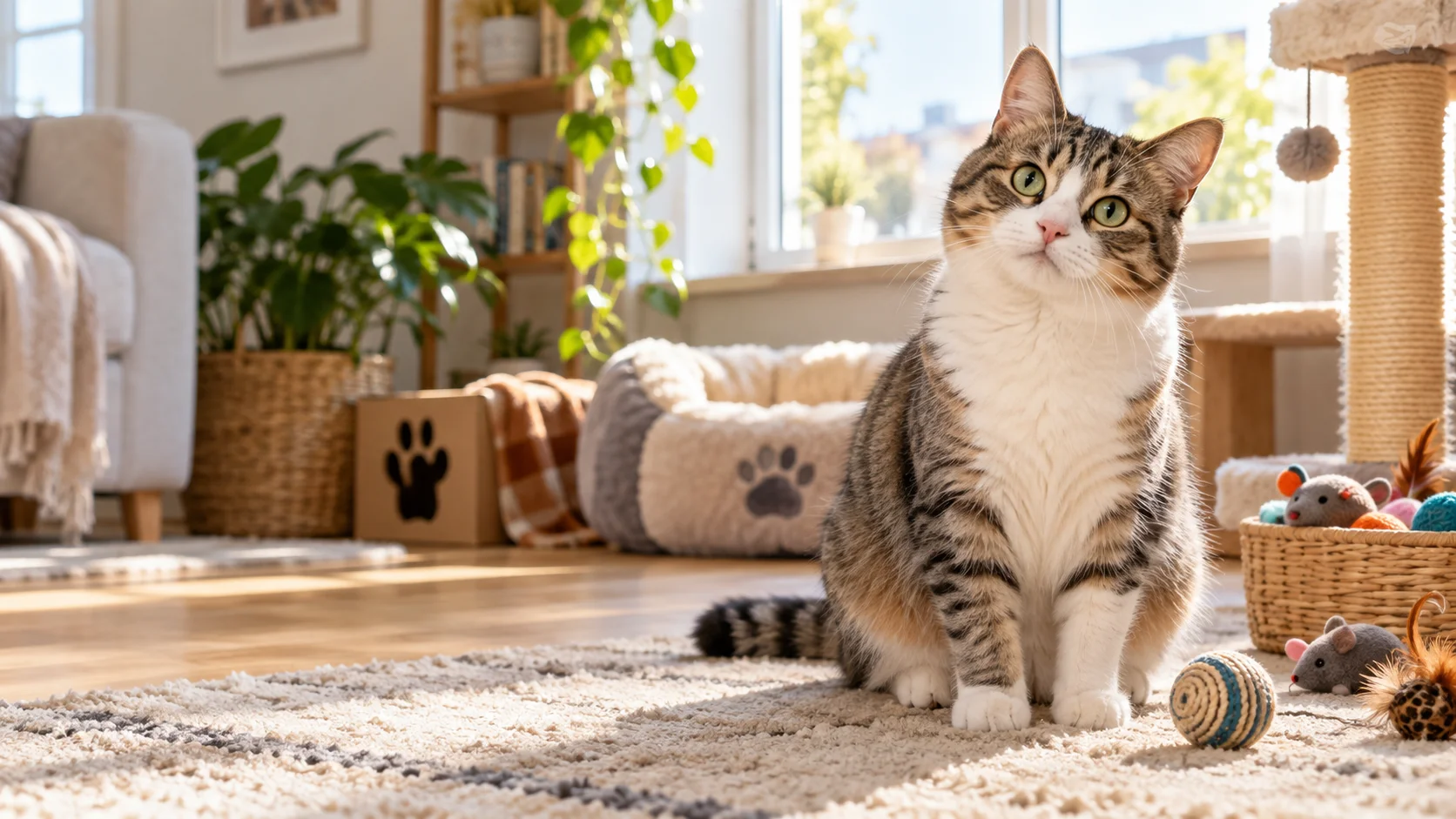
Have you ever looked at your cat sleeping on the same sofa for hours and wondered, how to tell if your cat is bored?
It is a question many cat owners eventually ask, especially when their cat spends most of its life indoors.
At first, it can be difficult to know what is normal. Cats sleep a lot. They can spend long periods grooming themselves, watching a window, or simply sitting in the same place. Sometimes they seem completely fascinated by absolutely nothing.
But cats are also curious animals. They like to investigate, climb, scratch, stalk, chase, hide, and watch what is happening around them. If they do not have enough opportunities to do these things, they may start looking for their own entertainment.
That does not mean you need to entertain your cat every minute of the day. You also do not need to fill your home with expensive toys.
What matters is giving your cat a safe environment with enough variety and opportunities to behave like a cat.
So, how to tell if your cat is bored really comes down to watching your cat’s normal behavior and noticing meaningful changes.
Can Cats Actually Get Bored?
We cannot ask a cat whether it feels bored, so there is no simple test that can give us a definite answer.
Instead, cat behavior experts look at what opportunities an animal has to exercise natural behaviors such as hunting, playing, exploring, climbing, scratching, hiding, and interacting with its environment.
Indoor cats can benefit from physical exercise, mental stimulation, social interaction, safe resting places, and opportunities to investigate their surroundings. VCA Animal Hospitals explains that indoor enrichment should give cats opportunities to express natural behaviors, while also recognizing that every cat has individual preferences.
That last point is important.
Your cat does not have to enjoy the same things as another cat. One cat might spend twenty minutes chasing a toy around the living room. Another may prefer sitting quietly beside a window and watching birds.
The goal is not to make your cat constantly active. The goal is to give your cat choices.
How to Tell If Your Cat Is Bored: 15 Signs to Watch For
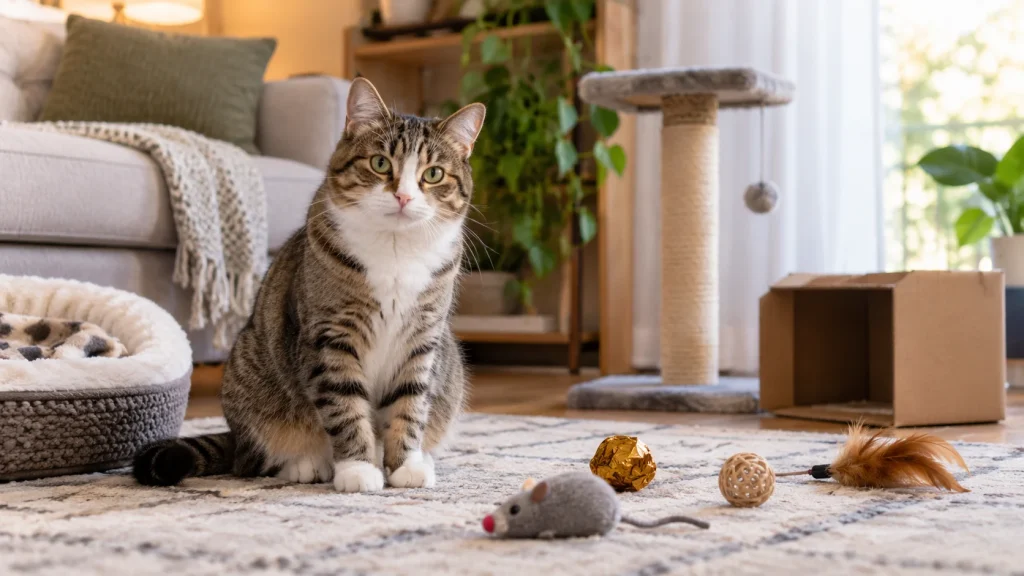
If you are trying to figure out how to tell if your cat is bored, start by looking for changes in behavior rather than focusing on one isolated habit.
1. Your Cat Sleeps More Than Usual
Cats sleep a lot. That is normal.
So if your cat spends much of the day sleeping, that does not automatically mean something is wrong.
The important thing is whether your cat’s behavior has changed.
If your cat used to play, explore the house, watch the window, or follow you from room to room but suddenly seems uninterested in almost everything, pay attention.
A sudden decrease in activity can have many possible causes, including illness or discomfort. It should not automatically be blamed on boredom.
If the change is sudden, significant, or accompanied by other symptoms, contact your veterinarian.
2. Your Cat Keeps Attacking Your Feet
You walk through the living room and suddenly your cat jumps out from behind the sofa and grabs your ankle.
It can be funny the first few times.
Your cat may simply be looking for something to chase.
Moving feet are particularly interesting because they resemble the kind of quick movement that naturally attracts a hunting cat.
The problem is that if you encourage this game, your cat may learn that human hands and feet are acceptable toys.
It is better to redirect that energy toward an appropriate toy.
If biting has already become a problem, our guide on how to stop a cat from biting explains some of the common reasons behind cat biting and ways to redirect the behavior.
3. Your Cat Scratches the Furniture Constantly
Scratching can be frustrating when the target is your sofa, but scratching itself is normal cat behavior.
Cats scratch to stretch their bodies, condition their claws, mark territory, and interact with their surroundings.
Instead of trying to eliminate scratching, give your cat an appropriate place to do it.
Some cats prefer tall vertical scratching posts. Others prefer flat cardboard scratchers.
Placement matters too. A scratching post hidden in a corner may be ignored, while one placed near a favorite sleeping area or an existing scratching location may be much more appealing.
Cornell University College of Veterinary Medicine discusses the importance of providing appropriate outlets for normal scratching behavior and matching the scratching surface to the individual cat’s preferences.
4. Your Cat Knocks Things Off Tables
Not every object pushed off a table is evidence of boredom.
Sometimes your cat simply discovers that touching an object makes it move, fall, or make an interesting sound.
And apparently, that can be entertainment enough.
If your cat repeatedly knocks objects down, look at what makes the activity interesting. Is it the movement? The sound? Your reaction?
Once you understand what your cat is getting from the activity, you can provide safer alternatives.
5. Your Cat Suddenly Wants Your Attention All the Time
Some cats are naturally affectionate and follow their owners from room to room.
That is completely normal.
But if your normally independent cat suddenly starts meowing, pawing at you, following you everywhere, or demanding attention throughout the day, think about what has changed.
Perhaps the daily routine has become less active. Maybe a favorite toy disappeared. Maybe another animal was introduced into the home.
Or perhaps something else is going on.
A behavioral change should always be considered in context rather than automatically being labeled as boredom.
6. Your Cat Seems Constantly Interested in Food
Food can be more than a meal for some cats. It can also become an opportunity to search, investigate, and work for something.
This is where food puzzles and simple food-search activities can be useful.
Instead of putting every meal into a bowl, you can sometimes use a portion of your cat’s normal daily food allowance in an appropriate puzzle feeder.
VCA Animal Hospitals notes that puzzle toys and hiding portions of a cat’s daily food can provide mental stimulation and an outlet for natural hunting behavior.
There is one important detail: food used for enrichment still counts as food.
If you are unsure about the appropriate amount to feed your cat, read our guide on how much you should feed your cat before adding extra treats or food-based activities.
7. Your Cat Plays With Things That Are Not Toys
A curious cat may decide that almost anything is interesting.
A piece of string.
A rubber band.
A plastic wrapper.
A cable.
A tiny object underneath the sofa.
This is where curiosity can become dangerous.
Some objects can be swallowed and cause serious problems. Electrical cords can also create obvious risks.
When choosing toys, think about what happens if your cat bites, claws, pulls, or carries the object around.
Cornell’s feline health experts recommend avoiding toys with small pieces or loose strand-like parts that can separate and be swallowed. They also point out that safe toys do not have to be expensive.
8. Your Cat Loses Interest in Toys Very Quickly
You buy a new toy.
Your cat investigates it for thirty seconds.
Then the toy becomes part of the furniture.
Many cat owners know this experience.
The solution is not necessarily to keep buying more toys.
Try rotating them instead.
Keep some toys out of sight for a while, then bring them back later. A toy your cat ignored last week may suddenly become interesting again.
Cornell specifically recommends rotating toys as one way to help keep them interesting.
9. Your Cat Spends Hours Watching the Window
This does not necessarily mean your cat wants to escape.
Outside the window there are birds, insects, people, trees, moving cars, changing light, and unfamiliar sounds.
For an indoor cat, a secure window perch can turn all of that into free entertainment.
The ASPCA also includes window observation as one possible form of feline environmental enrichment.
Just make sure the window is secure and your cat cannot accidentally escape.
10. Your Cat Hides More Than It Used To
Hiding is normal cat behavior.
In fact, every cat should have access to a quiet and safe place where it can retreat when it wants some peace.
A cardboard box, covered bed, cat carrier, or quiet corner can become a favorite resting area.
The concern is a sudden change.
If your cat suddenly starts hiding much more than before, especially alongside changes in appetite, grooming, litter-box habits, movement, or social behavior, do not assume that boredom is the explanation.
A significant behavioral change can sometimes be associated with stress, discomfort, or illness and may need veterinary attention.
11. Your Cat Chases Shadows, Reflections, or Moving Lights
Cats naturally pay attention to movement.
That is one reason chase games can be so effective.
An interactive toy can give your cat an appropriate way to stalk, chase, pounce, and catch something.
Try to let your cat actually catch the toy occasionally.
A game that never provides a satisfying end may become frustrating instead of rewarding.
12. Your Cat Becomes Extremely Active at Night
Many cats become active during the evening and early morning.
So-called “midnight zoomies” are hardly unusual.
However, if your cat sleeps almost all day and then turns your home into a racetrack at two in the morning, you may want to add more activity during the day.
Several short play sessions can be easier to maintain than one long session.
VCA recommends incorporating regular play into an indoor cat’s routine and suggests using several short play sessions during the day.
13. Your Cat Is Fascinated by Every New Object
You bring home a package and your cat immediately climbs into the box.
You move a chair and your cat investigates the space underneath.
You put a paper bag on the floor and suddenly that is the most interesting thing in the house.
This is normal feline curiosity.
You can use that curiosity safely by providing clean cardboard boxes, appropriate hiding places, and new but safe objects to investigate.
The ASPCA’s feline enrichment resources include simple household-based activities designed to give cats opportunities for exploration and problem solving.
14. Your Cat Seems to Need Constant Entertainment
Some cats genuinely enjoy human interaction.
There is nothing wrong with that.
But if your cat has nothing interesting available when you are busy, it may repeatedly seek your attention simply because you are the most interesting thing in the room.
Try giving your cat more choices throughout the day: a window perch, scratching surface, elevated resting area, hiding place, puzzle feeder, and a few rotating toys.
You may find that your cat becomes more independent simply because there are more things worth investigating.
15. Your Cat Develops a New Behavior
This is the sign that deserves the most caution.
If your cat suddenly becomes aggressive, stops using the litter box, stops grooming, eats differently, hides constantly, stops playing, or seems uncomfortable, do not assume that the solution is another toy.
Behavior can change because of stress, environmental changes, pain, illness, or other causes.
If the behavior is sudden, persistent, or accompanied by physical symptoms, contact your veterinarian.
How to Tell If Your Cat Is Bored by Looking at Its Daily Routine
Sometimes the easiest way to understand your cat is to look at an ordinary day.
What does your cat do after breakfast?
Does it explore the house? Watch the window? Play? Climb? Scratch? Interact with you?
Or does it eat and immediately return to the same sleeping spot for most of the day?
There is no perfect schedule for every cat, but variety is useful.
If every day looks exactly the same and your cat has very few opportunities to explore or play, adding a few small changes may be worthwhile.
How to Keep an Indoor Cat Entertained
1. Have Short Interactive Play Sessions
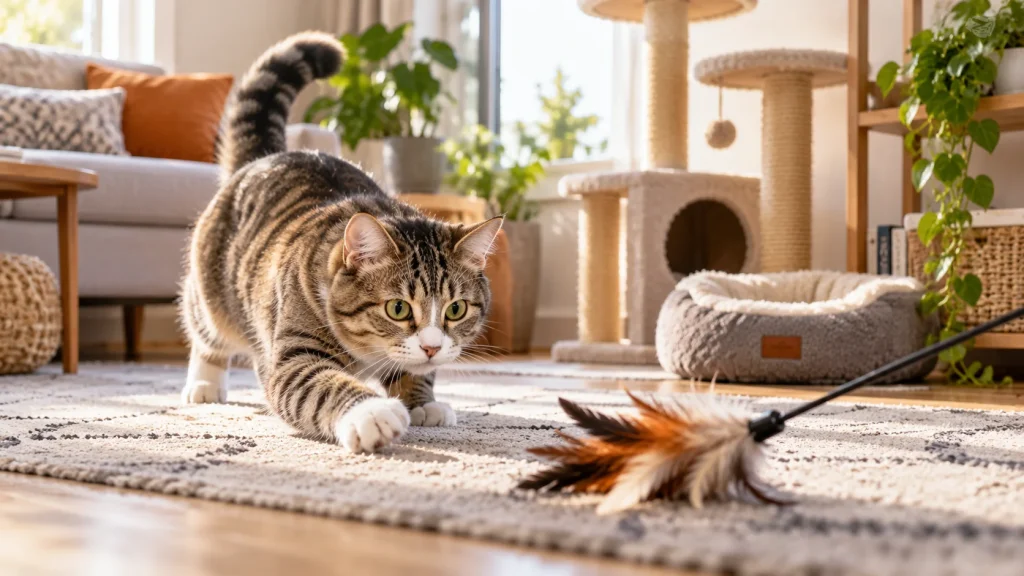
One of the easiest ways to enrich your cat’s day is simply to play with it.
Use an appropriate interactive toy and imitate the movement of prey. Let the toy disappear behind furniture, move slowly across the floor, change direction, and occasionally stop.
Do not make every game about speed.
For many cats, the stalking part is just as interesting as the chase.
Keep your hands and feet out of the game.
2. Give Your Cat Somewhere High to Sit
Many cats love elevated places.
A high resting position gives them a different view of the room and allows them to observe what is happening without being in the middle of everything.
A stable cat tree, secure shelf, or window perch can provide this opportunity.
VCA notes that elevated resting areas and cat trees can provide opportunities for climbing, hiding, resting, and play, particularly for indoor cats.
3. Create a Simple Cat Hideout
You do not need to buy an expensive cat house.
A clean cardboard box can work surprisingly well.
Put it somewhere quiet and see what happens.
Your cat may completely ignore it.
Or it may become the favorite place in the house.
That is part of the fun of living with cats.
4. Make Mealtime More Interesting
For cats that enjoy food-based activities, part of the daily meal can sometimes be offered through an appropriate puzzle feeder.
This gives the cat an opportunity to investigate and work for food rather than simply eating everything immediately from a bowl.
Make sure the activity is safe and that your cat still consumes enough of its daily food.
5. Rotate the Toys
You do not need a basket overflowing with toys.
A small selection with different textures and movement patterns may be enough.
Keep some toys away for several days and then bring them back.
This simple habit can make old toys feel new again.
6. Create a Window-Watching Area
A comfortable location near a secure window can provide passive entertainment throughout the day.
Birds, insects, people, trees, and changing weather give your cat something to observe.
If your cat enjoys watching the outside world, this may become one of the easiest forms of enrichment in your home.
Simple Cat Enrichment Ideas You Can Try Today
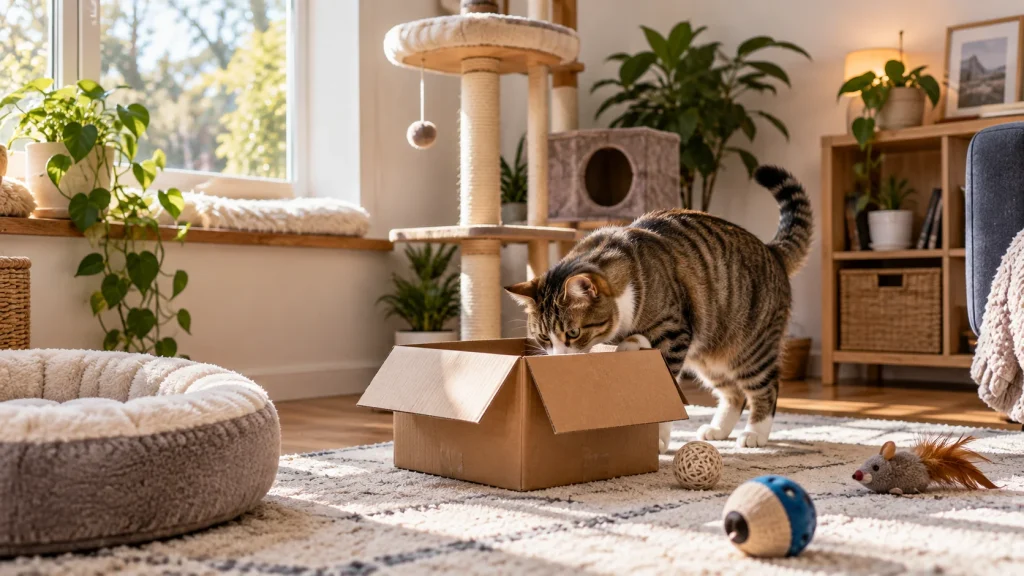
You can start without buying anything.
- Put a clean cardboard box in a safe area.
- Create a comfortable place near a secure window.
- Move a scratching post closer to where your cat already scratches.
- Rotate toys rather than leaving everything available all day.
- Use part of your cat’s normal food allowance in an appropriate puzzle feeder.
- Spend several minutes playing with your cat.
- Provide a stable elevated resting area.
- Give your cat more than one comfortable place to sleep.
- Provide a quiet hiding place.
- Change the location of safe toys occasionally.
The ASPCA’s feline DIY enrichment guide includes ideas involving food enrichment, cardboard boxes, window observation, tunnels, and other simple activities. Always supervise homemade enrichment items and remove anything your cat tries to chew or swallow.
How Often Should You Play With Your Cat?
There is no magic number that applies to every cat.
A young cat with lots of energy may happily play several times a day. An older cat may prefer shorter and gentler sessions.
Instead of asking only how many minutes your cat needs, pay attention to how it responds.
Does your cat become interested when you bring out the toy?
Does it stalk and chase?
Does it relax afterward?
Those observations can tell you more than a stopwatch.
VCA recommends regular play for indoor cats and notes that several short play sessions can be incorporated into a cat’s daily routine.
Why You Should Never Use Your Hands as Cat Toys
It is especially tempting with kittens.
You wiggle your fingers under a blanket. The kitten pounces. Everyone laughs.
The kitten learns that attacking human hands is a fun game.
Months later, that kitten is an adult cat with stronger teeth and sharper claws.
That is why it is better to establish the right habit from the beginning.
Use toys instead of body parts.
If your cat already bites during play or handling, our guide on how to stop cat biting can help you understand the behavior and choose a more appropriate response.
What About Food Puzzles?
Food puzzles can be a useful addition to an indoor cat’s routine, especially for cats that enjoy working for food.
The basic idea is simple: instead of receiving every bite immediately from a bowl, the cat has to investigate or manipulate something to reach part of its meal.
This can turn an ordinary feeding moment into a small hunting-style activity.
However, a puzzle feeder should not reduce the amount of food your cat actually needs.
It is also important to avoid simply adding treats on top of the normal daily diet.
If you are changing your cat’s feeding routine, our guide on how much to feed a cat can help you understand the factors that affect appropriate portions.
Do Indoor Cats Need Vaccinations?
Keeping a cat indoors can reduce exposure to some outdoor hazards, but indoor living does not mean preventive healthcare should be ignored.
Vaccination recommendations depend on several factors, including age, health, lifestyle, local risks, and veterinary advice.
If you are building a complete care routine for your cat, environmental enrichment is only one part of responsible ownership.
Regular veterinary care and appropriate preventive healthcare matter too.
If you want to learn more about feline vaccination schedules, see our guide to the cat vaccination schedule.
Your veterinarian can advise you about which vaccines are appropriate for your individual cat.
When Boredom May Not Be the Problem
This is worth repeating because it is easy to miss.
Not every behavioral change means your cat needs more toys.
A cat that suddenly stops playing could be uncomfortable.
A cat that suddenly hides could be frightened or sick.
A cat that suddenly becomes aggressive could be reacting to pain, stress, fear, or another trigger.
A cat that stops using the litter box may have a medical or environmental problem that needs attention.
When a behavior changes suddenly, especially if the change is persistent or accompanied by physical symptoms, talk to your veterinarian.
The Cornell Feline Health Center’s feline health resources provide information on a wide range of feline health and behavior topics.
A Simple Daily Routine for an Indoor Cat
You do not need a strict timetable.
A simple rhythm is enough.
- Morning: Feed your cat and offer a short interactive activity.
- During the day: Make sure comfortable resting and observation areas are available.
- Afternoon: Offer another short play session if your cat is interested.
- Evening: Try a more active chase or hunting-style game.
- Before bed: Let your cat settle into a comfortable and quiet resting area.
Adjust the routine according to your cat’s age, personality, health, and energy level.
Do You Really Need Expensive Cat Toys?
Not at all.
Some commercial toys are excellent, but price does not automatically determine whether a cat will enjoy something.
Cornell’s feline health experts point out that simple items such as cardboard boxes and paper bags can be entertaining for cats, provided they are used safely.
Sometimes the most valuable thing you can give your cat is not another object.
It is your time.
A few minutes of focused play can be more meaningful than leaving a pile of toys on the floor and walking away.
What Does a Happy Indoor Cat Actually Need?
There is no perfect home setup that works for every cat.
But most cats benefit from having choices.
A place to rest.
A place to hide.
A place to scratch.
A place to climb or observe.
Opportunities to play.
An appropriate feeding routine.
And some interaction with the people they trust.
VCA’s guidance on indoor-cat enrichment emphasizes providing safe resting places, opportunities for play and hunting-style behavior, and an environment that takes the individual cat’s preferences into account.
So, How to Tell If Your Cat Is Bored?
The answer is not found in one particular behavior.
Learning how to tell if your cat is bored is really about getting to know your individual cat.
Watch what it does when the house is quiet.
Notice what happens when you introduce a new toy.
See whether it enjoys climbing, watching the window, searching for food, chasing a toy, or exploring a cardboard box.
Then make small changes and see what happens.
You do not have to transform your entire home overnight.
Final Thoughts
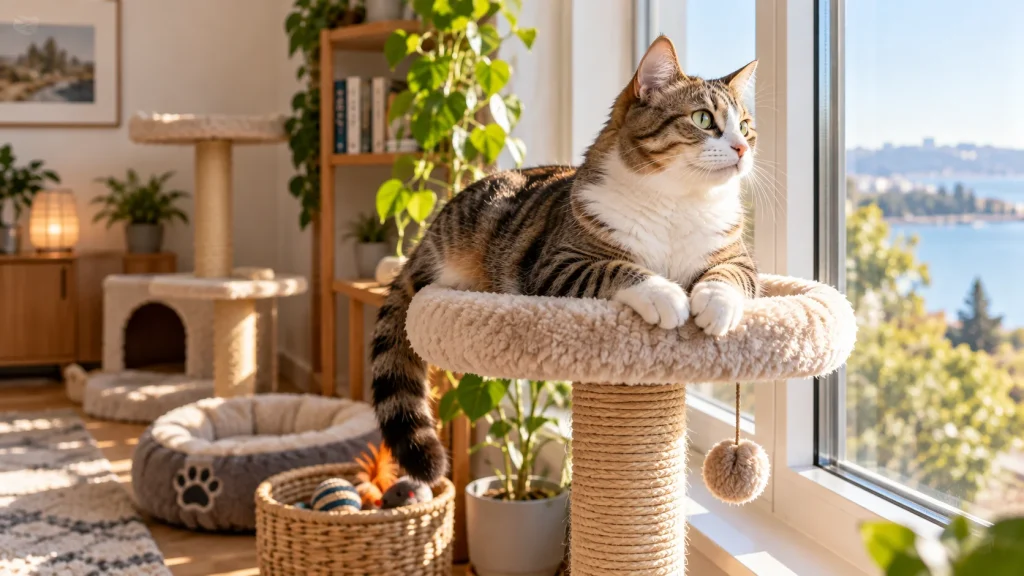
If you have been wondering how to tell if your cat is bored, start with something simple: observe.
Your cat will usually tell you what it likes if you pay attention.
Maybe it becomes excited when you pick up a wand toy. Maybe it spends twenty minutes watching birds through the window. Maybe it ignores every expensive toy you buy and immediately climbs into an empty cardboard box.
That is okay.
The best enrichment is not necessarily the most expensive one. It is the one that gives your cat a safe and interesting way to express its natural behavior.
Rotate toys. Offer safe places to climb and hide. Give your cat opportunities to explore. Use food puzzles when appropriate. Spend some focused time playing together.
And remember that a sudden or unusual behavioral change should not automatically be blamed on boredom. If something about your cat seems genuinely different, especially when physical symptoms are involved, speak with your veterinarian.
In the end, how to tell if your cat is bored is less about finding a perfect checklist and more about understanding the individual animal living in your home.
You may discover that your cat did not need more stuff at all.
It simply needed a few more interesting things to do.
Trusted Sources
- Cornell University College of Veterinary Medicine – Safe Toys and Gifts
- Cornell Feline Health Center – Feline Health Topics
- ASPCA – Feline DIY Enrichment
- ASPCA – Cat Care
- VCA Animal Hospitals – Enrichment for Indoor Cats
- VCA Animal Hospitals – Cat Play and Play Toys
This article is intended for general educational purposes and is not a substitute for professional veterinary diagnosis, treatment, or individualized veterinary advice.