
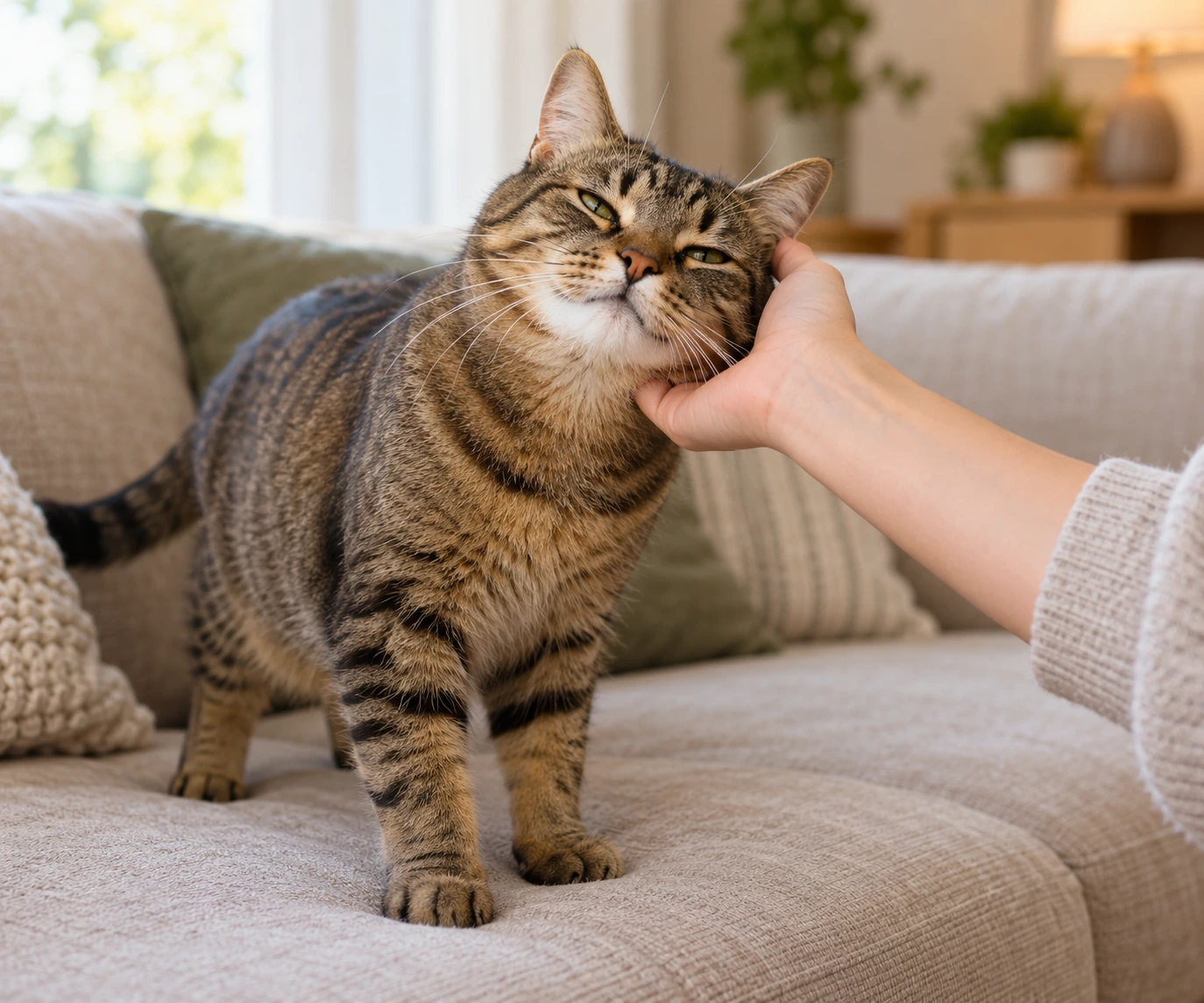

Most cats enjoy being touched, but not everywhere, not for as long as people tend to assume, and not on someone else’s schedule. Learning how to pet a cat well comes down to three things: where you touch, how long you keep going, and whether you notice when the cat has had enough.
This guide brings together what controlled studies have found about where cats like to be petted, what animal-welfare organisations recommend, and how to read the small signals cats give before a friendly session turns into a swat or a bite. It also covers the situations generic advice skips: shy and newly adopted cats, older cats who may be sore, children, picking cats up, and the point at which a change in how your cat reacts to touch is a reason to call the vet.
Table of Contents
The short answer
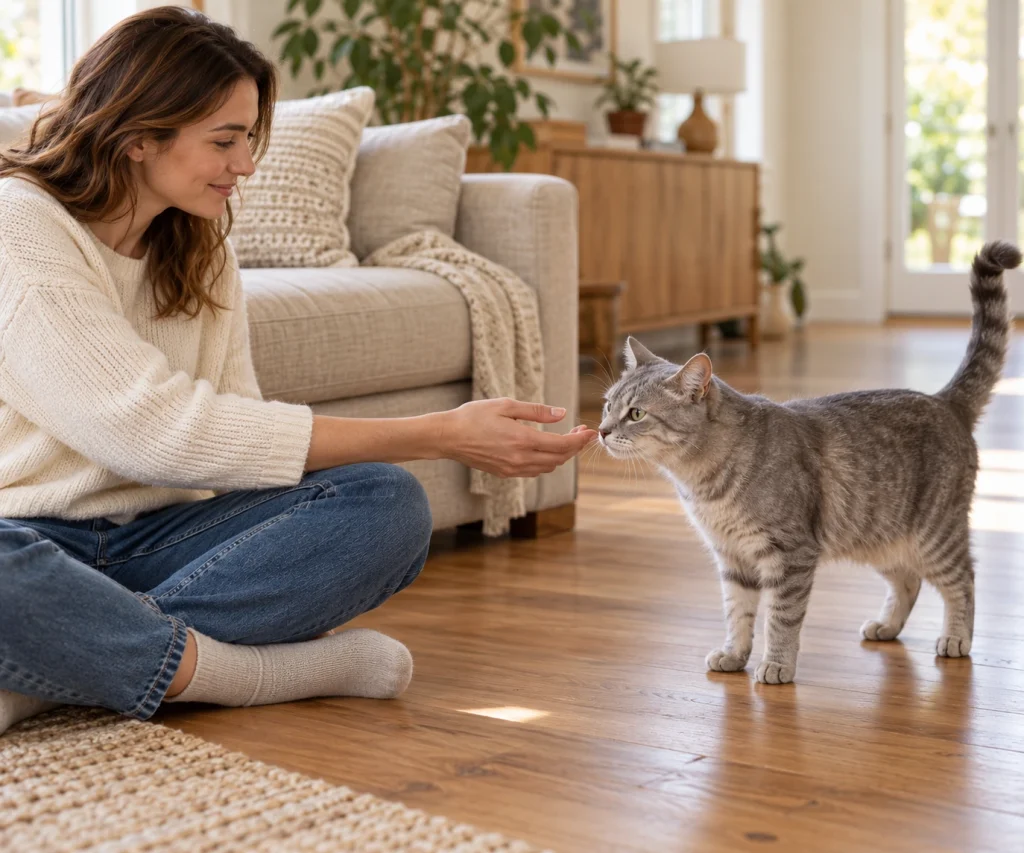
Let the cat come to you, offer a hand rather than reaching over its head, and stroke mainly around the cheeks, the base of the ears and under the chin. Keep strokes gentle and follow the direction of the fur. Pause every few seconds to see whether the cat leans back in for more. Avoid the belly and the base of the tail unless you know your individual cat genuinely likes it, and stop as soon as you see a twitching tail, flattening ears or rippling skin on the back.
That advice is not just folklore. It closely matches both the research on cats’ responses to being stroked and the practical “CAT” guidelines tested with shelter cats in London, which are described in the next section.
What research shows about where cats like to be petted
Questions about petting sound like matters of opinion, yet a small body of research has measured how cats respond to touch. The findings are reasonably consistent, although the studies have limits worth understanding.
The stroking study: head good, tail region bad
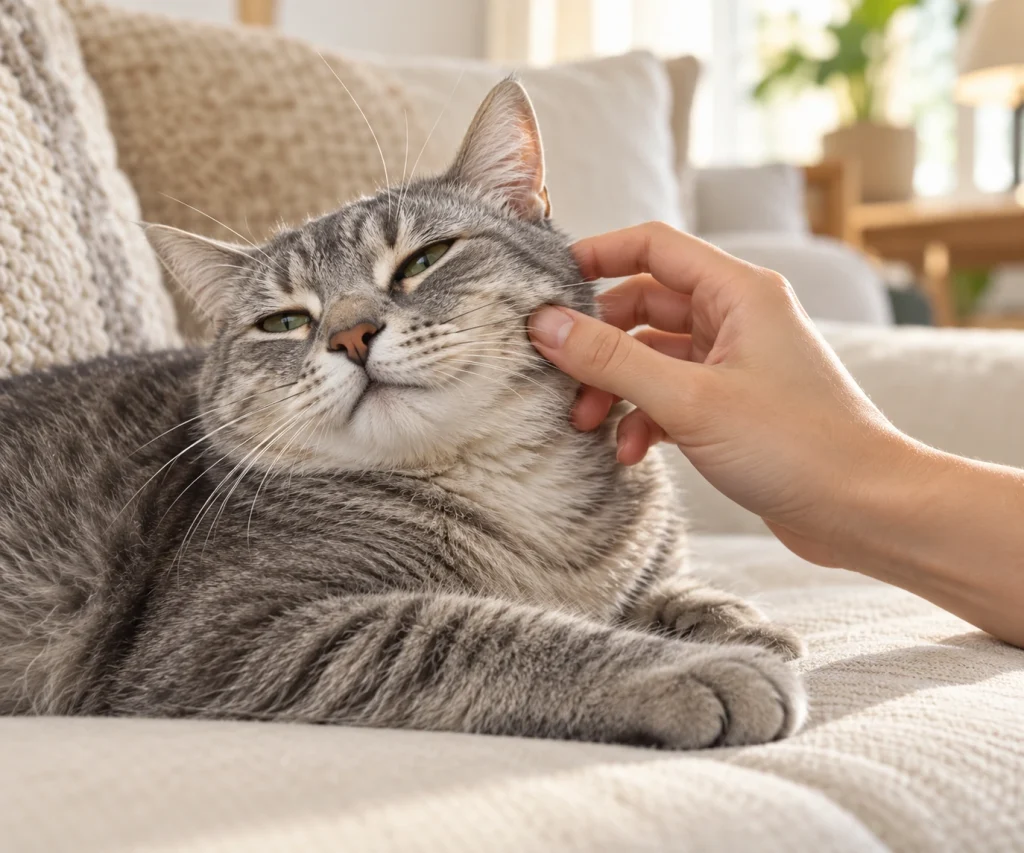
In a study published in Applied Animal Behaviour Science, Ellis and colleagues stroked pet cats in their own homes on different parts of the body and scored their positive and negative behavioural responses. The caudal region, meaning the area around the base of the tail, produced the most negative responses, and this held whether the person stroking was a stranger or the cat’s familiar handler. Stroking around the temporal region of the head, the area between the eye and the ear, was the most likely to produce positive responses. The order in which body areas were touched made no significant difference.
One result surprised the researchers: cats showed more negative responses when stroked by a familiar person than by an unfamiliar one. The authors were cautious about interpreting this, and the study design may have played a part. Still, it is a useful reminder that being “your” cat does not mean a cat will accept any kind of touch from you. Owners can become so used to handling their cat that they miss its signals.
The CAT study: what changed when people followed simple rules
A 2021 study in Frontiers in Veterinary Science (Haywood and colleagues) tested whether giving people short, practical guidance would change how cats responded to them. The research took place at Battersea Dogs and Cats Home in London and involved 100 cats and 120 members of the public. Each cat met different volunteers in short interactions, some before the volunteers had seen the guidance and some after.
The guidance used the acronym CAT:
- Choice and control. Sit down, offer a hand and let the cat decide whether to approach and rub against you. Don’t follow a cat that moves away. Pause the stroking every 3–5 seconds to check whether the cat wants more.
- Attention. Watch for signs the cat needs a break, such as turning its head away, flattening or rotating its ears, shaking its head, rippling skin on the back, licking its nose, sudden stillness, quick self-grooming or a twitching or swishing tail.
- Touch. Stick mainly to the base of the ears and around the cheeks, where most friendly cats prefer to be touched. Avoid the base of the tail and the stomach, and be cautious with the back, flanks, legs and tail.
After people received the guidance, the cats showed more friendly behaviour, including more rubbing against the person, longer periods with their ears in a neutral or forward position, more kneading, and more of the tail movements the researchers classed as friendly. Signs of conflict dropped. Hissing, growling, swiping or biting occurred in 27% of interactions before the guidance and 16% afterwards.
What the research doesn’t tell us
These studies are useful but small, and they describe tendencies, not rules. The CAT study involved mostly friendly, well-socialised shelter cats meeting strangers, so it cannot say exactly how your cat will respond to you at home. The researchers themselves noted that the main video coder could not be blinded to which condition was being filmed. Individual preference matters a great deal: some cats adore a long stroke down the back and a few genuinely enjoy belly rubs. Think of the research as a good starting map, then let your own cat’s reactions fill in the details.
Another study offers a broader point. When Vitale Shreve, Mehrkam and Udell tested pet and shelter cats’ preferences among food, toys, scent and social interaction with a person, half of the 38 cats that completed the test (19 cats) chose social interaction most often. That is a useful counter to the stereotype that cats merely tolerate people. Many cats do value human contact. They just want it on terms they can control.
Where to pet a cat, and where to be careful
Battersea and Cats Protection both describe the cat’s body in roughly traffic-light terms, and their advice lines up with the studies above. The table below summarises that guidance. Treat the middle column as “watch and see” rather than “never”.
| Area | How most cats respond | Practical approach |
|---|---|---|
| Cheeks, base of the ears, under the chin, top of the head | Usually welcome for friendly cats; this is where cats rub against people and objects themselves | Best starting point; use gentle strokes or a light scratch with your fingertips |
| Neck and shoulders, upper back | Many cats enjoy it once relaxed, but it varies | Try a short stroke and watch the reaction before continuing |
| Lower back, flanks, chest, legs | Mixed; depends heavily on the individual cat | Only once you know the cat well, and stop at the first sign of tension |
| Paws and tail | Often disliked | Generally leave alone during casual petting |
| Belly and base of the tail | Disliked by the majority of cats | Avoid unless your cat clearly and repeatedly asks for it |
Why the head and cheeks? Cats rub these areas on people, furniture and other cats they are friendly with, a behaviour linked to depositing scent from glands on the face. It is plausible that stroking these areas feels familiar and socially “normal” to a cat. That explanation is reasonable, but the research shows where cats prefer to be touched more clearly than it proves why.
How to pet a cat, step by step
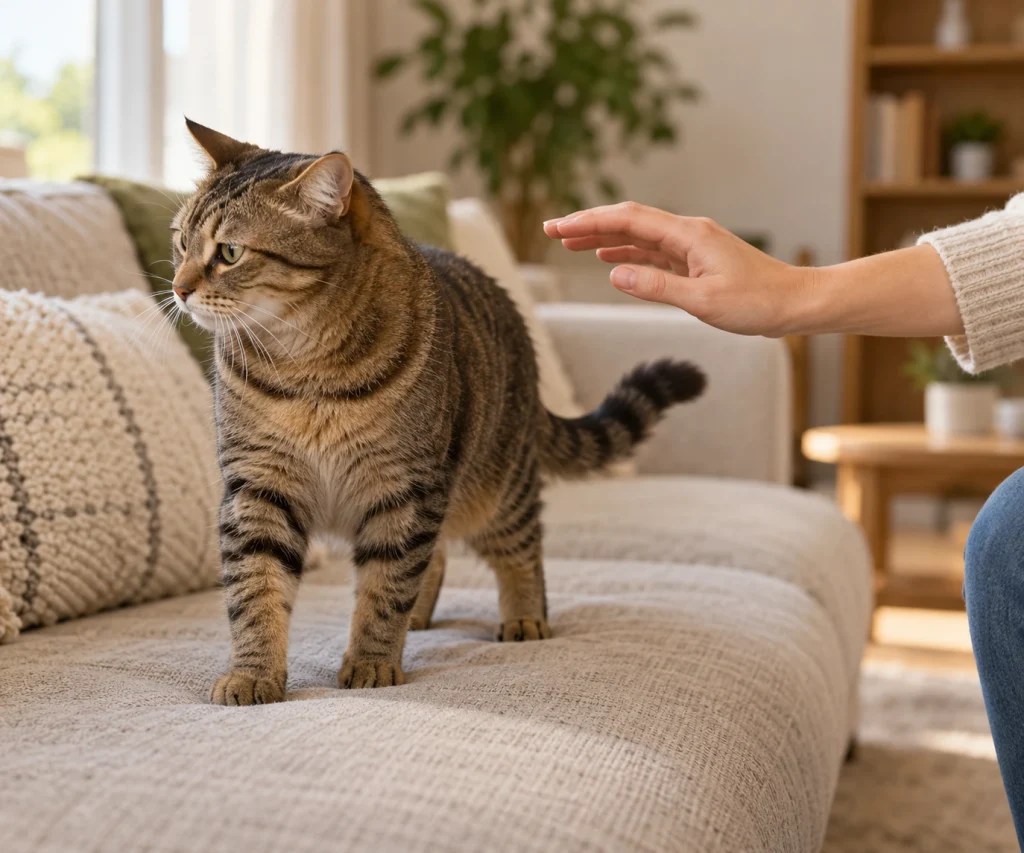
The sequence below shows how to pet a cat in line with the CAT guidance, and it works with most friendly cats. With a nervous or unfamiliar cat, slow every step down and be ready to stop at step two.
- Pick a good moment. Avoid waking a sleeping cat, interrupting a meal or reaching for a cat that is in the middle of play, because a hand can be mistaken for a toy. A cat that walks over, rubs against your legs or sits close by is a better candidate.
- Get lower and let the cat approach. Sit or crouch rather than looming over the cat. Hold out a relaxed hand or a single finger at about nose height and wait. A cat that sniffs and then pushes its cheek or head into your hand is inviting contact. A cat that sniffs and walks away has answered too.
- Start where the cat started. If it rubbed its cheek on your hand, stroke the cheek. Work gently around the base of the ears and under the chin.
- Use soft strokes in the direction of the fur. Cats Protection advises against patting, which can be too rough. Short strokes or a light fingertip scratch usually go down better than heavy, sweeping ones.
- Pause regularly. Every few seconds, lift your hand away. If the cat leans back in, nudges you or rubs against you, carry on. If it stays still, looks away or moves off, that is your answer.
- Stop before the cat has to tell you twice. End while the cat is still relaxed. A short, pleasant session is better than a long one that ends with a nip.
Done this way, petting becomes a conversation rather than something done to the cat. Over time you will learn your own cat’s preferences, which may differ from the general pattern.
Signs your cat is enjoying it, and signs to stop
No single signal tells the whole story, so look at the whole cat: ears, tail, skin, head and body position together. The signs below are drawn from the CAT study, Battersea, Cats Protection, the BC SPCA and the Cornell Feline Health Center.
| Usually a good sign | Time to pause or stop |
|---|---|
| Rubbing its head or cheek into your hand | Turning the head away, moving away or shifting position |
| Leaning back in when you pause | Ears flattening or rotating sideways or back |
| Relaxed body, ears upright or forward | Tail twitching, swishing or thumping |
| Kneading or staying close after you stop | Skin rippling or twitching along the back |
| Raising the hindquarters during a stroke along the back (in cats that like back strokes) | Licking the nose, shaking the head, a sudden quick groom, freezing or tensing up, dilated pupils, growling or hissing |
Purring is missing from the “good sign” column on purpose. Many contented cats purr, but cats can also purr in other circumstances, so purring on its own is not proof that a cat wants more stroking. Read it alongside the rest of the body.
Why some cats bite or swat during petting
Many owners have been in this situation: the cat seems relaxed, then suddenly grabs or bites the hand that was stroking it. This pattern is often called petting-induced aggression or overstimulation. The Cornell Feline Health Center is frank that the reasons “remain unknown”. It also notes that warning signs such as dilated pupils, a lashing tail and ears moving back usually come first. The BC SPCA describes the reaction as an instinctive response to something the cat finds unpleasant and lists flattened ears, tail twitching, rippling skin and low growling as signs to watch for.
In practice, the bite is rarely as sudden as it feels. It tends to come after a run of small signals that are easy to miss when you are relaxed on the sofa. To reduce the chance of it happening:
- Keep sessions short and stick to the head and cheeks, where tolerance is usually highest.
- Stop at the first twitch of the tail or ripple of the skin. Lift your hand away calmly rather than jerking it back.
- Never punish, restrain or “push through” the reaction. Cornell specifically advises against physical punishment and restraint, which tend to make cats more defensive.
- If your cat has a predictable limit, end the session just before it. Some owners pair a few seconds of gentle stroking with a treat, then gradually build up, stopping immediately at any warning sign. Cornell describes this approach.
Pain changes the picture. The BC SPCA notes that conditions such as arthritis or dental disease can make cats more sensitive, and Cornell advises ruling out medical causes before treating aggression as purely behavioural. If biting during petting is new, getting worse or happens when you touch one particular spot, read the vet section below. For the wider training side of biting, including play aggression, see our guide on how to stop a cat from biting, and for other forms of aggression, our complete guide to cat aggression.
The belly question: why a cat showing its tummy isn’t always asking for a rub
A cat rolling onto its back in front of you can look like an invitation, and it is one of the most common reasons people get scratched. Cats Protection puts it plainly: the belly is a vulnerable area, and showing it to you “usually isn’t an invitation to touch it”. The roll is better read as a sign that the cat feels relaxed and safe enough to expose that area near you, which is a compliment in itself.
Some cats really do enjoy belly rubs, and Cats Protection notes that early, gentle handling in kittenhood may make that more likely. If you want to find out whether your cat is one of them, offer a brief, light touch at the edge of the chest and watch closely. Legs folding in, a sudden grab with the front paws or back feet starting to kick all mean the answer is no.
Picking up and holding: when petting becomes handling
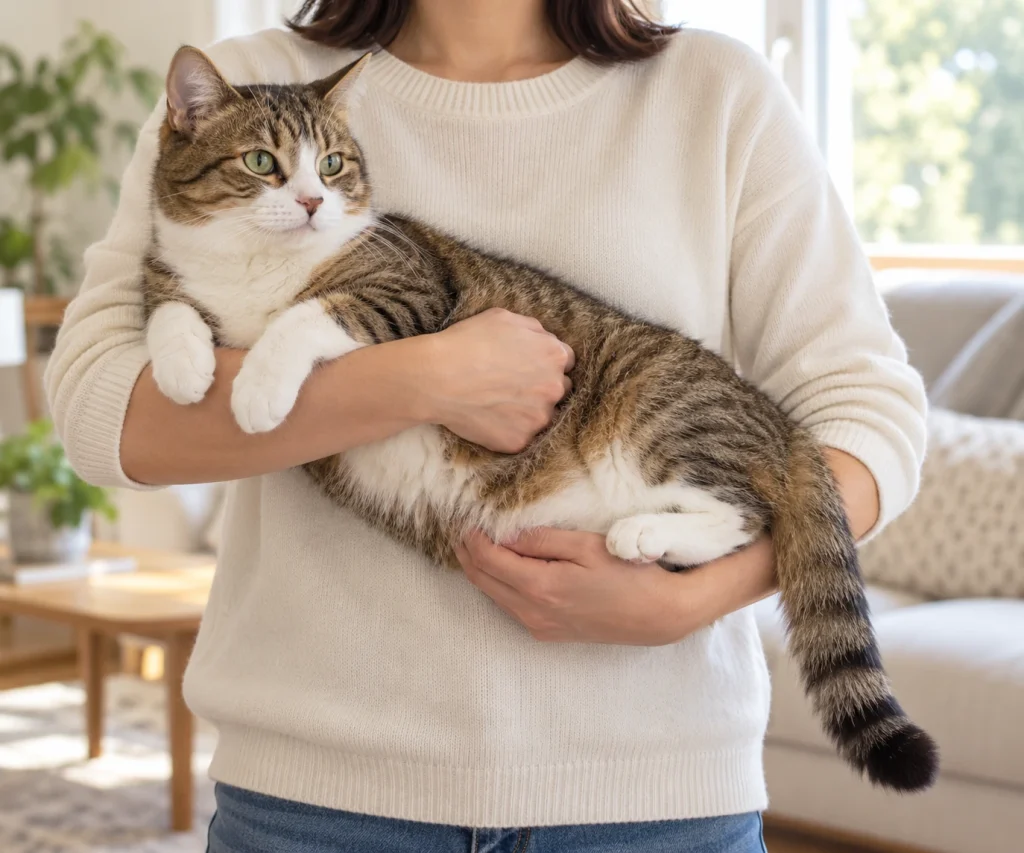
Being lifted is a very different experience from being stroked. The cat loses its ability to leave. Battersea advises never restraining or picking up a cat that is unwilling, because it can be stressful and may lead the cat to resort to aggression. Some cats are happy to be carried. Many prefer to stay on the ground or come to your lap of their own accord.
When you do need to lift a cat, for example to move it out of danger, support its whole body rather than letting its back legs dangle, keep it close to you, and put it down calmly before it starts to struggle. Avoid “scruffing”, which means gripping the loose skin at the back of the neck. International Cat Care opposes scruffing as a method of restraint because of the stress and distress it can cause. For predictable handling such as vet trips, gradual practice usually works better than a sudden grab. Our cat carrier training guide shows one way to build that kind of cooperation.
Petting shy, senior and unfamiliar cats, and teaching children
Shy, fearful or newly adopted cats
For a nervous cat, the most valuable thing you can offer is the freedom not to be touched. Sit quietly in the same room, let the cat approach in its own time and keep early contact to a brief touch on the cheek. Reaching into a hiding place to stroke a frightened cat usually sets things back. If your cat spends much of its time out of sight, our guides to why cats hide and cat anxiety cover how to build confidence first.
Senior cats and cats that might be sore
Older cats often still love contact, but areas that were once fine, such as the lower back and hips, may become uncomfortable. Cornell lists osteoarthritis among the medical problems that can contribute to aggression. If your cat is entering its senior years, the MyyCat Cat Life Stage Calculator can help you see where it sits. A cat that flinches, turns or nips when you stroke along the spine deserves a check-up rather than a “grumpy old cat” label. Our guide to cat arthritis explains the subtler signs.
Gentle brushing can be another way to share contact with a cat that enjoys it, especially an older cat that grooms less thoroughly than it used to. If you’d like to build it into your routine, the Cat Grooming Schedule Generator can help you plan sessions that suit your cat’s coat. As with petting, keep sessions short, start with the head and stop when the cat signals it has had enough.
Cats you don’t know
With a friend’s cat or a cat met outdoors, the “choice” part of the CAT guidance matters most. Crouch, offer a hand and let the cat make every decision. One brief cheek stroke is plenty for a first meeting. Never try to pick up or corner an unfamiliar cat, and avoid handling any cat that seems injured, unwell or frightened. Contact a local rescue or vet for advice instead.
Teaching children how to pet a cat
Children tend to grab, hug, chase and pick cats up, which are exactly the behaviours the CAT guidance discourages. The three ideas translate well for children: let the cat come to you (choice), watch its ears and tail (attention), and stroke only its head and cheeks (touch). Supervise young children around cats, show them how to use one gentle hand, and make sure the cat always has an easy escape route, such as a high shelf or a room children don’t go into.
Common petting myths, and what the evidence says
| Common belief | A more accurate view |
|---|---|
| “Cats don’t really like people; they just tolerate petting.” | In a preference test, half of the cats that completed it chose interaction with a person over food, toys and scent. Many cats value contact, on their own terms. |
| “A cat showing its belly wants a belly rub.” | Usually a sign of relaxation and trust, not an invitation. Most cats dislike belly touches. |
| “My cat knows me, so it will accept anything from me.” | In the stroking study, cats showed more negative responses to familiar handlers than to unfamiliar ones. Familiarity is no substitute for reading the cat. |
| “The bite came out of nowhere.” | Overstimulation is usually preceded by signals such as tail twitching, ear changes, skin rippling or tensing. |
| “Purring means keep going.” | Purring happens in several contexts. Read it together with the rest of the body language. |
| “Long, full-body strokes are best.” | Research and welfare guidance both point to the head and cheeks as the safest areas, with short sessions and regular pauses. |
When a change in how your cat reacts to touch needs a vet
A cat that has always disliked belly rubs is simply telling you its preferences. A change is different. Cats are good at hiding discomfort, and a new reaction to touch is sometimes one of the few visible clues. Cornell advises ruling out medical causes first when a cat becomes aggressive, naming conditions such as hyperthyroidism, osteoarthritis, dental disease and nervous-system problems.
Book a vet appointment if your cat:
- suddenly objects to being touched in a place it used to enjoy
- flinches, turns, growls or bites when one particular area is touched
- starts biting during petting when it never did before, or the reaction is escalating
- shows other changes alongside the touch sensitivity, such as hiding more, eating less, grooming less, reluctance to jump, or changes in litter box use
Seek urgent veterinary care if your cat cries out in pain when touched, has an obvious injury or swelling, cannot walk normally, is breathing with difficulty, or seems suddenly very unwell. Don’t try to examine a cat in obvious pain yourself. Even gentle cats can bite hard when they hurt, so keep handling to a minimum and call your vet or an emergency clinic.
Our guide on how to tell if your cat is sick covers other early signs worth watching, and the article on cat hyperthyroidism explains one of the conditions that can make an older cat more irritable. This article is general information and not a substitute for an examination. See our veterinary disclaimer.
Frequently asked questions
What is the best way to pet a cat for the first time?
Sit or crouch, offer a relaxed hand at nose height and wait. If the cat sniffs and rubs its cheek against you, give a gentle stroke on the cheek or at the base of the ears. Then pause. Let the cat decide whether there is a second stroke.
Where do cats like to be petted the most?
Most friendly cats prefer the cheeks, the base of the ears and under the chin. Research found the area between the eye and ear tended to produce the most positive responses, while the area around the base of the tail produced the most negative ones.
How long should I pet my cat?
There is no fixed time. Let the cat set the length. The CAT guidance suggests pausing every 3–5 seconds to check whether the cat wants more. Many cats prefer several short sessions to one long one.
Why does my cat bite me when I pet it?
Often it is overstimulation: the cat has had enough and warning signs such as a twitching tail or rotating ears went unnoticed. Pain can also play a part, so a new or worsening reaction is worth discussing with a vet.
Should I pet my cat while it’s sleeping?
It is better not to. Cats Protection advises against petting cats when they are asleep, scared, in pain or playing. A startled cat may react defensively, and constant interruptions can make rest less restful.
Is it OK to pick my cat up?
Only if your cat is comfortable with it. Support the whole body, keep the cat close and put it down before it struggles. Avoid lifting or restraining an unwilling cat, and don’t scruff it.
How do I teach my child how to pet a cat?
Use the CAT idea in simple words: let the cat come to you, watch its ears and tail, and stroke only its head and cheeks with one gentle hand. Supervise young children, and make sure the cat can always walk away.
Sources
- Ellis SLH, Thompson H, Guijarro C, Zulch HE. The influence of body region, handler familiarity and order of region handled on the domestic cat’s response to being stroked. Applied Animal Behaviour Science. 2015;173:60–67.
- Haywood C, Ripari L, Puzzo J, Foreman-Worsley R, Finka LR. Providing humans with practical, best practice handling guidelines during human-cat interactions increases cats’ affiliative behaviour and reduces aggression and signs of conflict. Frontiers in Veterinary Science. 2021;8:714143.
- Vitale Shreve KR, Mehrkam LR, Udell MAR. Social interaction, food, scent or toys? A formal assessment of domestic pet and shelter cat preferences. Behavioural Processes. 2017;141:322–328.
- Cornell Feline Health Center. Feline behavior problems: aggression.
- Battersea Dogs and Cats Home. How to stroke a cat and interact with them.
- Cats Protection. How to pet a cat.
- BC SPCA. Ask the SPCA: cat petting aggression.
- International Cat Care. Position on scruffing cats.