
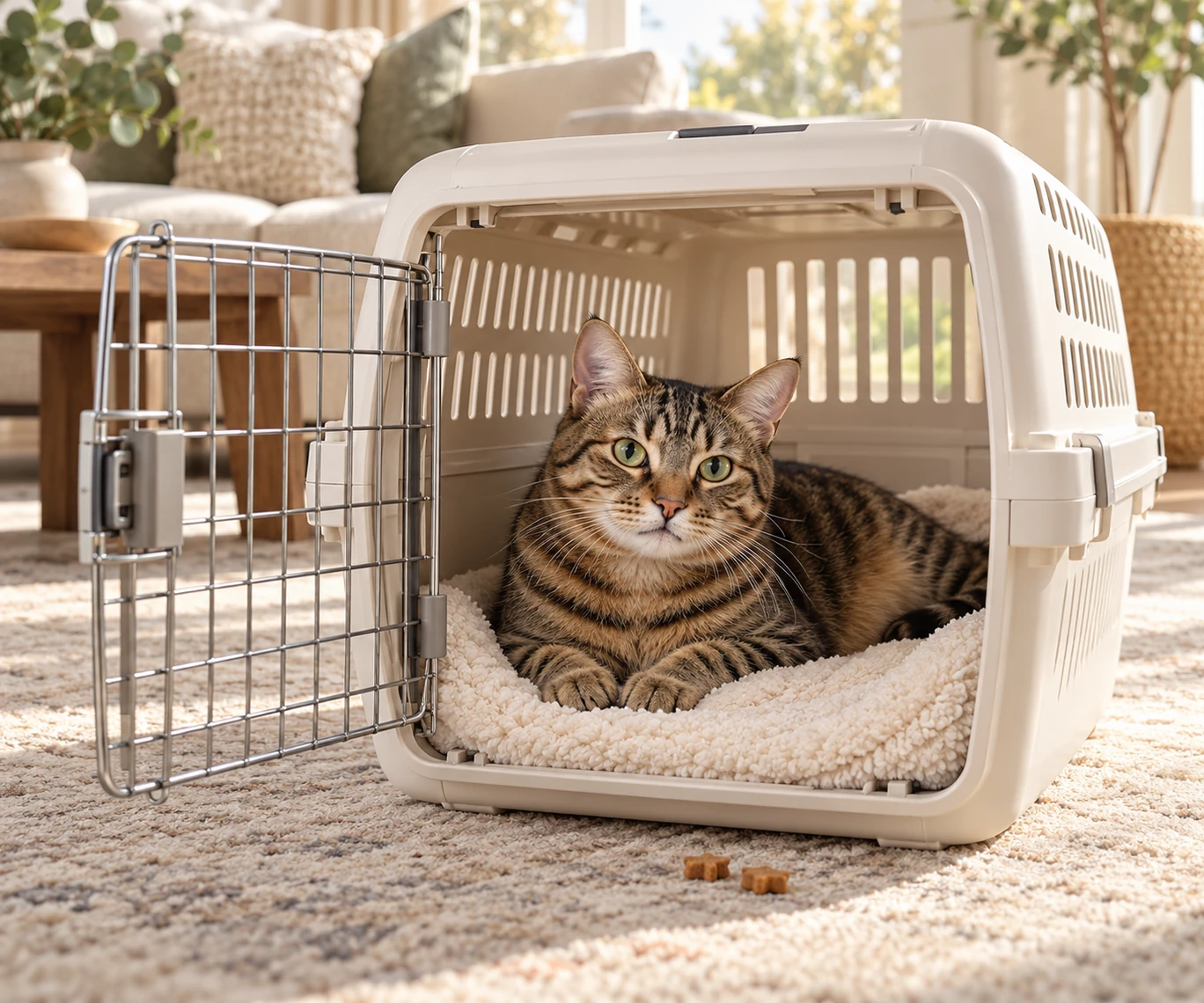

The carrier comes out, and your cat disappears under the bed. Getting them in takes two people, a towel and a few scratches, and the whole trip to the vet starts in a state of panic. It doesn’t have to be that way. Cat carrier training teaches your cat that the carrier is a normal, safe and even rewarding place, so getting into it becomes calm and routine.
Quick answer: Leave a sturdy carrier out at home all the time, make it comfortable with familiar bedding, and reward your cat with treats, meals or play for approaching and going inside. Then, step by step, get your cat used to the door closing, being lifted and short car rides, always moving at your cat’s pace. Veterinary cat-care organizations note that it may take days or weeks before your cat trusts the carrier, so start well before you need it.
Table of Contents
Why Carrier Training Is Worth the Effort
For many cats, the carrier only appears before a car ride and a vet visit, so they quickly learn to associate it with stress. Carrier training changes that association.
There is research behind this. In a 2018 study published in Applied Animal Behaviour Science, 22 cats were split into a carrier-training group and an untrained control group. The trained cats showed significantly less stress during the car ride, and their veterinary examinations were shorter. The researchers concluded that owners should be encouraged to use carrier training to reduce the stress of vet visits.
International Cat Care puts it simply: cats are clever and can learn to enter their carrier if we teach them that it can be a positive experience. A carrier-trained cat is also easier to move in an emergency, which matters if you ever need to leave home quickly.
First, Choose the Right Carrier
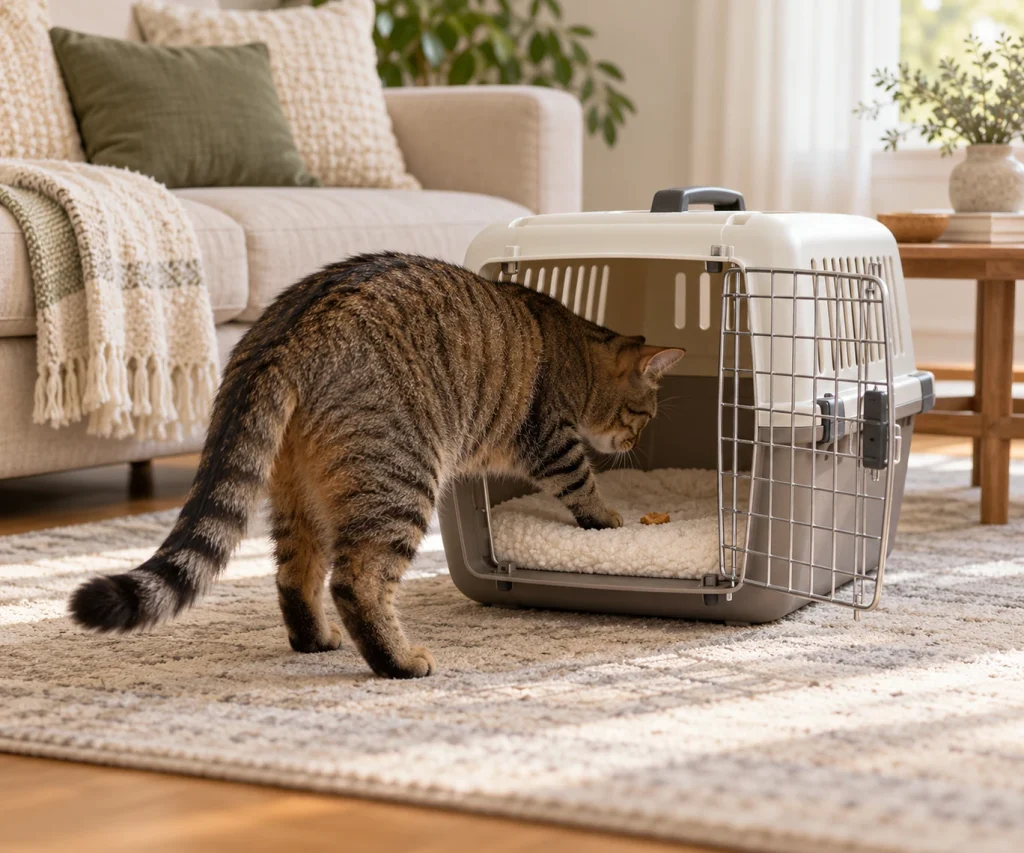
The right carrier makes training much easier. The American Association of Feline Practitioners (AAFP) Cat Friendly Homes program and International Cat Care recommend:
- A sturdy, hard-sided carrier. International Cat Care suggests avoiding soft fabric carriers, which can collapse and are hard to keep clean, and backpack styles that cause a lot of movement.
- A top opening as well as a front door, or a removable top half. AAFP notes that a removable top lets your cat stay in the bottom half during the vet’s examination, rather than being pulled out.
- Easy cleaning and a leak-proof base.
- Some visual shielding with good ventilation.
- One carrier per cat, as International Cat Care advises.
If your cat already strongly fears their old carrier, starting training with a different carrier may help.
Before You Start: How Training Sessions Should Work
The AAFP’s guidance on cat training is built on positive reinforcement: focusing on what you want your cat to do and rewarding it. A few principles make the difference:
- Find rewards your cat really values. AAFP notes that preferences vary, and many cats value social interaction as well as food. Try small pieces of a favorite treat, a lickable treat, play or gentle attention.
- Reward immediately. AAFP stresses that the reward needs to come right after the behavior. A consistent word such as “good” or a clicker can mark the exact moment if the reward takes a second to arrive.
- Keep sessions short and end on a success.
- Let your cat choose. Your cat should always be free to walk away. Never push, chase or force your cat into the carrier during training.
- Watch for stress. AAFP advises stopping training if your cat shows fear or anxiety, protective behaviors such as hiding, growling or hissing, or signs of illness or pain.
Treats add up over a training period. MyyCat’s Cat Treat Calculator can help you keep treats within a sensible share of your cat’s daily food.
Step-by-Step Cat Carrier Training Plan
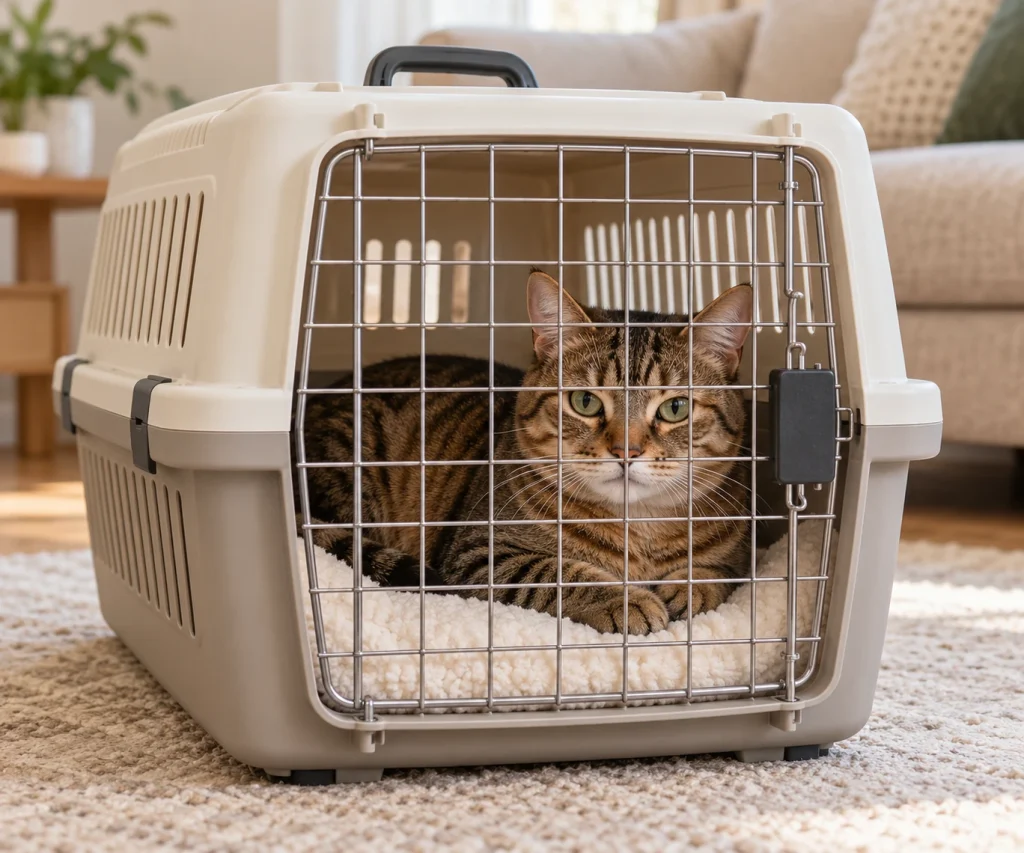
Cat carrier training works best in small stages. Move to the next stage only when your cat is relaxed at the current one. Some cats move through a stage in a session or two; others need many days. If your cat hesitates, go back a step.
Stage 1: Make the Carrier Part of the Furniture
AAFP and International Cat Care both recommend keeping the carrier out in a room where your cat already likes to spend time, rather than storing it away.
- Remove the door, or fix it open, so it can’t swing shut.
- Put familiar soft bedding inside. AAFP notes that bedding or clothing with your scent can help your cat feel more secure.
- Optionally, use a synthetic feline pheromone spray or wipe in the carrier, which AAFP says may reduce anxiety.
- Leave it there and let your cat investigate in their own time.
Stage 2: Reward Approaching and Going Inside
- Place treats near the carrier, then at the entrance, then just inside, then further in.
- Drop a treat or toss a toy inside occasionally when your cat isn’t looking, so they “discover” good things there. AAFP suggests putting treats, catnip or toys in the carrier to encourage your cat to go in on their own.
- Try feeding some meals next to the carrier, then gradually move the bowl inside.
- Reward your cat whenever you see them choose to go in or rest there.
Stage 3: Build Time Inside
- When your cat goes in, give a few treats one after another while they stay inside.
- Gradually increase how long your cat stays before the next reward.
- Reward calm, settled behavior such as sitting or lying down.
Stage 4: Introduce the Door
- Put the door back on, but leave it open for a few days of normal use.
- While your cat is inside eating treats, swing the door partly closed and immediately open it again.
- Progress to closing it for a second, then a few seconds, feeding treats through the door.
- Slowly build up to longer periods with the door closed, always opening it before your cat becomes worried.
Stage 5: Lifting and Carrying
- With your cat inside and the door closed, lift the carrier a few centimeters off the floor, put it down, open the door and reward.
- Gradually lift higher and hold for longer.
- Practice carrying it a few steps, then around the room. AAFP recommends carrying it with both arms, like a valuable package, rather than swinging it by the handle.
- Practice covering the carrier with a light towel or blanket, which AAFP and International Cat Care suggest to block the view during travel.
Stage 6: Short Car Trips
- Carry the carrier to the car, sit there for a moment, then go back inside and reward.
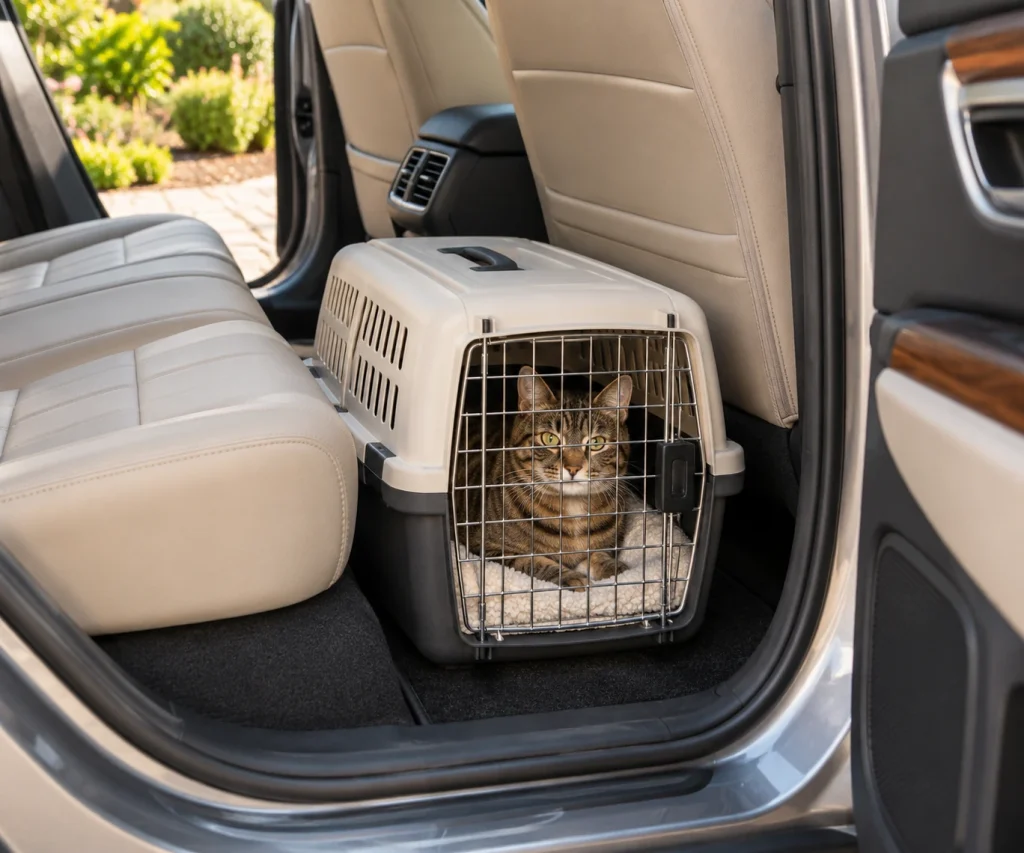
- Secure the carrier in the car. AAFP and International Cat Care suggest the footwell behind the front seats, or a crash-tested carrier belted in on the back seat.
- Start the engine briefly, then turn it off and return home.
- Progress to short drives around the block. AAFP recommends short “test drives” with favorite treats.
Stage 7: Keep It Positive
Leave the carrier out as a resting place and keep rewarding your cat for using it. If the carrier only reappears before vet visits, the old association can creep back. Occasional short, rewarding practice trips help maintain the training.
How to Get a Cat Into a Carrier Today (If You Can’t Wait)
Sometimes a vet visit can’t wait. These calmer approaches can help:
- Close doors to the room beforehand so you aren’t chasing your cat through the house.
- If the carrier has a removable top, AAFP suggests taking it off, encouraging or gently lowering your cat into the bottom half, and calmly replacing the top.
- For a top-opening carrier, AAFP suggests gently lowering your cat in from above.
- AAFP suggests wrapping a resistant cat in a towel to manage outstretched legs.
- Cover the carrier once your cat is inside, as AAFP and International Cat Care recommend for travel.
- International Cat Care notes that a synthetic feline pheromone spray in the carrier about 15 minutes before travel may help.
Stay calm and move slowly. A rushed, frightening experience makes the next trip harder, so start proper carrier training as soon as you’re home.
Common Carrier Training Mistakes
- Bringing the carrier out only for vet trips. This teaches your cat that the carrier predicts something unpleasant.
- Rushing the steps. AAFP notes it may take days or weeks before your cat trusts the carrier.
- Using force or punishment. Scolding, chasing or pushing your cat in increases fear and doesn’t teach the behavior you want.
- Calling your cat only to put them in the carrier. MyyCat’s recall training guide explains why this can teach cats to avoid coming when called.
- Training when your cat is unwell or in pain. AAFP advises against training in these situations.
- Swinging the carrier by the handle. Carry it steadily with both arms.
Troubleshooting
My cat won’t go near the carrier
Move it further away from where your cat rests, remove the top half so it looks less enclosed, or try a different carrier. Reward your cat just for being in the same room, then for looking at it, then for approaching.
My cat goes in but bolts when the door moves
Go back to Stage 3 and build relaxed time inside. Then reintroduce the door in tinier steps, such as moving it just a little and rewarding before your cat notices.
My cat cries or seems stressed in the car
Go back to shorter trips, such as sitting in the stationary car. Cover the carrier, keep it secure and level, and drive smoothly. If your cat drools, vomits or remains very distressed, ask your vet for advice, as some cats need extra support for travel.
After the Vet Visit: Multi-Cat Homes
Cats recognize each other partly by scent, and a cat returning from the vet may smell unfamiliar. International Cat Care suggests keeping the returning cat separate at first, so they can smell familiar again by grooming and contact with the home. AAFP suggests swapping bedding that carries each cat’s scent. If you see hissing or tension, separate the cats and reintroduce them gradually; MyyCat’s guide to cat aggression covers what to watch for.
When to Get Extra Help
Ask your vet or a qualified behavior professional for help if your cat shows intense fear, panics, or becomes aggressive around the carrier or during travel. Signs of fear can overlap with pain or illness, so a vet check is a good first step. MyyCat’s guide to cat anxiety explains common signs of stress and ways to reduce it at home.
Carrier training also pairs well with other handling skills. MyyCat’s guides to nail trimming training and leash and harness training use the same step-by-step, reward-based approach.
Frequently Asked Questions
How long does cat carrier training take?
It varies. AAFP notes that it may take days or weeks before a cat trusts the carrier. Fearful cats, or cats with bad past experiences, may need longer. Progress at your cat’s pace rather than to a deadline.
Should I leave the cat carrier out all the time?
Yes. AAFP and International Cat Care both recommend keeping the carrier out in a room your cat likes, so it becomes a familiar resting place rather than a warning sign.
Can you carrier train an adult or older cat?
Yes. International Cat Care notes that cats can learn to enter the carrier when we teach them it can be a positive experience. Adult cats with negative associations may simply need more time and smaller steps.
Should I cover my cat’s carrier?
AAFP and International Cat Care both suggest covering the carrier with a towel or blanket during travel to block the view of changing surroundings. Keep ventilation in mind.
Why does my cat hate the carrier?
Often because the carrier has only ever appeared before car rides and vet visits, so it has become linked with stress. Carrier training works by building new, positive associations.
Key Takeaways
- Cat carrier training teaches your cat that the carrier is safe and rewarding, which research links to less stress on the way to the vet.
- Choose a sturdy carrier with a top opening or removable top, one per cat.
- Leave it out, make it comfortable, and reward approaching, entering, staying, the door, lifting and short car trips, in that order.
- Go at your cat’s pace, keep sessions short, and never force or punish.
- Keep the carrier out and keep it positive after training is done.
More From MyyCat
The treat calculator mentioned in this guide is collected with MyyCat’s other free resources on the MyyCat cat care tools page. For more reading on cat care and training, you can also browse MyyCat’s books.
This article is for informational and educational purposes only and is not a substitute for professional veterinary or behavioral advice. Please read our veterinary disclaimer.
Sources & References
- Pratsch L, Mohr N, Palme R, Rost J, Troxler J, Arhant C. — Carrier training cats reduces stress on transport to a veterinary practice, Applied Animal Behaviour Science, 2018
- AAFP Cat Friendly Homes — Getting Your Cat to the Veterinarian
- AAFP Cat Friendly Homes — Choosing the Perfect Cat Carrier
- AAFP Cat Friendly Homes — Cat Training Techniques for Caregivers
- International Cat Care — Visiting Your Vet: A Guide for Cat Carers (PDF)