

Walking a cat on a leash can sound unusual, but for the right cat it is a good way to add safe, supervised time outdoors. Done slowly, harness and leash training gives curious indoor cats new sights and smells without the risks of roaming free. It is not for every cat, though, and success depends far more on patience and your cat’s personality than on any particular method.
This guide covers whether leash walking suits your cat, how to choose and fit a harness, a step-by-step training plan, common problems, outdoor safety, and good alternatives if your cat would rather stay inside.
Quick answer: Use a well-fitted cat harness, never a collar. Let your cat get used to the harness indoors with treats, then add a leash and practice inside before going out. Keep the first outdoor trips very short and quiet, let your cat set the pace, and stop at any sign of fear. Check with your vet about vaccinations and parasite prevention before your cat goes outside.
Table of Contents
Why Leash Train Your Cat?
Leash walking is optional. Many cats live full, happy lives indoors without it. For cats who are curious about the outdoors, though, it can offer some real benefits.
Safer Time Outdoors
Cats who roam outdoors face real dangers. The ASPCA notes that outdoor cats do not live as long as indoor cats, and lists risks such as traffic, fights with other animals, fleas, ticks and infectious diseases. Supervised leash walking lets a cat explore outside while you stay in control. It reduces some of these risks, but it does not remove them.
Before you start going outside, ask your veterinarian whether your cat’s vaccinations and parasite prevention are right for their health, age, location and expected outdoor exposure. VCA Animal Hospitals recommends updating vaccinations and parasite prevention before walks, because time outside raises the chance of meeting stray animals or picking up fleas and ticks.
Many owners also work on recall training alongside leash walks. It is not required, but a cat who comes when called adds an extra layer of safety if a harness ever loosens or a leash is dropped.
Older cats and cats with mobility problems or medical conditions may need shorter outings, different activities, or a vet’s advice before starting. If a cat who used to enjoy walks becomes reluctant, sore or distressed, consider a veterinary check rather than assuming it is a training problem.
Extra Activity
Many indoor cats get little physical activity. A cat walk usually involves a lot of sniffing, watching and short bursts of movement rather than steady exercise, so it is best thought of as a bonus on top of daily play, not a replacement for it. If your cat needs to lose weight, our guide on helping your cat lose weight safely explains why diet and a vet-guided plan matter most.
Mental Stimulation
For cats who enjoy it, the sights, sounds and smells of the outdoors can be rich enrichment. But leash walking is not the only way to keep a cat mentally busy. Climbing spaces, scratching posts, food puzzles, window perches and interactive play all offer real enrichment for cats who prefer to stay indoors. If you think your cat is under-stimulated, our guide to the signs your cat is bored can help.
Time Together
Training with treats and patience can be a positive shared activity. Many owners find that the calm, reward-based handling involved in harness training also helps with other everyday care, such as getting a cat used to being touched and handled.
A Note on Car Trips and Vet Visits
A harness is not a substitute for a carrier. The American Association of Feline Practitioners’ 2025 position statement on transporting cats recommends that cats travel in a secured carrier, not loose or in a harness. A cat who panics in a parking lot can slip a harness or pull the leash out of your hand. Our guide to cat carrier training explains how to make the carrier a comfortable place.
Choosing the Right Cat Harness
The harness matters more than any other piece of equipment. A poorly fitting one is uncomfortable and easy to escape from. These are the main styles:
Step-In Harness
Your cat steps into two leg holes, and the straps fasten over the back. Because you don’t have to pass anything over the head, many cats accept it easily. Look for soft, adjustable material.
Vest-Style Harness
A vest covers more of the body and spreads pressure over a wider area. When it is well fitted, it is generally harder for a cat to wriggle out of, which makes it a popular choice for beginners and for cats who try to back out. Some cats find the extra coverage strange at first.
H-Style or Strap Harness
This lighter design uses one strap around the neck and one around the chest, joined along the back. Some cats prefer the lighter feel, but with less coverage it is easier to slip out of if the fit isn’t right, so it is usually better for calm, experienced walkers.
What to Avoid
- Never attach a leash to a collar. VCA advises that cats should always be walked on a harness, because collars slip off too easily. A collar would also put all the pressure on the neck if the leash is pulled.
- Avoid flimsy harnesses with thin straps or weak buckles.
- Avoid retractable leashes. VCA notes they can let a cat reach trees or fences. A fixed-length leash gives you steadier control.
📚 Recommended Cat Guides
🐱 The Trainable Cat Book
Learn proven methods to train your cat and stop unwanted behaviors.
View Book →❤️ Complete Cat Care Manual
Your complete guide to cat nutrition, health, grooming, behavior, and daily care.
Get the Manual →How to Get the Right Size and Fit
- Harness sizes vary between brands, and there is no universal weight-to-size standard.
- Measure your cat as the product’s instructions describe, usually around the chest just behind the front legs, and compare it with that harness’s own size chart.
- Don’t size by weight alone; two cats of the same weight can have very different shapes.
- The harness should be snug without restricting movement or breathing. A common rule of thumb is that you should be able to slide one or two fingers under the straps, but no more.
- Check the fit indoors first. Watch your cat stretch, twist and back up, and make sure they can’t slip out before you ever go outside.
Step-by-Step Leash Training Plan
Go at your cat’s pace. Some cats move through these stages in days; others need weeks. Both are normal. If your cat seems worried at any stage, go back to the last step where they were relaxed. As VCA puts it, the key to walking your cat is to let them set the pace.
Step 1: Introduce the Harness
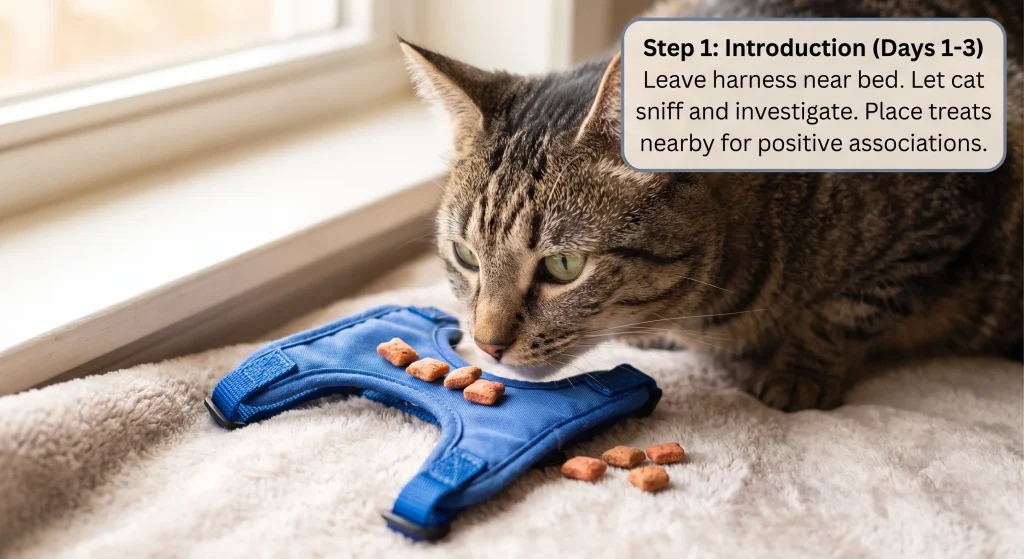
Leave the harness near your cat’s bed or favorite resting spot so they can sniff and investigate it. Place treats on and around it. Don’t try to put it on yet. The goal is simply for your cat to see the harness and expect something good.
Step 2: Short Periods Wearing the Harness
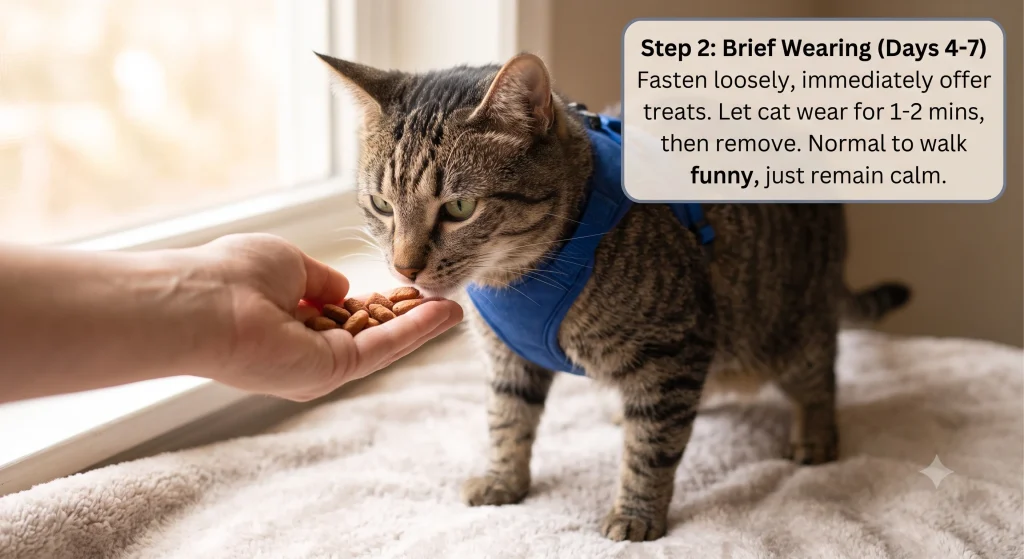
When your cat is relaxed around the harness, gently drape it over their back for a few seconds, then remove it and give a treat. Gradually increase the time. Once that is easy, fasten it, give treats straight away, and take it off after a minute or two. Repeat a few times a day, slowly building up the time.
Many cats walk oddly at first: they may freeze, flop over, crawl low to the ground or walk backward. This is a common reaction to the new feeling. Stay calm, offer treats or a game, and keep sessions short. Some cats adjust in a few sessions; others take longer. Never leave a harnessed cat unsupervised, as straps can catch on furniture.
Step 3: Add the Leash Indoors
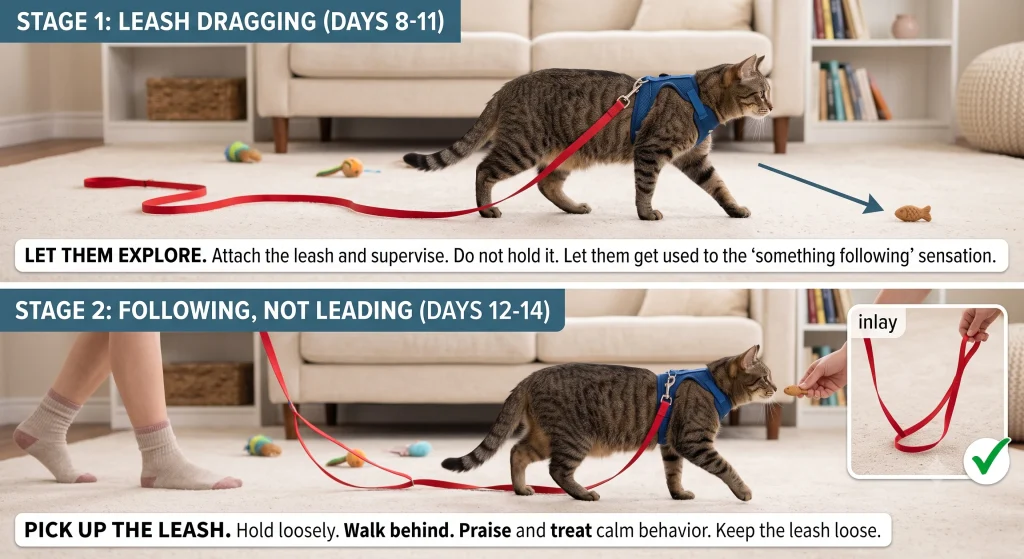
Once your cat moves normally in the harness, clip on the leash. VCA suggests attaching the leash and following your cat around the house so they get used to its weight. Keep the leash loose and let your cat lead, rewarding calm movement. Some owners let the cat drag a light leash for a short time first; if you do, stay right beside them so it can’t snag or tangle.
Step 4: Practice Gentle Guiding Indoors
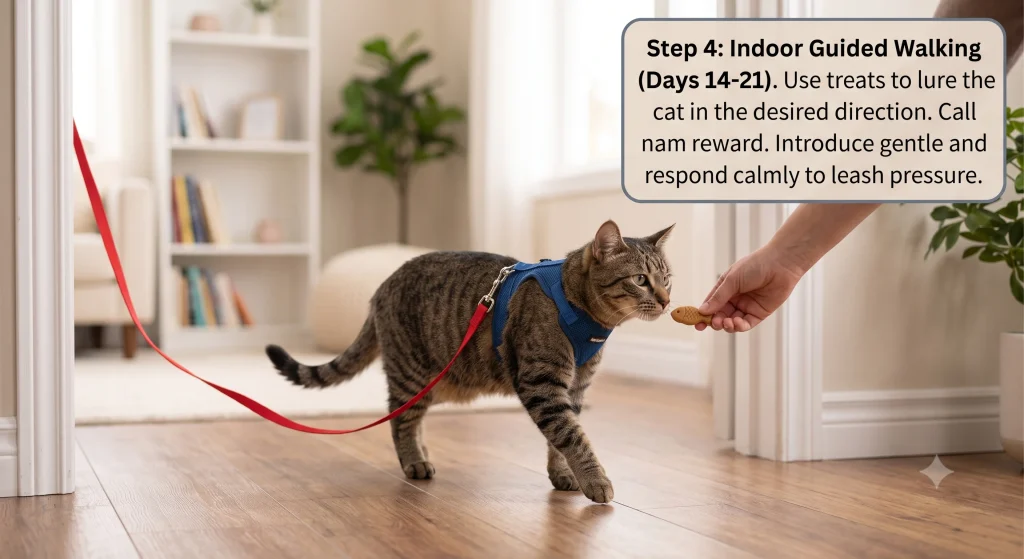
Now start encouraging your cat to follow you. Use a treat or toy to lure them a few steps, and reward them when they come along. VCA advises using gentle pressure and luring with treats, and never dragging your cat. Cats do not walk to heel like dogs, so think of this as teaching your cat to follow you willingly rather than to be steered. Practice in different rooms, with short sessions of a few minutes.
Step 5: The First Trip Outside

Choose a quiet, enclosed or familiar spot, such as your yard or a calm patio, at a quiet time of day. Avoid busy streets, dogs and loud noises. VCA recommends keeping the first few outings very short, just around a driveway or front yard.
Carry your cat out (in their harness, with the leash attached and held firmly), set them down gently, and let them explore at their own speed. If they want to crouch, sniff or hide behind you, that’s fine. If your cat seems frightened, calmly pick them up or bring them back inside and try again another day. Ending on a calm note matters more than how long you stayed out.
Step 6: Build Confidence Gradually

Slowly increase the length of outings and, if your cat is enjoying them, introduce new places. Some cats want to explore; others prefer to sit and watch birds. Both are fine. Regular, short sessions usually work better than occasional long ones.
Step 7: Keep It Positive Long Term
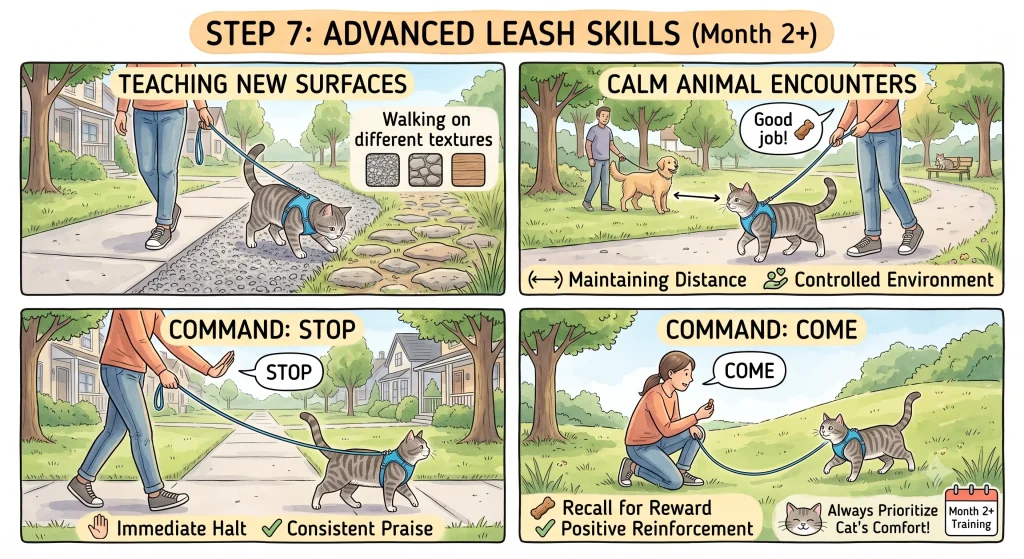
Confident cats may enjoy new surfaces and routes, and some learn to come to a cue for a treat. Keep avoiding situations that could overwhelm your cat, such as close encounters with dogs or crowds, and keep rewarding calm behavior.
One side effect to watch for: a cat who enjoys outings may start waiting by the door. To avoid this, consider carrying your cat out through a different door or in their carrier, so the front door doesn’t become the start of every adventure. Our guide on how to stop a cat from running out the door has more tips.
Common Problems and Solutions
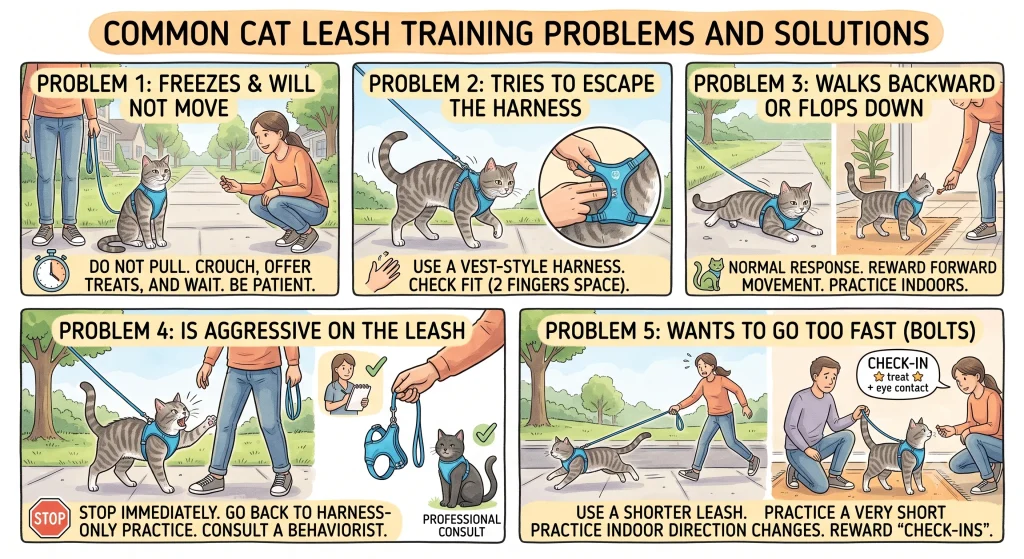
My cat freezes and won’t move
Freezing is a common reaction indoors and out. Don’t pull on the leash. Crouch down, offer a treat and give your cat time. If they stay frozen, end the session calmly and go back a step next time. Forcing movement usually makes cats more wary.
My cat tries to back out of the harness
Check the fit first; a harness that is too loose or the wrong shape for your cat is a common cause. A well-fitted vest-style harness can be harder to escape. If your cat is backing out because they are frightened, slow the training down.
My cat flops over or walks backward
This is a common early response to the feel of a harness. Keep sessions short, use treats or play to encourage normal movement, and reward any forward steps. Most cats improve with gradual practice, but don’t force it.
My cat hisses, swats or bites when leashed
Stop the session. These are signs of fear or discomfort. Go back to short, positive harness-only practice indoors. If the reaction continues, ask your vet to check for pain or other medical causes, and consider a qualified cat behavior professional. Some cats simply don’t enjoy being restrained, and that’s okay.
My cat tries to bolt outside
Keep the leash short (but not tight) in exciting places, hold it securely, and reward your cat for checking in with you. Practice in quieter areas until your cat is calmer. A cat who bolts in fear needs a quieter location, not more control.
Outdoor Safety Tips
- Check the harness fit and buckles before every walk.
- Use identification. The ASPCA advises that cats allowed outdoors wear a safety collar, with an elastic panel that lets the cat break free if the collar catches on something, plus an ID tag, and recommends an ID tag or microchip for all cats. In one study of 538 cats, about 73% wore their collars for the whole six months. Keep the leash attached to the harness, never to the safety collar.
- Stay with your cat at all times. Never tie a cat up outside or leave them unattended on a leash.
- Avoid temperature extremes. Hot pavement can burn paws, and cats can overheat. Walk in cooler parts of the day, offer water on longer outings, and head home at the first sign of heavy panting or distress.
- Watch for toxic plants and chemicals. Lilies are a particular danger: the ASPCA warns that even a small bite, licked pollen or water from a lily vase can cause life-threatening kidney injury. Also avoid treated lawns, pesticides and puddles that may contain antifreeze.
- Keep away from dogs and other animals. Even a friendly dog can terrify a cat. Have an escape plan, such as picking your cat up or retreating to a carrier or backpack.
- Don’t let your cat catch wildlife. It is stressful for the prey, and wild animals can carry parasites and disease.
- Check for fleas and ticks after outings, and keep up the parasite prevention your vet recommends.
Best Times and Places to Walk
Good Places to Start
- Your own yard or patio: familiar, quiet and close to home.
- Quiet green spaces away from dogs, crowds and traffic, once your cat is confident.
- Easy, quiet trails for experienced cats only, on flat ground and over short distances.
Good Times to Go
Early morning and evening are often quieter and, in warm weather, cooler. Choose times when your usual spots are least busy.
When to Stay In
- In hot midday sun, especially on pavement
- During storms, heavy rain or strong wind
- When fireworks or other loud events are likely
- Near busy roads, construction or areas with loose dogs
What If My Cat Doesn’t Like Leash Walking?
Not every cat will enjoy it, and some find the outdoors frightening. That’s okay. VCA notes that cats vary widely: some take to walks, some resist, and many fall somewhere in between. If walks cause your cat stress, these alternatives can offer similar benefits:
- A catio or enclosed outdoor space, where your cat can enjoy fresh air safely.
- Window perches, ideally with a view of a bird feeder.
- Indoor enrichment, such as cat trees, puzzle feeders and daily interactive play.
- A secure pet stroller or carrier for outdoor time without walking.
The goal is not to make your cat walk on a leash. It is to improve their quality of life, and there are plenty of ways to do that.
Key Takeaways
- Always use a harness, never a collar, and check the fit indoors first.
- Ask your vet about vaccinations and parasite prevention before going outside.
- Go slowly and let your cat set the pace, using treats your cat really likes.
- Keep sessions short and end on a calm note.
- Never punish your cat or pull them along. If training isn’t going well, go back a step or take a break.
- Use a carrier, not a harness, for car trips and vet visits.
- Accept that some cats won’t enjoy it, and offer other enrichment instead.
Equipment Checklist
| Item | Purpose | Notes |
|---|---|---|
| Well-fitted cat harness | Safe attachment point for the leash | A vest style is a popular choice for beginners |
| Fixed-length leash | Control without sudden slack or tension | Avoid retractable leashes |
| Treats your cat loves | Positive reinforcement | Small, soft pieces; count them as part of daily food |
| Safety collar with ID tag, plus a microchip | Identification if your cat gets loose | Never attach the leash to the collar |
| Carrier or secure pet backpack | A safe retreat and a way to get home quickly | Useful if your cat is frightened |
| Portable water bowl | Water on longer or warmer outings | Collapsible bowls are light to carry |
| Waste bags | Cleaning up | Some cats do go to the toilet outdoors |
| Basic pet first aid kit | Minor scrapes and emergencies | Keep your vet’s number in your phone |
Frequently Asked Questions
How long does it take to leash train a cat?
There is no fixed timeline. Some cats are comfortable within days, while others need weeks or longer. Let your cat’s behavior, not a calendar, decide when to move on.
Can all cats be leash trained?
Many cats can learn to accept a harness, but not all will enjoy going outside. Very fearful cats, or cats with health problems, may be better suited to indoor enrichment or a catio. Ask your vet first if your cat has any health concerns.
What kind of harness is best?
The best harness is one made for cats that fits your cat securely and comfortably. Vest-style harnesses are a popular choice because they cover more of the body and are generally harder to escape from, but fit matters more than style.
Should I use a collar or a harness?
Always a harness. Collars slip off too easily and put pressure on the neck if the leash is pulled. A safety collar with an ID tag is still useful for identification, but the leash should attach only to the harness.
My cat flops over when I put the harness on. Is this normal?
Yes, it’s a common reaction to the new sensation. Keep sessions short and positive, and reward normal movement. If your cat still seems very distressed after gradual practice, try a different style of harness or slow down further.
Can I leash train an adult cat?
Yes. Many owners find kittens accept new experiences more easily, but adult cats can learn too. It may simply take more time and patience, and it depends on your cat’s temperament.
How often should I walk my cat?
There is no set requirement. Short, regular outings that your cat enjoys are better than occasional long ones. Let your cat’s interest and energy guide how often and how long you go.
Is it safe to walk my cat near dogs?
It’s best to avoid dogs. Even a calm dog can frighten a cat, and a frightened cat may try to escape the harness or scratch whoever is holding them. Choose quiet places, keep your distance, and be ready to pick your cat up or retreat.
Can I take my cat hiking?
Some confident, experienced cats enjoy gentle trails. Start with short, flat, quiet paths, avoid hot or cold weather and busy trails, and bring a carrier or backpack so your cat can rest or retreat. Turn back at the first sign of tiredness or stress.
What if my cat tries to chase birds or squirrels?
Hunting is natural, so be ready for it. Hold the leash securely, redirect your cat with a treat or toy, and choose areas with less wildlife until your cat is calmer. Don’t let your cat catch wild animals.
This article is for general information and is not a substitute for veterinary advice. If you have concerns about your cat’s health or behavior, please contact your veterinarian. Read our full veterinary disclaimer.
Sources & References
- VCA Animal Hospitals: Train Your Cat to Walk on a Leash
- ASPCA: General Cat Care
- ASPCA: Getting to the Bottom of the Dangers of Easter Lilies
- American Association of Feline Practitioners: 2025 Transportation of Cats in Motor Vehicles Position Statement
- ScienceDaily: summary of Lord LK, et al. Evaluation of collars and microchips for visual and permanent identification of pet cats. JAVMA, 2010
[…] spaces. Even walking on a leash becomes easier when your cat comes when called. Check out our cat leash training guide for how recall and leash training work […]
[…] or loud noises. Use secure doors, carriers, cat-secure enclosures, or appropriately supervised harness training rather than relying on recall alone to keep a cat safe […]