
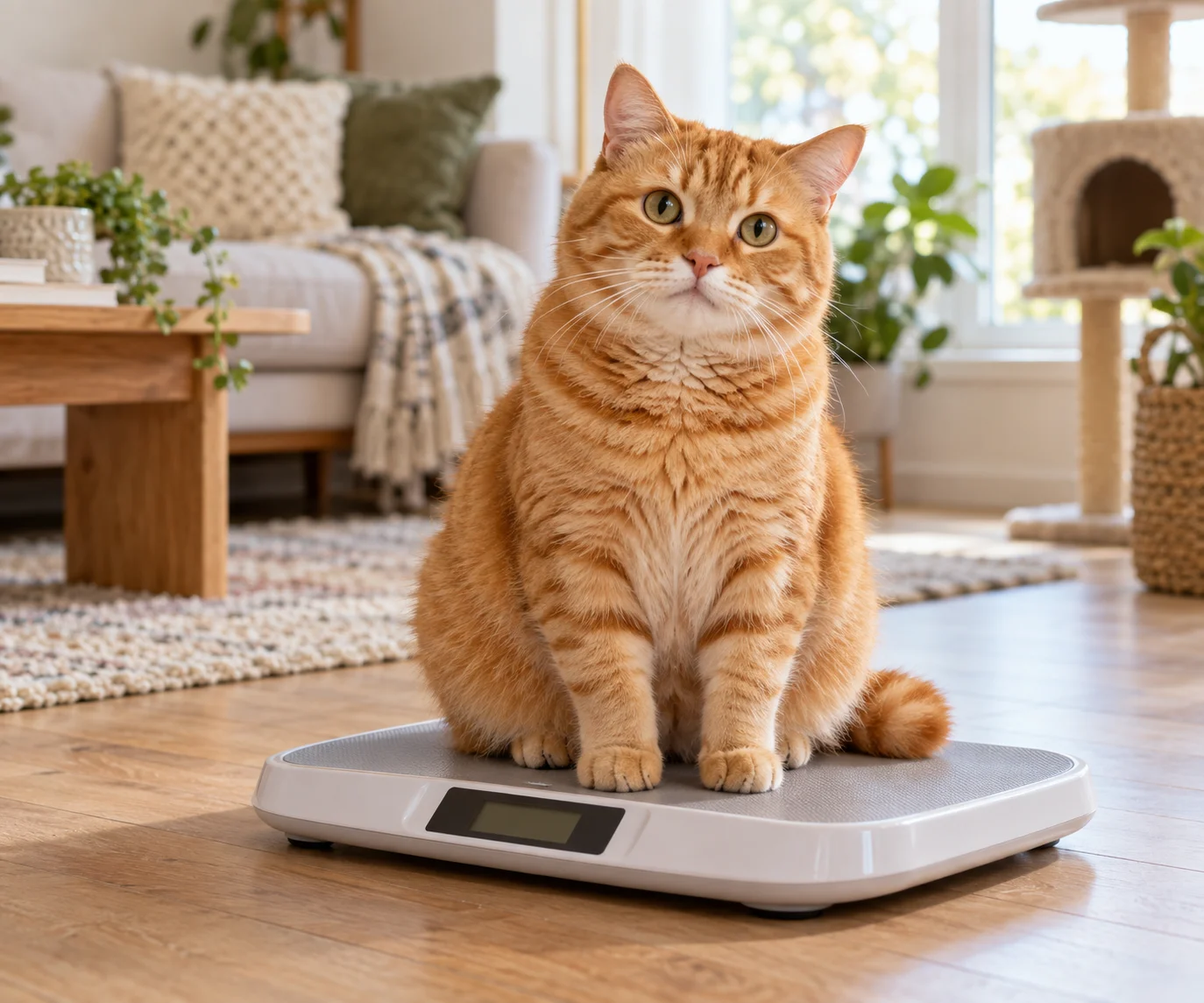

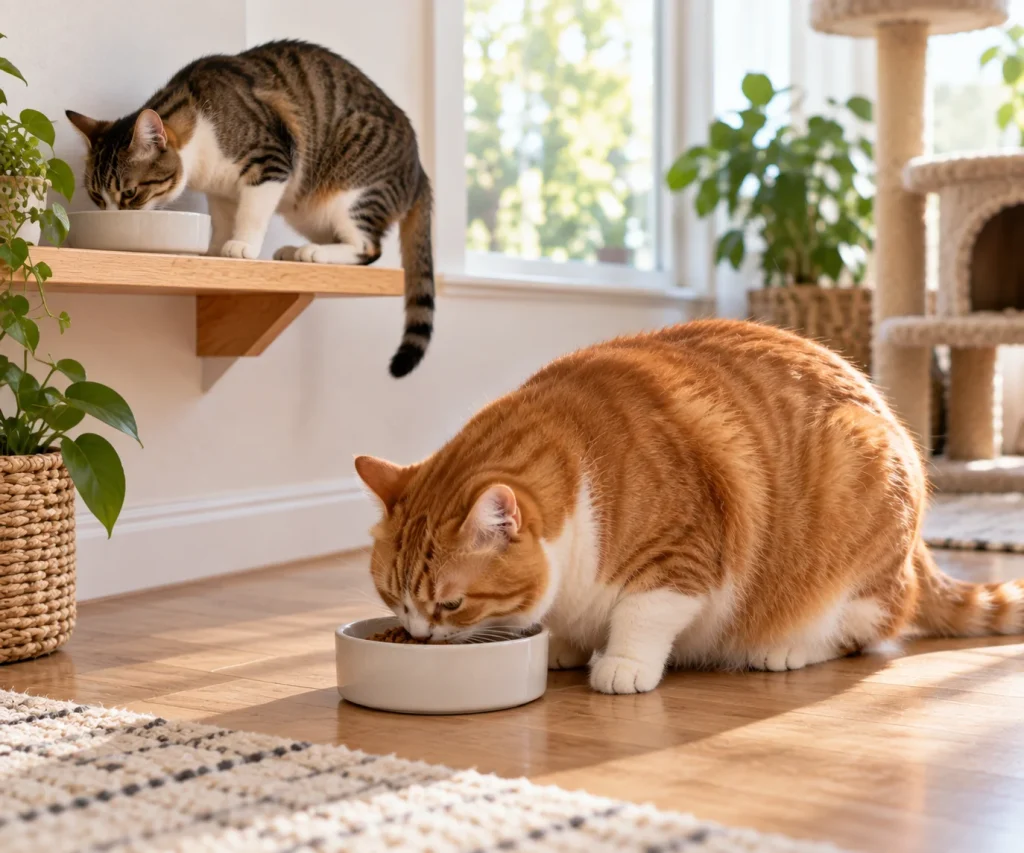
Maybe your vet brought it up at the last checkup. Maybe you noticed it yourself: the waist has disappeared, the ribs are hard to find, and jumping onto the couch now takes a running start. You want to help your cat slim down, but you have also read that dieting can be dangerous for cats. Both of those things are true, and this guide shows you how to handle them together.
Quick answer: The safest way to help your cat lose weight is slowly and with your veterinarian’s guidance. Your vet confirms that your cat is overweight and healthy enough to diet, then sets a target weight and a starting calorie amount. At home, you feed that amount in measured meals, count every treat, add daily play, and weigh your cat regularly so the plan can be adjusted. Most veterinary guidelines aim for roughly 0.5–2% of body weight per week, and a cat that stops eating needs veterinary attention the same day.
This guide explains how a cat weight loss plan works so you can follow your vet’s instructions with confidence. It is not a feeding prescription for your cat. Individual targets, calorie amounts, and adjustments should always be confirmed with your veterinarian.
Table of Contents
Why Cat Weight Loss Is Different From Human Dieting
For people, “eat a lot less and lose weight fast” is usually just uncomfortable. For cats, it can be dangerous. When an overweight cat eats too little, its body starts moving stored fat to the liver faster than the liver can process it. The result is hepatic lipidosis, or fatty liver disease. The Merck Veterinary Manual describes it as the most common acquired liver disease in cats and a potentially fatal one, typically set off when an overconditioned cat stops eating or goes without food.
That is why crash diets, skipped meals, and suddenly cutting your cat’s food in half are off the table. Safe weight loss in cats is deliberately slow, carefully measured, and monitored. It takes longer, but it protects your cat’s liver and helps preserve muscle while the fat comes off.
Is Your Cat Actually Overweight?
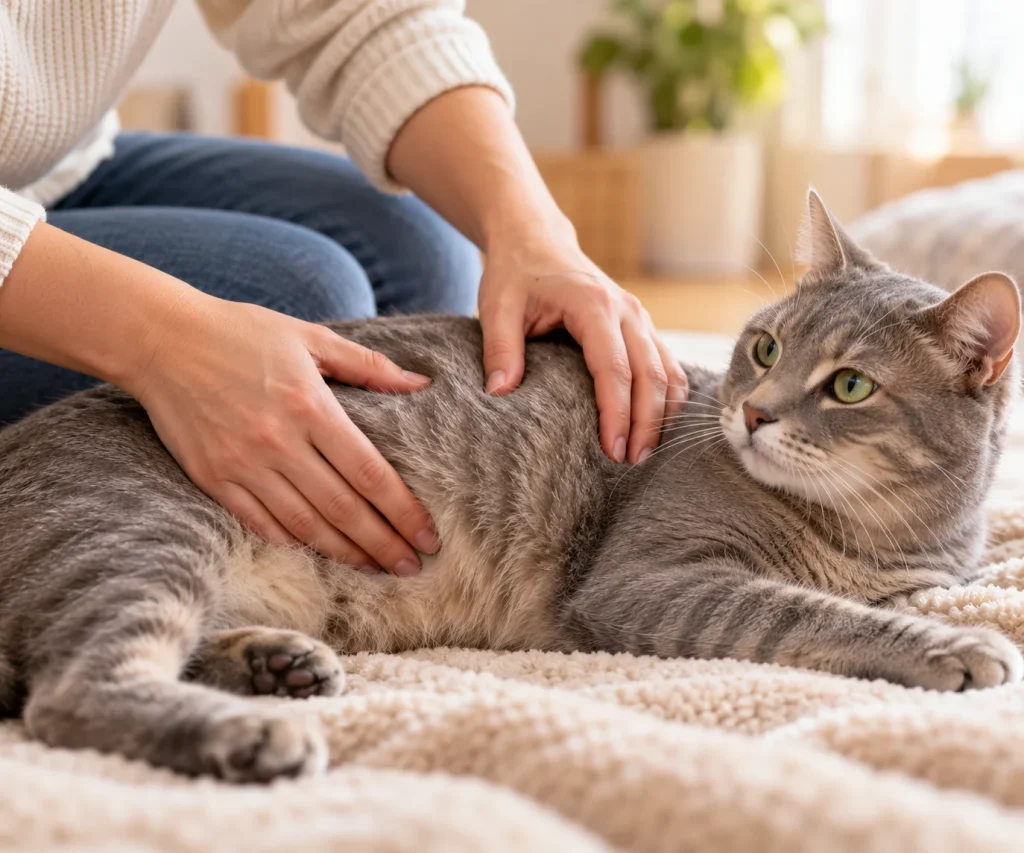
The number on the scale only tells part of the story. A large-framed cat can be lean at a weight that would be obese for a small, fine-boned cat. That is why veterinarians use a body condition score (BCS), a hands-on assessment of how much fat your cat is carrying.
On the widely used 9-point scale, 5 is ideal. According to the WSAVA cat body condition score chart, a cat at 5/9 is well proportioned, with ribs you can feel under a slight fat covering and a visible waist behind the ribs. At 7/9, the ribs are hard to feel through moderate fat and the waist is difficult to see. At 8 and 9, the ribs cannot be felt, the waist is gone, and fat deposits appear over the lower back. The same chart notes that a score of 6/9 may be acceptable for some cats, particularly older ones.
You can get a rough idea at home:
- Ribs: Run your hands along your cat’s sides. You should be able to feel the ribs without pressing hard.
- Waist: Look down from above. There should be a gentle inward curve behind the ribs.
- Belly: From the side, look for a slight tuck. Many cats have a loose flap of skin between the back legs (the primordial pouch), so judge the belly together with the ribs and waist rather than on its own.
MyyCat’s Cat Body Condition Score Calculator walks you through these checks step by step. It is a useful way to record where your cat is starting from and to share observations with your vet, but your veterinarian’s hands-on assessment is what the plan should be built on.
Why Extra Weight Matters
An overweight cat is not just a rounder cat. VCA Animal Hospitals notes that obese cats are about three times more likely to develop type 2 diabetes than cats at a normal weight, and that excess weight is linked to arthritis, heart disease, high blood pressure, and shorter lives. Heavy cats may also struggle to groom themselves and move less, which makes early signs of illness easier to miss. If your cat is older and stiff, extra weight adds load to already sore joints, a topic covered in MyyCat’s guide to cat arthritis.
How to Help Your Cat Lose Weight: The Step-by-Step Plan
Every successful cat weight loss plan has the same basic parts: a veterinary starting point, a realistic goal, a controlled calorie budget, accurate measuring, more movement, and regular check-ins. Here is how each step works in practice.
Step 1: Start With a Veterinary Exam
Before changing how much your cat eats, have your vet examine them. VCA advises that an obese cat should never be put on a diet without veterinary supervision, and your vet may recommend blood work to check for problems that would affect the plan. Diabetes, arthritis, heart or kidney disease, and certain medications can all change what a safe diet looks like.
It also works the other way. If your cat is losing weight without trying, or eating ravenously while getting thinner, that is not a diet success; it is a reason to see the vet. Conditions such as cat hyperthyroidism can cause exactly that pattern.
To make the appointment more productive, bring:
- The exact brand and formula of every food your cat eats, ideally with the packaging or a photo of the label
- A food diary from the last several days: every meal, treat, topper, and bit of table food
- Notes on who feeds the cat, and whether other pets’ food is accessible
VCA explains that a food diary lets your vet estimate what your cat is actually eating now, so the diet can start from a realistic number rather than a guess.
Step 2: Agree on a Target Weight
Your vet will estimate an ideal weight based on your cat’s body condition, frame, and muscle. Generic weight charts cannot do this for an individual cat. If your cat has a lot to lose, your vet may set an interim goal first and reassess once your cat gets there, which also keeps the process from feeling endless.
Step 3: Set a Starting Calorie Budget, Not a Crash Diet
How many calories should a cat eat to lose weight? There is no single safe number for every cat. Veterinarians use several equations, and VCA stresses that the result is only a starting point for an average cat; your cat may need more or fewer calories, and the amount usually needs adjusting over time.
Two principles are common to most approaches. First, calories are typically based on your cat’s target weight, not their current weight. Second, the reduction is moderate. Cats are not starved into losing weight; they are fed a controlled, complete diet that creates a gentle deficit.
If you would like to understand the numbers your vet is working with, MyyCat’s Cat Calorie Calculator estimates daily energy needs from weight and lifestyle. Use it as a conversation starter with your vet, not as a way to set a diet on your own.
Step 4: Choose the Right Food for Weight Loss
This step surprises many owners. It might seem logical to just feed less of your cat’s current food, or to buy a bag labeled “light” or “indoor.” But VCA points out that there are no over-the-counter weight-loss diets for cats. Retail foods with weight claims are still adult maintenance diets, and feeding them in restricted amounts can leave your cat short on essential nutrients.
Veterinary therapeutic weight-loss diets are formulated for exactly this situation. They generally have fewer calories per cup or can, more protein to help preserve lean muscle, more fiber to help your cat feel full, and a higher concentration of vitamins and minerals, so your cat still meets their requirements while eating fewer calories. MyyCat’s guide to cat protein sources explains why protein matters so much for cats in particular.
Whatever food your vet recommends, switch gradually. VCA suggests moving in stages from 25% new food up to 100% over roughly one to three weeks, depending on how your cat tolerates it. MyyCat’s guide on how to change cat food safely covers the transition in detail. If your cat refuses the new food, contact your vet rather than waiting it out; going without food is the one thing a dieting cat must not do.
Step 5: Measure Every Meal, Preferably in Grams
A controlled diet only works if the portions are actually controlled. Free-feeding, topping up the bowl whenever it looks low, or eyeballing a scoop makes it almost impossible to know what your cat is eating.
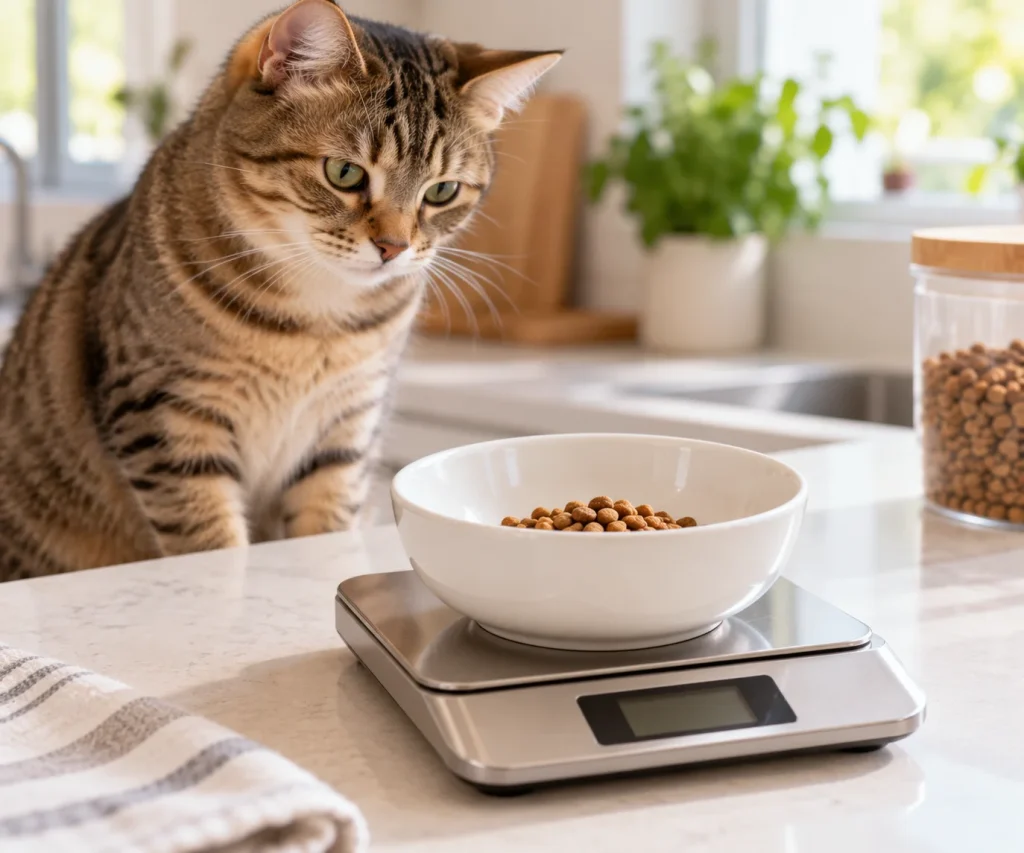
VCA recommends asking your vet for the daily amount in grams and using a kitchen scale, because measuring cups are imprecise and small errors add up quickly for an animal this size. A gram scale also makes small adjustments easy. To convert a calorie budget into grams, look for the calories per kilogram (kcal/kg) on the food label. MyyCat’s Cat Food Label Calculator can help you read the numbers on the bag or can.
Divide the daily amount into set meals. There is no single best schedule: VCA notes that studies disagree on whether smaller, more frequent meals or fewer, larger meals keep cats more satisfied. What matters is that the daily total stays consistent. A portion-controlled automatic feeder can help if your cat wakes you up for breakfast, because your cat learns to wait for the feeder instead of you.
Step 6: Budget Treats and Hidden Calories
Your cat does not have to give up treats. VCA and the Association for Pet Obesity Prevention (APOP) both suggest treats and extras make up no more than about 10% of daily calories, with those calories counted inside the daily total, not added on top. MyyCat’s Cat Treat Calculator shows how many of your cat’s specific treats fit that budget, and the cat treats guide covers healthier options.
An easy trick is to set aside a few pieces of your cat’s measured daily kibble to use as treats. Then look for the calories that slip through without anyone noticing:
- Food wrapped around pills, and lickable or squeeze treats
- Bites of human food, milk, or butter from a plate
- A second breakfast from another family member who did not know the cat was already fed
- The dog’s bowl, or another cat’s leftovers
A shared feeding log on the fridge or a family group chat is often the simplest fix. APOP emphasizes that plans work best when everyone in the household follows the same feeding and treat rules.
Step 7: Add Play and Everyday Movement
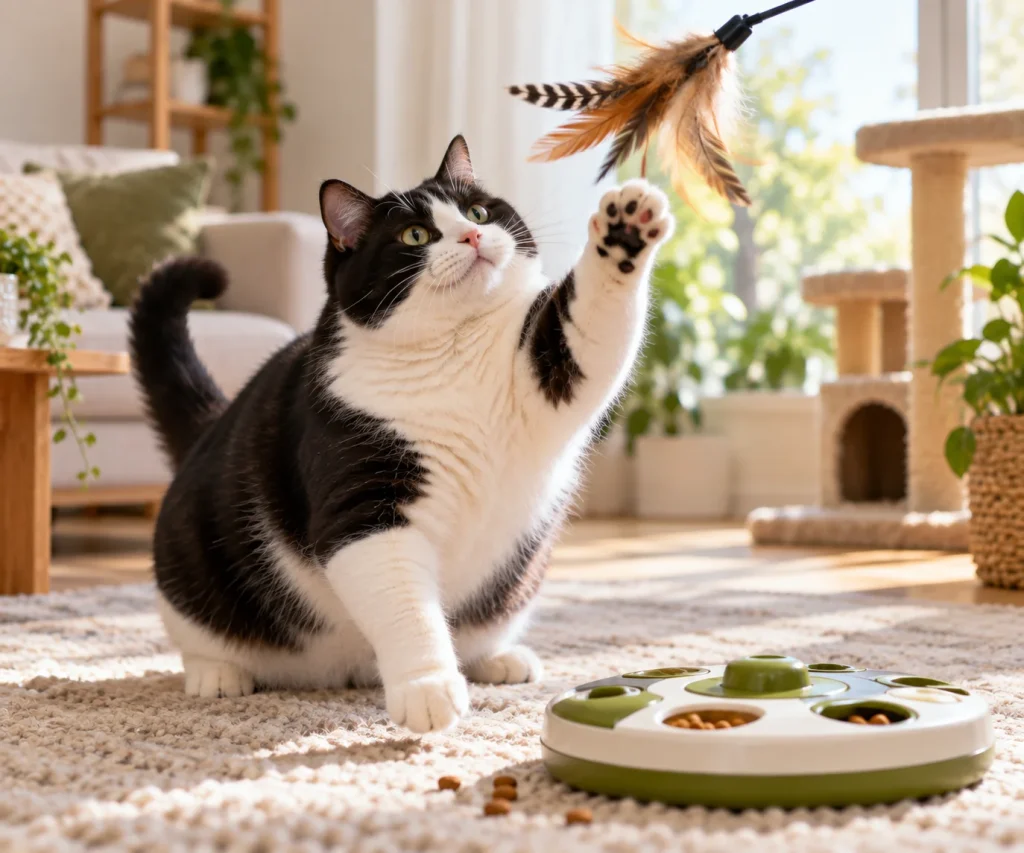
Cats are built for short bursts of activity, not long workouts, so think in minutes rather than miles. VCA suggests aiming for about ten minutes of active play twice a day, along with small changes that make your cat move for food:
- Use wand toys, balls, or crinkle toys, and end each session with a successful “catch”
- Serve part of the daily ration in a food puzzle or treat ball
- Toss kibble down a hallway for your cat to chase
- Move the food bowl upstairs, downstairs, or far from your cat’s favorite nap spot
Start gently and adjust for age, joint pain, and breathing. A heavy, arthritic cat should not be pushed into jumping. Play also helps with food-seeking behavior, since some cats “beg” out of boredom rather than hunger. MyyCat’s guide on how to tell if your cat is bored has more enrichment ideas that do not involve food.
Step 8: Weigh In, Track, and Adjust
This is where most home plans fall apart, and where the real safety net lies. VCA recommends a recheck within one week of starting the diet, another within one to two weeks after the food transition, and weigh-ins at least every other week until your cat reaches the goal. Your vet may let you weigh at home with a baby or pet scale and report the numbers, with periodic clinic visits to confirm accuracy.
For home weigh-ins, use the same scale at the same time of day, ideally before breakfast, and write every result down. The traditional method of weighing yourself holding the cat and subtracting your own weight is usually too imprecise to detect the small weekly changes you are looking for.
Worked Example: What a Cat Weight Loss Plan Might Look Like
Illustrative only. The cat, numbers, and food below are invented to show how the math fits together. They are not a recommendation for your cat. Your veterinarian sets your cat’s target weight, calorie amount, and food.
Meet “Milo,” a fictional 7-year-old indoor cat who weighs 16 lb (about 7.3 kg). His vet scores him 8/9 and, after an exam and blood work, sets a target of about 11 lb (5.0 kg).
- Estimating energy needs at the target weight. One equation used by the Cornell Feline Health Center is 30 × weight in kg + 70. For a 5.0 kg target: 30 × 5 + 70 = 220 kcal per day.
- Setting a starting point below that. In Cornell’s example, a cat was fed about 70% of that figure to lose weight gradually. Other veterinary approaches use a somewhat different percentage or start from a food diary. For Milo, those approaches would land somewhere around 155–175 kcal per day. His vet chooses 160 kcal per day as the starting amount.
- Setting aside a treat budget. About 10% of 160 kcal is 16 kcal for treats, leaving 144 kcal for his main food.
- Converting calories to grams. Milo’s prescribed food lists 3,600 kcal/kg, which is 3.6 kcal per gram. 144 ÷ 3.6 = 40 grams of food per day, split into three meals of about 13 grams.
- Knowing what “on track” looks like. At 7.3 kg, 1% of body weight is about 73 grams (roughly 2.6 oz) and 2% is about 146 grams (roughly 5.1 oz) per week. His vet would expect a loss somewhere within or below that range, not above it.
Here is what the first few entries of Milo’s log might look like:
| Week | Weight | Change since last weigh-in | Eating normally? | Action |
|---|---|---|---|---|
| 0 | 7.30 kg | — | Yes | Start plan; begin food transition |
| 2 | 7.20 kg | −100 g (about 0.7% per week) | Yes | On track; continue |
| 4 | 7.08 kg | −120 g (about 0.8% per week) | Yes | On track; continue |
| 6 | 7.06 kg | −20 g (about 0.1% per week) | Yes | Check for hidden calories; ask vet before changing portions |
Notice what does not happen in week 6. Milo’s owner does not decide to cut his food in half. A slowdown is common and is a reason to check the basics and talk to the vet, not to crash-diet.
Weight-Tracking and Adjustment Table
Use this table to interpret your weigh-ins. Calculate the average weekly change as a percentage of your cat’s current weight. The actions are prompts to discuss with your vet, not permission to make big changes on your own.
| What you see | What it may mean | What to do |
|---|---|---|
| Cat has eaten little or nothing for 24 hours, or is eating much less than usual | Risk of hepatic lipidosis or another illness | Pause the plan and contact your vet the same day |
| Losing more than 2% of body weight per week | Too fast; muscle loss and liver risk increase | Re-weigh to confirm, then contact your vet promptly |
| Losing about 1–2% per week | A typical target range for many cats | Continue as planned; keep logging |
| Losing about 0.5–1% per week | Slower, but may be exactly what your vet intended, especially for very obese cats | Continue unless your vet wants a different pace |
| Little or no change for 3–4 weeks | Hidden calories, measuring errors, or a starting amount that is too high | Audit treats, other pets’ food, and portions; ask your vet about a small adjustment |
| Weight going up | Extra food access, often in multi-cat homes or from other family members | Review who feeds the cat and when; talk to your vet |
| Vomiting, diarrhea, lethargy, or hiding | Food intolerance or illness | Contact your vet before continuing |
Why Do the Numbers Online Disagree?
If you have searched “how fast should a cat lose weight,” you have probably seen different answers. The American Animal Hospital Association (AAHA) says cats should lose no more than 1–2% of body weight per week. VCA gives the same 1–2% range but says closer to 0.5% may be more appropriate for severely obese cats. APOP uses a planning range of about 2–5% per month and advises contacting your vet if weekly loss goes above 2%. Calorie formulas vary too, with some starting at 70% of ideal-weight needs and others at a different percentage or from what the cat currently eats.
These are not really contradictions. They reflect different starting points, different levels of obesity, and different levels of caution, and they all agree on the important parts:
- Weight loss should be gradual, never rapid
- Any formula only produces a starting point
- The real plan comes from what your cat’s scale does over the following weeks
- A cat that stops eating is an emergency, whatever the numbers say
So rather than choosing the most aggressive number you can find, let your vet set the pace and use your weigh-ins to fine-tune it together.
Warning Signs: When to Pause the Plan and Call Your Vet
APOP is clear: if your cat stops eating or eats much less than usual, pause the weight-loss plan and contact your veterinary team, and a cat that has eaten little or nothing for 24 hours needs to be seen the same day. Also call your vet promptly if you notice:
- A yellow tint to the gums, inner ears, or whites of the eyes
- Vomiting, diarrhea, or drooling
- Lethargy, weakness, or hiding more than usual
- Weight dropping faster than your vet planned
- Increased thirst or urination, or any other change that worries you
For a broader checklist of illness signs, see MyyCat’s guide on how to tell if your cat is sick.
Weight Loss in Multi-Cat Homes
When one cat needs to lose weight and another does not, food theft can quietly undo the whole plan. VCA and APOP suggest:
- Feeding in separate rooms with the door closed, then picking up leftovers after a set time (VCA suggests about 15–30 minutes)
- Feeding the lean cat up high, where a heavier cat cannot easily reach
- Using a microchip-activated feeder that opens only for the right cat
- Never leaving food out while you are away, since you cannot control who eats what
In some homes, both cats can eat the same weight-management food in different portions. Ask your vet whether that is appropriate for your other cat.
Common Mistakes to Avoid
- Cutting food drastically to “speed things up”
- Feeding less of a regular maintenance food instead of a diet designed for calorie restriction
- Measuring with a scoop or by eye instead of weighing portions
- Forgetting that treats, pill pockets, and table scraps count
- Switching between foods without having your vet recheck the math
- Skipping weigh-ins, so nobody notices when progress stalls or goes too fast
Keeping the Weight Off
Reaching the target weight is a milestone, not the finish line. Once your cat gets there, ask your vet to calculate a maintenance amount and whether to stay on the same food. Increase portions only as directed, keep weighing your cat regularly, and recheck body condition at every vet visit. The habits that got the weight off, such as measured meals, a treat budget, and daily play, are the same ones that keep it off. MyyCat’s guide on how much to feed your cat covers long-term portion control for healthy adult cats.
Frequently Asked Questions About Cat Weight Loss
How fast should a cat lose weight?
Gradually. Common veterinary guidance falls between about 0.5% and 2% of body weight per week, with slower rates often preferred for very obese cats. Losing more than 2% a week is a reason to contact your vet. Your veterinarian will set the right pace for your cat.
How long does it take for a cat to lose weight?
It depends on how much your cat needs to lose and the pace your vet sets. VCA notes that losing 1% per week takes twice as long as losing 2%. For a cat with several pounds to lose, reaching the goal often takes many months, and a year or more is not unusual. APOP cautions that no fixed timeline fits every cat.
How many calories should a cat eat to lose weight?
There is no universal number. Your vet estimates a starting amount, usually from your cat’s target weight and current intake, then adjusts it based on weigh-ins. Any figure you see online, including the example in this article, is not a prescription for your cat.
Can I just feed my cat less of their current food?
It is not the recommended approach. VCA explains that regular retail foods, including “light” formulas, are maintenance diets, and restricting them can leave your cat short on nutrients. A veterinary weight-loss diet is designed to be fed in reduced calories while still meeting nutritional needs.
Is wet food better for cat weight loss?
Wet food usually provides fewer calories for the same volume, which some cats find more satisfying, and veterinary weight-loss diets come in both wet and dry forms. APOP notes that no single food format is best for every cat, so let your vet choose based on your cat’s health and preferences.
My cat keeps begging. What should I do?
Offer attention, play, or brushing instead of food, use an automatic feeder for set mealtimes, and keep fresh water available. Begging often reflects routine or boredom as much as hunger. If begging is new or intense, or comes with weight loss or increased thirst, mention it to your vet. MyyCat’s cat hydration guide has tips for encouraging your cat to drink.
Key Takeaways
- To help your cat lose weight safely, start with a vet exam, a body condition score, and a target weight.
- Cat weight loss must be gradual. Rapid loss or not eating can trigger hepatic lipidosis.
- Use the food your vet recommends, weigh portions in grams, and keep treats to about 10% of daily calories.
- Add short, daily play sessions and food puzzles.
- Weigh your cat regularly, log the results, and let your vet guide any adjustments.
- A cat that eats little or nothing for 24 hours needs to see a vet the same day.
More From MyyCat
Keeping track of body condition, calories, and treats is easier with the right tools. You can find every free calculator mentioned here, plus feeding and grooming planners, on the MyyCat cat care tools page. And if you prefer to read about cat care away from a screen, take a look at MyyCat’s books.
This article is for informational and educational purposes only and is not a substitute for professional veterinary diagnosis, treatment, or advice. Please read our veterinary disclaimer.
Sources & References
- VCA Animal Hospitals — Following a Weight Loss Plan for Cats
- Association for Pet Obesity Prevention — How to Help Your Cat Lose Weight Safely
- American Animal Hospital Association — Feline Fitness: How to Help Your Cat Lose Weight
- Cornell Feline Health Center — Ask Elizabeth: Care of Obese Cats
- World Small Animal Veterinary Association — Cat Body Condition Score Chart
- Merck Veterinary Manual — Feline Hepatic Lipidosis