
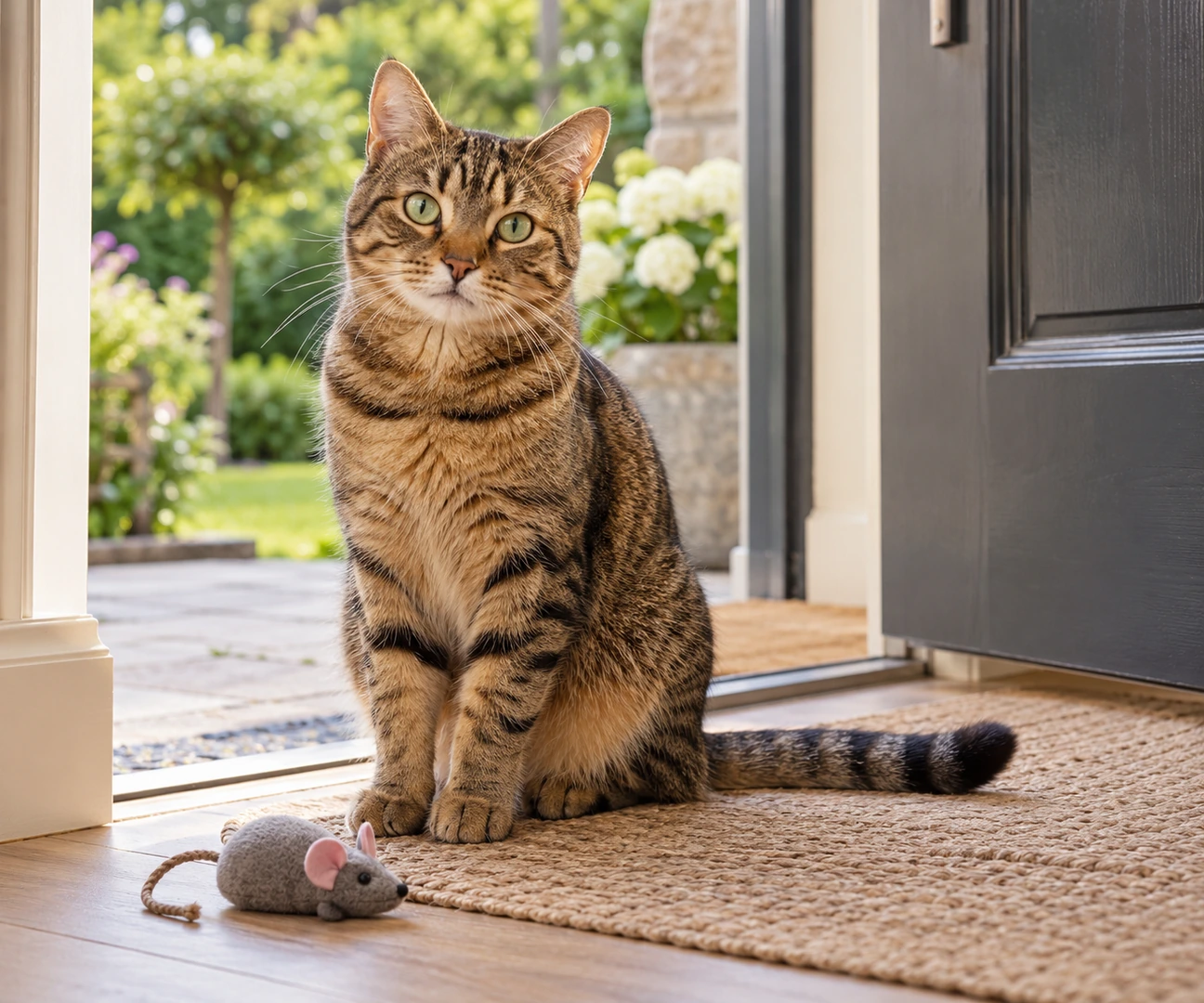

Quick answer: If you have ever wondered why do cats bring you dead animals, the best-supported explanation is less sentimental than the “gift” story. Cats hunt even when they are well fed, and a cat that isn’t hungry enough to eat its catch will often carry it back to the place it feels safest your home. The idea that your cat is thanking you, or teaching you to hunt, is a popular interpretation, but there is no good evidence for it. The behavior is normal, it shouldn’t be punished, and there are practical, research-backed ways to reduce it.
This guide separates what is known from what is guesswork, explains what to do when a dead (or very much alive) animal appears on your floor, and covers the health points worth knowing.
Table of Contents
Hunting isn’t about hunger
The first thing to understand is that a well-fed cat still hunts. International Cat Care explains that the motivation to hunt is only partly related to hunger: cats are opportunistic predators that evolved to catch small prey whenever the chance arises, because hunting attempts often fail and the next meal is never guaranteed. A full food bowl doesn’t switch that drive off.
What hunger does seem to affect is what happens after the catch. International Cat Care notes that cats are more likely to kill and eat their prey when they are hungry. A pet cat that has just eaten may catch something, lose interest in eating it, and carry it somewhere else instead.
Most prey never makes it home
What you find on the doormat is only part of the picture. In a well-known study, researchers fitted small video cameras to 55 free-roaming pet cats in Athens, Georgia (USA). About 44% of the cats were recorded hunting. Of the prey they caught, 23% was brought back to the house, 28% was eaten, and 49% was simply left where it was caught (Loyd et al., 2013, Biological Conservation). The study involved cats in one area of the United States, so the exact proportions won’t apply everywhere — but it shows that a cat that rarely brings anything home may still be hunting.

Why do cats bring you dead animals? The explanations, by strength of evidence
Many articles present a list of reasons as if they were equally proven. They aren’t. Here is how the common explanations compare.
Well supported: the cat is taking its catch somewhere safe
Welfare charity Cats Protection explains that cats bring prey home because home is where they feel safe and secure — somewhere to eat or handle the catch without being disturbed. Combined with the point above, this fits what owners see: a satisfied cat catches something, carries it back to its core territory, and then may not bother eating it.
Possible, but unproven: an echo of feeding kittens
Mother cats bring prey back to their kittens, and some commentators suggest pet cats are doing something similar with their owners. It’s an interesting idea, but it hasn’t been tested in a way that shows cats are deliberately provisioning or “teaching” people, and neutered males bring prey home too. Treat it as a hypothesis, not an explanation.
Myths worth dropping
- “It’s a thank-you gift.” There’s no evidence cats intend prey as a present. Cats Protection says plainly that they are not giving gifts or teaching hunting skills.
- “Your cat thinks you’re a bad hunter.” This assumes your cat is judging your hunting ability and setting out to train you. Nothing in the research supports that.
- “Praise or punish it and the behavior will change.” Hunting isn’t driven by your reaction. Shouting won’t stop it and will only stress your cat, according to Cats Protection.
- “A bell on the collar solves it.” In a controlled UK trial, bells had no discernible overall effect on the number of animals cats brought home (see below).
None of this means your cat doesn’t value you. It means this particular behavior is best explained by hunting instinct and feeling safe at home, not by human-style gift giving.
Why some cats bring prey in alive
A live mouse loose in the kitchen is even less welcome than a dead one. International Cat Care describes the “toying” seen in cats as a conflict between the need to kill and the risk of being injured by prey that can bite or scratch, and notes that handling prey after the kill can also be a sign the cat isn’t hungry enough to eat it. Bringing a live animal home fits the same pattern: the cat takes its catch somewhere safe and carries on the sequence there.
Indoor cats that bring you toys
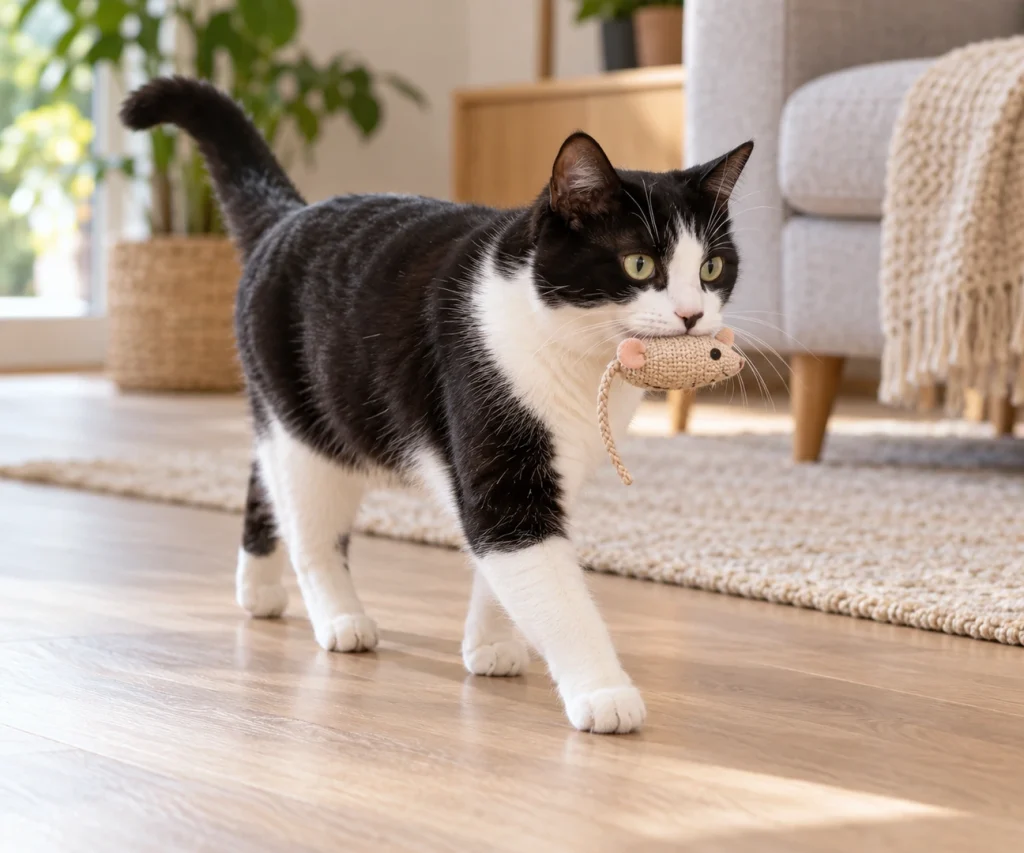
Indoor cats often carry toys into the room where you are, drop them at your feet, or leave them in their bed or food bowl. This is the same stalk–catch–carry sequence directed at an object instead of a mouse, and it is normal. The most useful response is to treat it as an invitation to play: a short session with a wand toy gives the hunting drive a proper outlet. Use toys rather than hands or feet, so play doesn’t turn into biting — our guide on how to stop a cat from biting explains why. If your indoor cat also seems restless, destructive or demanding, it may be under-stimulated; see signs your cat is bored.
What to do when your cat brings you a dead or live animal
- Stay calm. Don’t shout at or chase your cat. It won’t stop future hunting and can make your cat anxious around you.
- If the animal is dead, wait until your cat has lost interest or is in another room, then pick it up with gloves or an inside-out plastic bag, seal it and put it in the outdoor bin. Clean the spot and wash your hands.
- If the animal is alive, move your cat to another room and close the door. Open a door or window so the animal has a clear route out; Cats Protection notes that most will leave on their own when given an exit.
- If a bird or other wild animal is injured, contact a vet or local wildlife rescue promptly. RSPCA veterinary guidance treats cat-caught birds as needing antibiotics even when no wound is visible, because bacteria from a cat’s mouth can cause serious infection.
Health points for your cat (and you)
Hunting isn’t only an issue for wildlife. Cats that catch and eat prey are exposed to parasites such as intestinal worms — our guide to worms in cats covers the signs and prevention. Ask your vet whether your cat’s parasite-prevention plan reflects the fact that it hunts.
Toxoplasmosis is the other question owners often ask about. The Cornell Feline Health Center explains that cats become infected by eating infected prey or raw meat, and that indoor cats that don’t hunt or eat raw meat are unlikely to be infected. Because the parasite’s eggs in cat feces need at least 24 hours to become infective, scooping the litter box daily reduces the risk to people. Wear gloves when handling prey, and if you are pregnant or have a weakened immune system, ask someone else to deal with both prey and litter where possible and speak to your doctor.
If your cat vomits, stops eating or seems unwell after eating prey, contact your vet.
How to reduce how often your cat brings prey home
You can’t remove the hunting instinct, but you can change how often it ends at your back door. The strongest evidence comes from a 12-week trial with 355 cats in 219 households in south-west England (Cecchetti et al., 2021, Current Biology). The researchers counted animals the cats brought home, so the results describe returned prey rather than every kill.
Daily play that mimics hunting
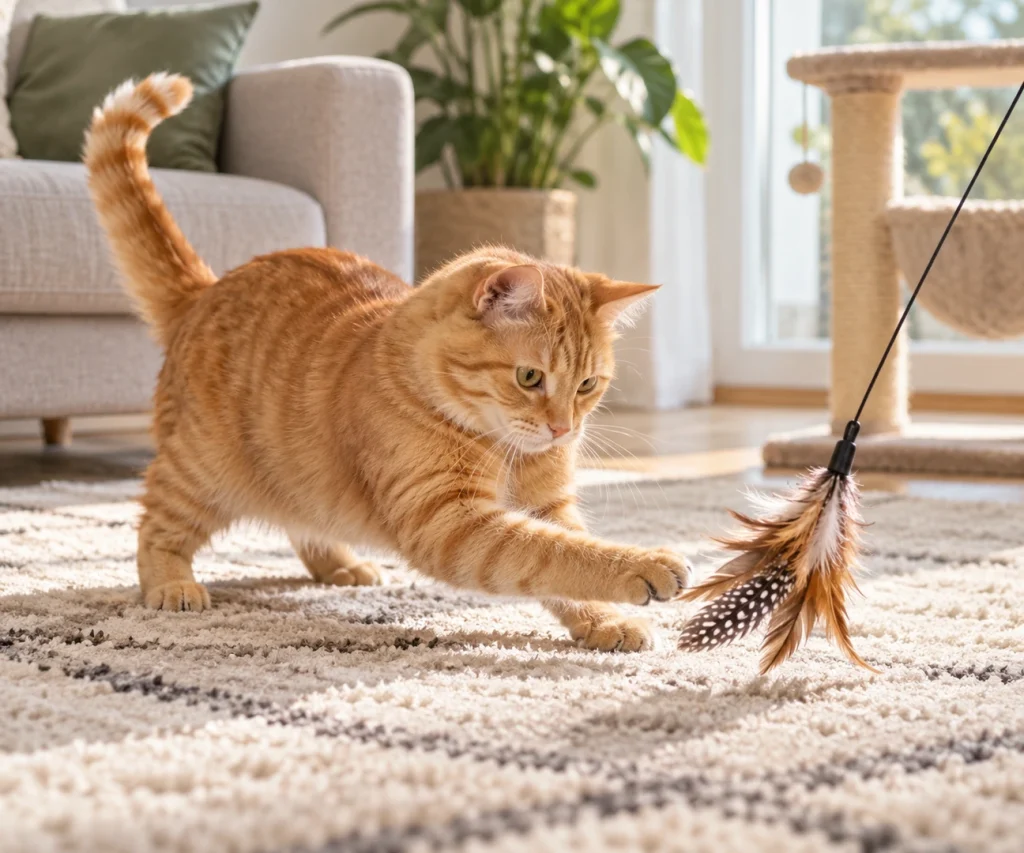
In the trial, 5–10 minutes of daily object play — owners moving a feather toy on a string, then letting the cat “catch” a toy mouse — reduced the number of animals brought home by 25%. It’s also the cheapest option on this list. Ending a session with a real catch matters, so the sequence feels complete to your cat.
A high-meat diet
Cats switched to a premium commercial food in which the protein came from meat brought home 36% fewer animals than before the switch and than control cats. The researchers didn’t identify exactly why, so this shouldn’t be read as proof that your cat’s current food is “lacking.” If you decide to change food, do it gradually — see how to change cat food safely — and check the new food’s protein content with our cat food label calculator. Our guide to protein sources in cat food explains what the ingredient list is telling you. Ask your vet first if your cat has a medical condition or a prescription diet.
One surprise from the same trial: puzzle feeders, often recommended for enrichment, were associated with cats bringing home more prey, not less. Puzzle feeders still have uses, but don’t rely on them to reduce hunting.
Keep your cat in at dawn and dusk
Both International Cat Care and Cats Protection suggest keeping cats indoors at the times prey animals are most active, such as dawn and dusk. A regular evening meal can make it easier to get your cat in before dark; our free cat feeding schedule generator can help you set a routine. If your cat tries to slip out as the door opens, our door-dashing training plan can help, and our guide to cat night behavior explains why cats are so active around twilight.
Collars: what helps and what doesn’t
In the UK trial, bells had no discernible overall effect, although individual cats varied. Brightly colored “Birdsbesafe” collar covers reduced the number of birds brought home by 42% but had no clear effect on mammals. Any collar should be a quick-release (breakaway) type.
Make the garden less of a hunting ground
Cats Protection advises keeping bird feeders and tables out of cats’ reach. For owners who want to stop hunting completely, indoor living or an enclosed outdoor space (a “catio”) is the only reliable option — International Cat Care’s guide to indoor versus outdoor access covers the trade-offs. An indoor cat then needs plenty of play and enrichment to replace what it gets from hunting.
For more planners that help with feeding and daily care, browse our free cat care tools.
Frequently asked questions
Is my cat bringing me dead animals as a gift?
Probably not in the way people mean it. The better-supported explanation is that cats carry prey to the place they feel safest, often when they aren’t hungry enough to eat it. There’s no evidence that cats intend it as a present.
Why does my cat bring prey home but not eat it?
Because hunting and hunger are only loosely linked. A well-fed cat can still feel the urge to hunt, but may not be motivated to eat what it catches.
Should I punish my cat for bringing in dead animals?
No. Punishment doesn’t reduce hunting and can damage your cat’s trust in you. Calmly remove the animal and focus on daily play, diet and keeping your cat in at dawn and dusk.
Will a bell stop my cat from hunting?
Not reliably. In a controlled UK trial, bells had no discernible overall effect on the number of animals cats brought home.
Can I catch anything from the animals my cat brings home?
Handle prey with gloves or a bag and wash your hands afterwards. Hunting cats can pick up parasites, including the one that causes toxoplasmosis, so scoop the litter box daily and ask your doctor for advice if you are pregnant or immunocompromised.
This article is for general information and is not a substitute for veterinary advice. If you are worried about your cat’s behavior or health, contact your veterinarian. See our veterinary disclaimer.