
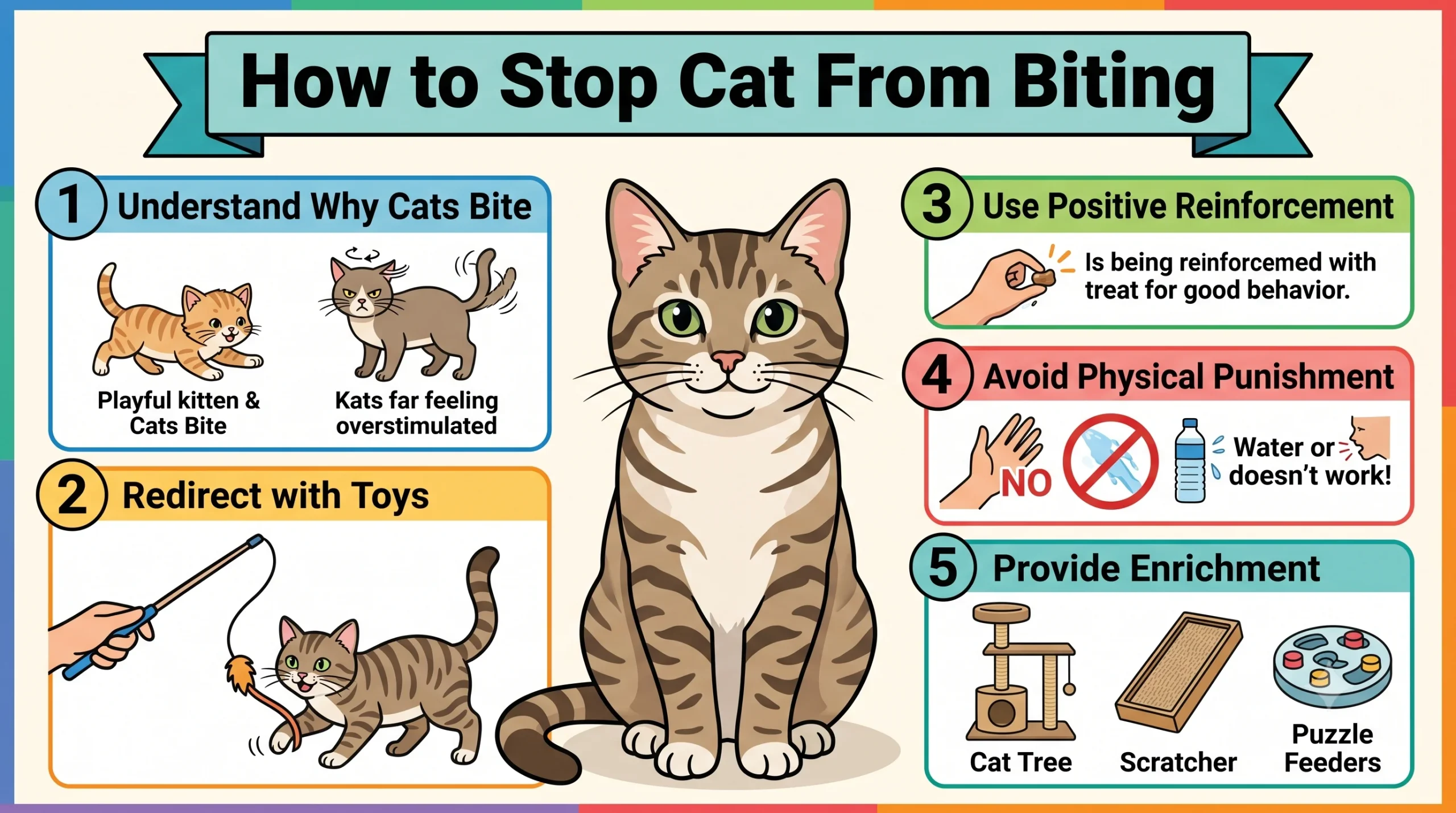

How to Stop a Cat From Biting: Causes, Training, and Safety
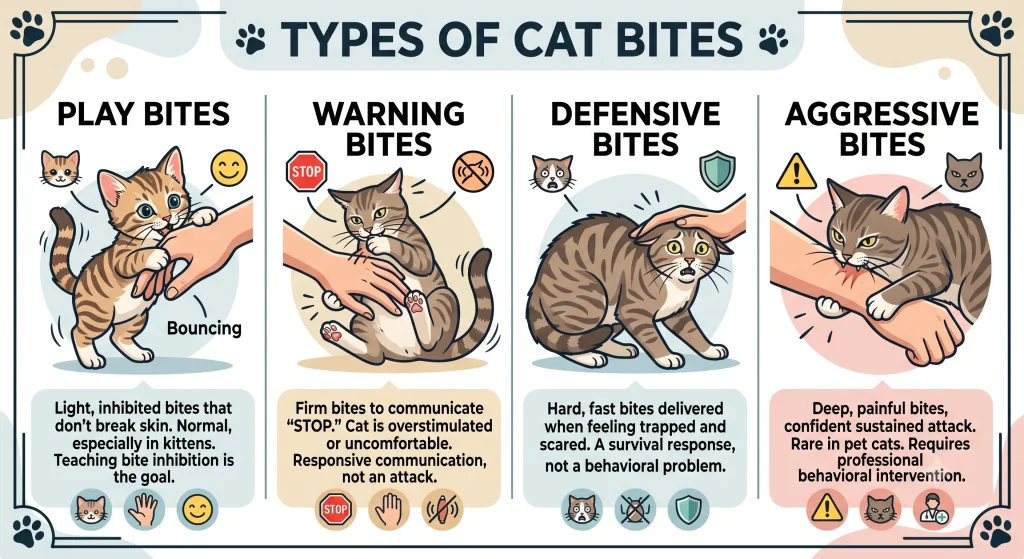
Cat biting is not one behavior with one solution. A kitten grabbing your hand during play, a frightened cat biting when cornered, a cat reacting to painful touch, and a cat biting during petting need different responses.
The goal is not to promise that every bite can be eliminated. Instead, identify the context, prevent injury, address medical or environmental causes, and teach safer alternatives where training is appropriate.
Table of Contents
Why Do Cats Bite?
Common contexts include:
- Play and predatory-style behavior: stalking, pouncing, grabbing, and biting may be directed toward moving hands or feet.
- Petting intolerance: a cat may initially accept contact and then signal that it wants the interaction to stop.
- Fear or defensive behavior: biting can occur when a cat feels threatened, trapped, restrained, or unable to escape.
- Redirected aggression: a highly aroused cat may bite a nearby person or animal that was not the original trigger.
- Pain or illness: touching, lifting, grooming, or approaching a painful cat can trigger defensive biting.
- Inter-cat conflict: tension around introductions, resources, territory, or redirected arousal can result in bites.
- Handling intolerance: nail trimming, brushing, medication, or restraint may exceed a cat’s tolerance.
For a broader discussion of aggressive behavior, see our Cat Aggression Guide.
Play Biting in Kittens and Young Cats
Kittens learn important social and motor skills through play with their mother and littermates. Early social experiences can influence later behavior, but there is no single age or simple formula that determines whether a kitten will develop rough play.
When play is directed at people:
- keep hands and feet out of wrestling games;
- use wand toys, kicker toys, balls, and other appropriate targets;
- pause the interaction if play becomes too rough;
- reward engagement with appropriate toys; and
- provide multiple opportunities for active play and exploration throughout the day.
Do not rely on a rigid requirement such as “three 20-minute sessions.” Play needs vary with age, health, temperament, and interest. If your cat seems chronically under-stimulated, see How to Tell If Your Cat Is Bored.
Petting-Induced Biting
Some cats solicit petting and later turn toward the hand, swat, or bite. This is sometimes called petting-induced aggression or petting intolerance.
The exact cause is not fully established. Cornell Feline Health Center notes that the causes of this type of aggression are unknown; possibilities include reaching a tolerance limit for physical contact or controlling when the interaction ends.
Watch for changes such as:
- tail twitching or lashing;
- ears rotating or flattening;
- the cat turning its head toward your hand;
- body or skin tension;
- pupil changes;
- freezing or attempting to move away; and
- growling, hissing, or other clear warnings.
Stop before the cat escalates. There is no evidence-based universal rule that every sensitive cat should be petted for exactly 10 or 15 seconds. Let the individual cat’s behavior determine when the interaction ends.
Fear-Based and Defensive Biting
A frightened cat may bite when it believes escape is impossible. Veterinary visits, unfamiliar people, forced handling, sudden noises, new animals, or being cornered can trigger defensive behavior.
Do not punish or pursue a frightened cat. Increase distance, provide an escape route or hiding place, and avoid unnecessary restraint. For persistent fear, see our Cat Anxiety Guide.
Redirected Biting
Redirected aggression can occur when a cat becomes intensely aroused by a stimulus it cannot reach, such as an unfamiliar cat outside a window, and then attacks a nearby person or household animal.
Do not reach for or attempt to soothe a highly aroused cat with your hands. Give the cat space and separate animals safely. Recovery time varies, so do not force contact again after an arbitrary number of minutes or hours.
If household cats become hostile after an incident, use a gradual reintroduction. Our How to Introduce Cats guide explains the process, while Are My Cats Playing or Fighting? can help distinguish social play from conflict.
Pain-Related Biting
A cat that suddenly begins biting during touch, lifting, grooming, or movement may be painful. Potential causes include arthritis, dental disease, wounds, ear or skin disease, urinary discomfort, and other medical problems.
Do not treat a sudden behavior change as a training failure. Arrange a veterinary examination, especially if biting is new or accompanied by hiding, appetite changes, reduced activity, altered grooming, limping, elimination changes, or other signs of illness.
See our How to Tell If Your Cat Is Sick and Cat Arthritis Guide for related warning signs.
Biting During Grooming or Nail Trimming
Handling can become stressful or uncomfortable, particularly when a session is prolonged, the cat has had negative experiences, or the area being handled is painful.
For a cat that is medically comfortable but fearful of routine handling, gradual desensitization and positive reinforcement can help. Work below the point at which the cat struggles or bites, and increase difficulty only when the cat remains relaxed.
For paw handling specifically, follow our Cat Nail Trimming Training Guide.
How to Stop Play Biting
For play-related biting, use a consistent strategy:
- Stop using hands as prey. Do not encourage grabbing or wrestling with bare skin.
- Offer an appropriate target. Use toys that allow stalking, chasing, pouncing, grabbing, and kicking.
- Pause rough play calmly. If teeth or claws are being used dangerously, end or reduce the interaction without yelling or physical punishment.
- Reward appropriate play. Continue enjoyable interaction when the cat engages safely with toys.
- Add environmental outlets. Scratching areas, climbing spaces, food puzzles, hiding areas, and rotating toys can expand the cat’s behavioral opportunities.
Training works best when the environment gives the cat acceptable ways to perform normal feline behaviors.
Should You Walk Away After a Bite?
Ending play can be useful when a cat becomes too rough, but a fixed “ignore for 30 seconds to two minutes” rule is unnecessary. The response should fit the situation.
If the cat is frightened, painful, or highly aroused, the priority is safety and distance—not trying to use withdrawal as a training consequence. If the behavior is playful, calmly pausing interaction can prevent rough biting from continuing to produce exciting play.
Why Punishment Is a Bad Strategy
Do not hit, yell at, scruff, spray, or otherwise punish a cat for biting. Aversive handling can increase fear and defensive behavior and may damage trust.
A warning growl, hiss, or attempt to leave is useful information. The goal should not be to suppress warnings; it should be to recognize the cat’s discomfort early enough that biting is less likely.
Environmental Enrichment Can Help
The AAFP/ISFM environmental needs guidelines emphasize safe places, separated key resources, opportunities for play and predatory behavior, positive human interaction, and respect for feline sensory needs.
Useful options include:
- vertical climbing and resting spaces;
- scratching posts or pads;
- interactive toys;
- food puzzles;
- safe hiding places;
- window views when they do not trigger territorial arousal; and
- multiple separated resources in multi-cat homes.
What If Your Cat Bites at Night?
Nighttime biting does not have one universal explanation. It may involve play, attempts to get attention, movement under bedding, fear after being startled, or another behavioral or medical issue.
Look at what happens immediately before the bite. If movement under blankets triggers stalking and pouncing, increase appropriate play opportunities and avoid reinforcing attacks on hands or feet. If the cat reacts only when unexpectedly touched while resting, avoid startling it.
If nighttime activity is the broader issue, see our Cat Night Behavior Guide.
Why Does My Cat Bite and Then Lick Me?
There is no single proven meaning. The sequence can occur during play, grooming-like social interaction, changing arousal, or when a cat alternates between accepting and rejecting contact.
Do not assume that biting followed by licking always means “overstimulation cycling,” affection, apology, or dominance. Interpret the full interaction and body language instead.
What About “Love Bites”?
The phrase “love bite” is informal and can obscure important differences. Gentle mouthing that does not injure may occur during social interaction, but harder biting, repeated biting, or a bite associated with tension or attempts to escape should not be dismissed as affection.
Cat Bites to People: What to Do
If a cat bite breaks the skin, wash the wound promptly with soap and running water. Cat bites can produce deep puncture wounds and bacterial infection even when the surface injury looks small.
Seek prompt medical advice for a bite that breaks the skin, particularly for deep punctures, bites to the hand or near a joint, or if you have an increased infection risk. Seek medical attention for increasing pain, redness, warmth, swelling, drainage, fever, or difficulty moving the affected area.
A healthcare professional or public-health authority can also advise whether tetanus or rabies management is necessary based on the exposure, your vaccination history, the animal, and local public-health recommendations.
When Cat Biting Needs Veterinary or Behavior Help
Seek professional help when:
- biting starts suddenly or becomes more severe;
- the cat may be painful or ill;
- bites are deep or repeatedly injure people;
- aggression is difficult to predict or manage safely;
- children, older adults, or medically vulnerable people are at risk;
- cats in the household cannot safely coexist; or
- behavior and environmental changes are not improving the problem.
Severe aggression may require a veterinarian and, when available, a board-certified veterinary behaviorist rather than home training alone.
Can Adult Cats Learn Safer Behavior?
Yes, many adult cats can improve when triggers are identified and the environment and human responses are changed appropriately. However, the outcome depends on the cause, history, severity, medical status, and household environment.
It is more accurate to aim for safer, lower-frequency behavior than to promise that every cat will stop biting completely.
Key Takeaways
- Find the context before choosing a solution. Play, fear, pain, petting intolerance, and redirected aggression require different responses.
- Do not promise that every bite is “fixable.” Many cases improve, but outcome depends on the underlying cause and severity.
- Keep hands out of rough play. Provide appropriate toys and reinforce safe interaction.
- Respect warning signals. Stop or change the interaction before the cat needs to escalate.
- Do not use fixed petting or play timers as universal rules. Follow the individual cat’s behavior.
- Never punish biting. Punishment can increase fear and defensive responses.
- Sudden biting can be medical. Pain and illness should be considered when behavior changes unexpectedly.
- Human bite wounds matter. Wash punctures promptly and seek appropriate medical care.
FAQ
Why does my cat bite me when I pet them?
The cat may have reached its tolerance for physical contact, become aroused, experienced discomfort, or wanted the interaction to end. The exact mechanism of petting-induced aggression is not fully established.
How do I stop my kitten from biting?
Keep hands and feet out of rough play, provide appropriate toys, pause play when it becomes unsafe, and reward engagement with acceptable targets. Consistency and appropriate play opportunities matter more than punishment.
Is my cat aggressive or just playing?
Look at the full context and body language rather than bite pressure or ear position alone. Play often includes stalking, pouncing, chasing, and reciprocal pauses, while fear or conflict may include attempts to escape, defensive postures, growling, hissing, or sustained hostility.
Should I punish my cat for biting?
No. Physical or verbal punishment can increase fear and defensive behavior. Identify the trigger, create safety, and teach or manage an appropriate alternative.
Why does my cat bite me and then lick me?
There is no single established meaning. It may occur during play, social grooming-like interaction, or changing arousal. Interpret the sequence alongside the cat’s body language and the events around it.
Can an adult cat be trained not to bite?
Many adult cats can learn safer interaction patterns, especially when the trigger is identifiable and medical causes have been addressed. Complete elimination cannot be guaranteed in every case.
When should I take my cat to the veterinarian for biting?
Arrange veterinary evaluation when biting starts suddenly, worsens, occurs with handling of a particular body area, or is accompanied by other changes in health or behavior.
What should I do if a cat bite breaks my skin?
Wash the wound promptly with soap and running water and seek appropriate medical advice, particularly for deep punctures, bites to the hand or near a joint, signs of infection, or possible rabies exposure.
Sources & References
- Cornell Feline Health Center: Aggression
- UC Davis School of Veterinary Medicine: Managing Your Kitten’s Rough Play
- AAFP/ISFM: Feline Environmental Needs Guidelines
- Merck Veterinary Manual: Behavior Problems in Cats
- CDC: Cats and Human Health
MyyCat provides educational information for cat caregivers and is not a substitute for individualized veterinary, medical, or veterinary behavior advice.
[…] outlet. Use toys rather than hands or feet, so play doesn’t turn into biting — our guide on how to stop a cat from biting explains why. If your indoor cat also seems restless, destructive or demanding, it may be […]