
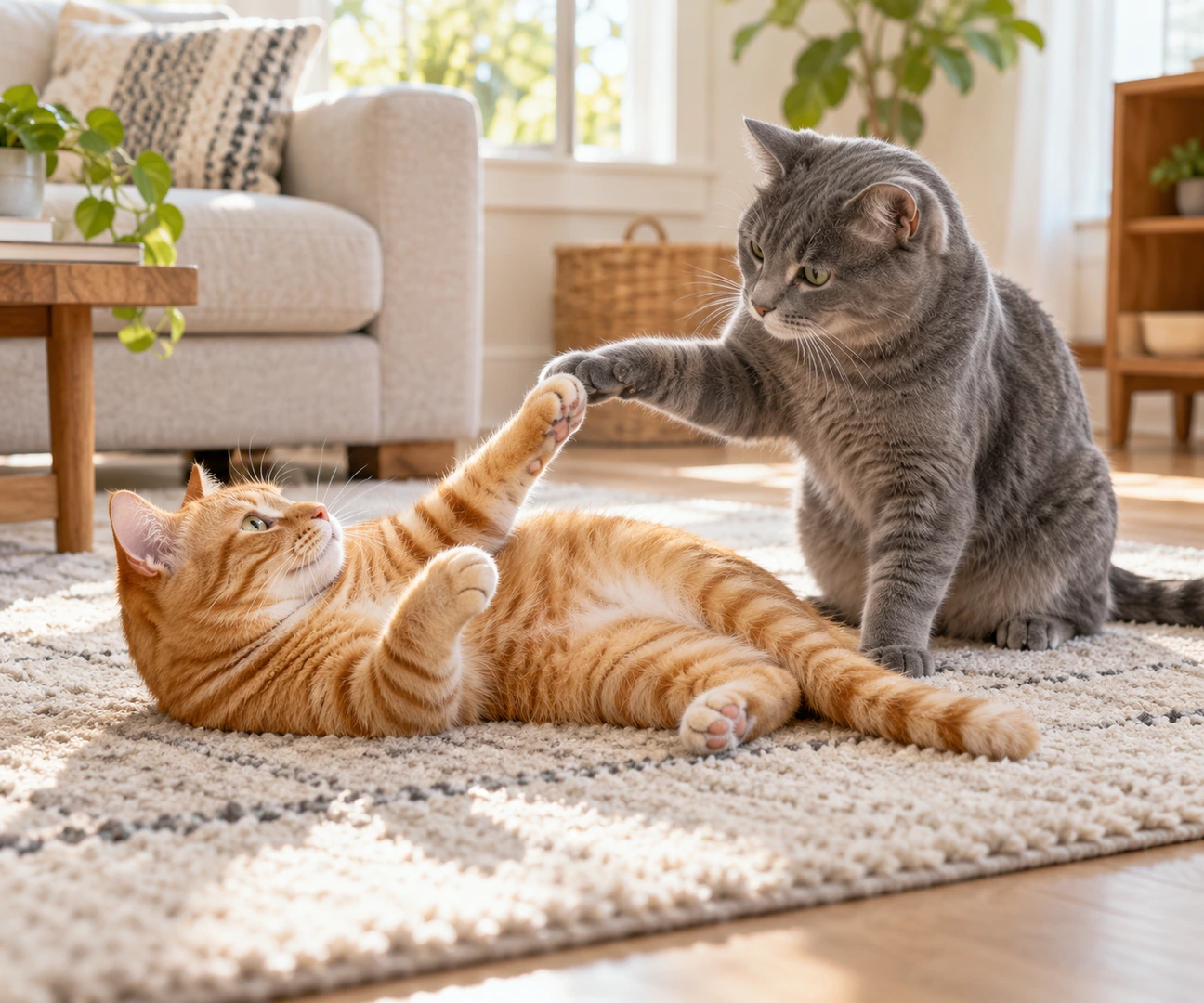

Two cats rolling across the floor in a tangle of paws can look worrying, and it is often hard to tell in the moment whether you’re watching a game or the start of a fight. If you’re asking yourself “are my cats playing or fighting?”, the good news is that there are reliable clues and they are found less in any single movement than in the overall pattern: how noisy the interaction is, whether both cats are joining in, and how they behave once it’s over.
This guide explains what normal play fighting looks like, the signs of a real fight, what a 2023 study of cat interactions actually found, the quieter signs of conflict that owners often miss, and how to step in safely when play turns into something more serious.
Table of Contents
Are my cats playing or fighting? The quick answer
Cats that are playing usually wrestle with little or no noise, take turns being the chaser and the one being chased, pause and restart on their own, and carry on as normal afterwards. Cats that are fighting are more likely to hiss, growl or yowl; one cat tends to do most of the chasing while the other tries to get away; and the tension lingers after the scuffle ends.
Many interactions fall somewhere in between, which is why no single sign a flattened ear, a swishing tail, one loud noise should be treated as proof either way. Look at the combination of signals, the context, and how the two cats get along the rest of the time.
What normal cat play fighting looks like
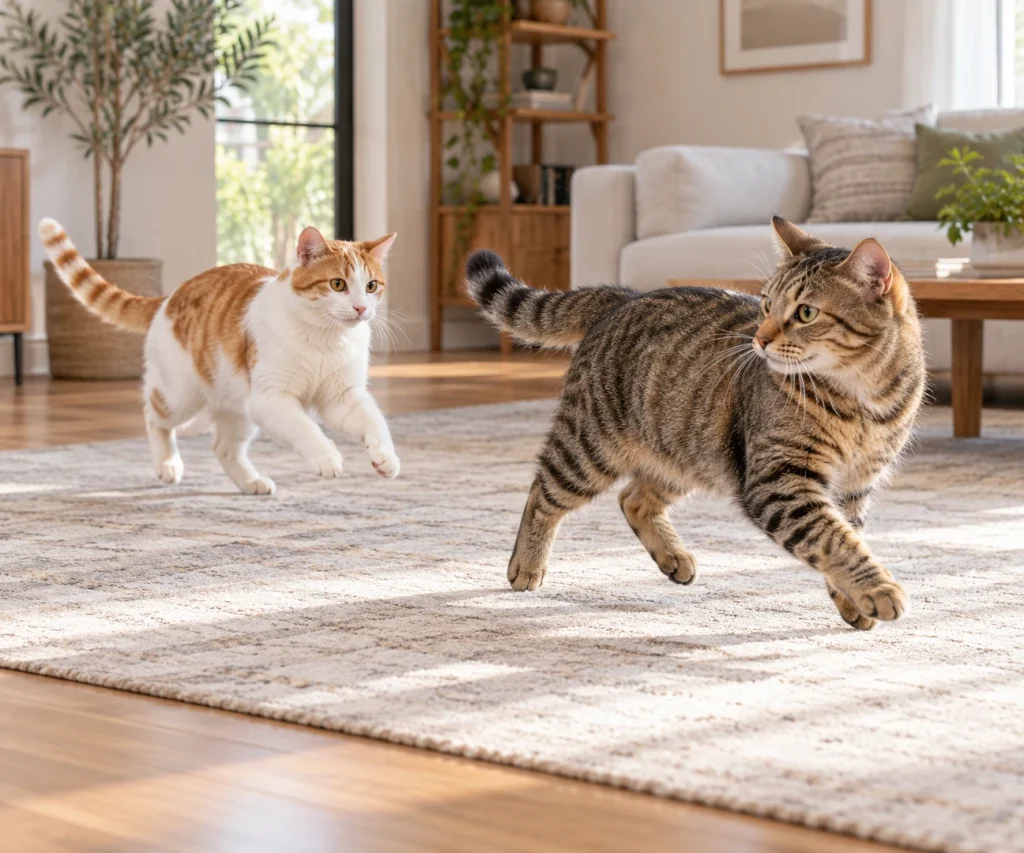
Play fighting is a normal social behavior, particularly between cats that know each other well. In healthy play, both cats are engaged, the roles keep changing, and the contact is controlled. The ASPCA describes play as reciprocal cats switch roles with ears facing forward and contact that stays restrained, whereas real aggression involves growling, spitting and hissing.
Is chasing normal?
Yes, when it is mutual. Playful chases tend to switch direction: one cat chases, then turns and becomes the one being chased. What matters is whether the cat being chased is choosing to run as part of the game, or is genuinely trying to escape for example, running to hide, staying hidden, or avoiding the other cat afterwards. One-sided pursuit, especially with vocalizing, is one of the clearer signs that an interaction isn’t play.
Is wrestling normal?
Yes. In the 2023 study described below, wrestling was the behavior most strongly associated with playful interactions. Cats may roll over, grab each other with their front legs and kick with their back legs. In play, the cat on top and the cat underneath usually swap places, and bouts are broken up by short pauses.
Is biting during play normal?
Mouthing and gentle bites are common in play. The difference lies in restraint: playful bites don’t cause injury, and the bitten cat doesn’t cry out, flee or avoid the other cat afterwards. Bites that break the skin, tufts of fur left on the floor, or one cat yowling in pain all suggest the interaction has gone beyond play.
Kittens play fighting
Kittens play rough and often. In the 2023 study, kittens were over-represented in the playful group and almost absent from the conflict group, which fits what most owners see: wrestling, pouncing and chasing are a normal part of growing up. Problems are more likely when a young, energetic cat repeatedly targets an older cat that doesn’t want to join in. In that situation the older cat needs places to retreat, and the youngster needs more play with you — interactive toys that mimic prey are ideal, and the same kind of play is recommended to channel hunting behavior.
Signs your cats may really be fighting
International Cat Care lists hissing, growling, biting, scratching, chasing and wrestling among the obvious signs of conflict. It also describes typical postures: the more confident cat may stand tall, often side-on to look bigger, while the other crouches defensively with eyes wide open and a fixed stare. Other signs that an interaction is more than play include:
- one cat consistently chasing, cornering or ambushing the other
- a cat trying to escape, hiding afterwards, or avoiding the other cat for hours
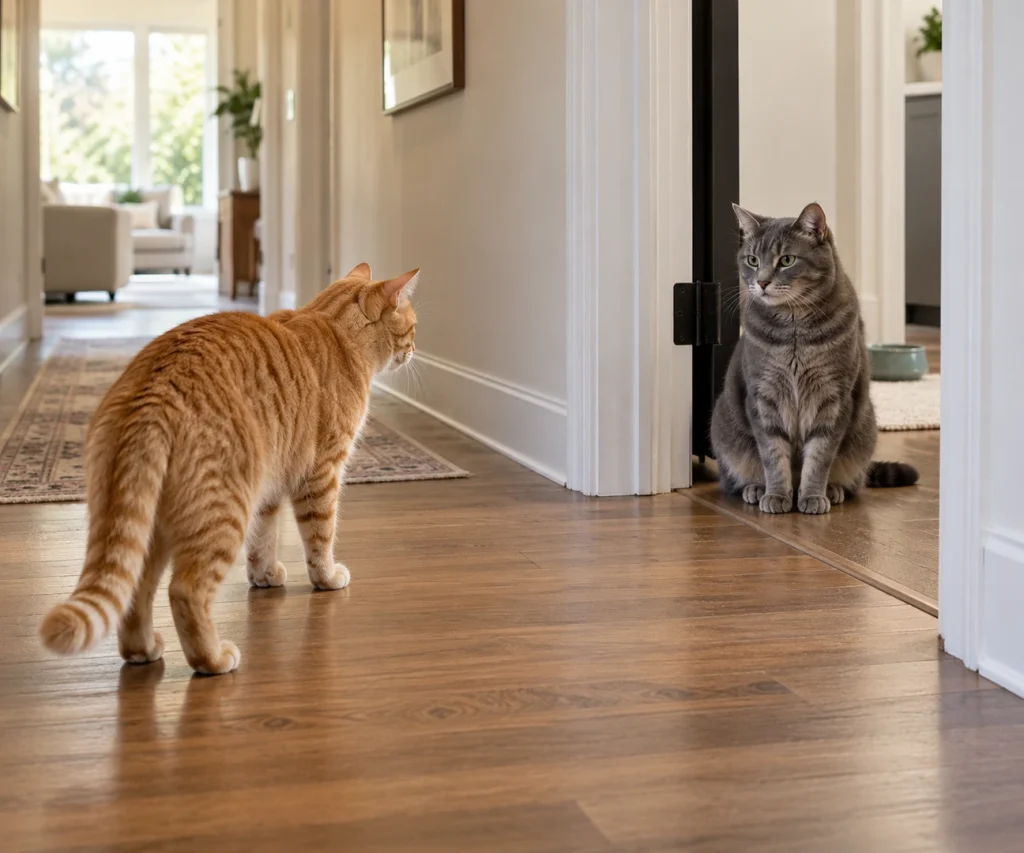
- long, tense stand-offs rather than short, bouncy bouts
- fur being pulled out, scratches, or bite wounds
- the interaction escalating rather than winding down naturally
Many guides also mention raised fur, ears pinned back and claws out as signs of a real fight. These are sensible cues to watch, but the 2023 study didn’t measure them, so treat them as supporting evidence alongside the bigger pattern rather than as stand-alone proof.
Is hissing or growling always a sign of a fight?
Not always, but it is one of the most useful warning signs. In the 2023 study, vocalizing was the behavior most strongly linked to the conflict group, while playful interactions involved little or no vocalizing. A single hiss in an otherwise relaxed, mutual game may simply mean one cat has had enough; repeated hissing or growling, especially combined with one-sided chasing, is a much stronger signal that the cats aren’t playing.
Cat play fighting vs real fighting at a glance
Use this table as a guide to patterns, not a checklist. One column won’t always match perfectly, and context matters.
| Signal | More consistent with play | More consistent with a fight |
|---|---|---|
| Noise | Little or no hissing, growling or yowling | Repeated hissing, growling, spitting or yowling |
| Reciprocity | Both cats join in and swap roles | One cat does most of the chasing or pinning |
| Chasing | Changes direction; the “chased” cat turns back | One-sided; the chased cat runs to hide or escape |
| Wrestling | Rolling and grabbing with restrained contact | Intense grappling with injuries or fur pulled out |
| Pauses | Short breaks, then one cat restarts the game | Tense stand-offs, fixed stares, or no let-up |
| Re-engaging | Both cats return to each other willingly | One cat avoids the other or leaves the room |
| Afterwards | Relaxed: grooming, resting or eating near each other | Hiding, avoidance, or one cat guarding spaces |
What a 2023 study found about play, fights and the in-between
Most advice on this topic is based on experience rather than data. One study set out to measure it. Researchers led by Noema Gajdoš-Kmecová collected 165 videos of cats interacting — 63 from owners and 102 from YouTube — and analyzed 105 of them, covering 210 cats (Gajdoš-Kmecová et al., 2023, Scientific Reports). They scored six types of behavior — wrestling, chasing, vocalizing, inactivity, other interactive behavior and non-interactive behavior — and used statistical clustering to see which patterns naturally grouped together. Four experienced assessors also labeled each interaction independently.
Three groups emerged:
- Playful (39.5% of cats): frequent wrestling with little vocalizing. Both cats in a pair usually took part, and kittens were over-represented.
- Agonistic, or conflict-related (32.4%): the highest levels of vocalizing and chasing, with recurring periods of inactivity. Almost all of these cats were adults.
- Intermediate (28.1%): longer exchanges with pauses between bouts, showing a mix of playful and conflict-related features. This group sat closer to play than to fighting.
The intermediate group is the most useful finding for owners, because it describes the interactions people find hardest to read: games that run on, get a little rough, and end with one cat walking off. Writing about their work, the researchers suggested that the pauses in these exchanges may give each cat a chance to check whether the other still wants to continue. An occasional interaction like this isn’t necessarily a problem, but it is worth watching whether it becomes more frequent, more one-sided or noisier over time.
What the study can’t tell you
The authors describe their work as a pilot study and are clear about its limits. Many videos came from the internet with no information about the cats’ ages, sex, history or relationship, and the simple set of behaviors they scored didn’t include subtle signals such as ear and tail movements. The study therefore can’t give a definitive yes-or-no answer to “are my cats playing or fighting?” for any particular household. What it does provide is evidence for the two most practical clues — quiet wrestling points towards play, while vocalizing and one-sided chasing point towards conflict.
How to tell if both cats are willing participants
Willingness is often the deciding factor. A rough-looking game between two keen participants is usually fine; a gentler-looking interaction that one cat is trying to escape is not. Ask yourself:
- Who starts it? If both cats initiate games at different times, that’s a good sign. If the same cat always starts and the other never does, watch more closely.
- Do they swap roles? Reciprocity — chaser becomes chased, top becomes bottom — was common in playful pairs in the 2023 study and is highlighted by the ASPCA as a feature of play.
- What happens in the pauses? In play, one cat often re-invites the other with a pounce or a sideways hop. In conflict, a pause is when one cat tries to leave.
- What happens afterwards? Cats that were playing usually settle quickly and may rest or groom near each other. A cat that hides, stays tense or avoids a room has probably not enjoyed the experience.
Watching before, during and after an interaction is often the most reliable way to answer “are my cats playing or fighting?” — far more reliable than judging a few seconds of action in isolation.
Look at the relationship, not just the scuffle
One interaction tells you less than how two cats get along through the rest of the day. International Cat Care explains that cats in multi-cat homes often form sub-groups, and that cats which get along tend to:
- groom each other
- sleep together or close by
- play together
- touch noses when they meet
Rubbing against each other and choosing to spend time in the same space are further signs of a friendly relationship. The authors of the 2023 study make the same point from the other direction: cats that share resources, groom and rub each other and sleep together may tolerate the occasional tense exchange, while pairs that show few friendly signs and some vocalizing during interactions may need professional help before things escalate.
Quiet signs of conflict between cats
Not every conflict involves fighting. International Cat Care describes a quieter form of tension in which one cat puts pressure on another without obvious aggression. Signs include:
- Staring: cats perceive a direct stare as threatening.
- Blocking: sitting in doorways, hallways or near litter boxes, cat flaps, food or resting areas so the other cat can’t get past.
- Displacing: following, ambushing, or pushing another cat out of a favorite resting spot.
- Avoidance: one cat staying out of certain rooms, eating or using the litter box only when the other cat is elsewhere.
International Cat Care notes that this kind of passive conflict can escalate into fighting if nothing changes. The strain can also show up in other ways, such as hiding, peeing or spraying outside the litter box, or overgrooming.
What to do if your cats are fighting
When to step in
If both cats are clearly playing, leave them to it. Step in when you see the warning signs above building up: repeated hissing or growling, one cat unable to get away, injuries, or an interaction that keeps escalating instead of winding down. With “in-between” interactions, it is often enough to calmly redirect one cat with a toy before things get heated.
How to interrupt a fight safely
- Keep your hands away. International Cat Care warns never to try to pick up or handle either cat during or immediately after a fight, because you are at high risk of being scratched or bitten. Cats in this state can lash out at anything nearby, including you.
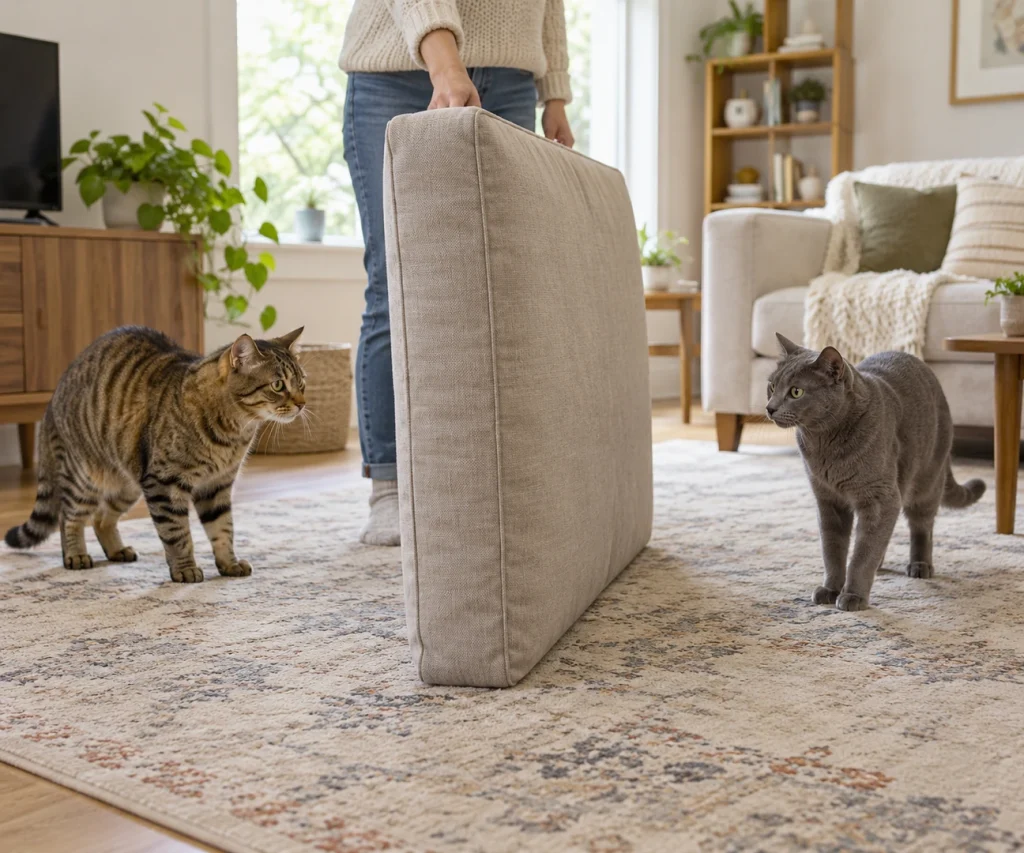
- Interrupt from a distance. A sudden noise such as a loud clap can break their focus. You can also slide a cushion, a large piece of cardboard or a baby gate between them to block their view of each other.
- Give them a way out. Open a door so one cat can leave, rather than trapping them in a corner together.
- Don’t punish either cat. Shouting, chasing or punishment adds stress and may teach the cats to associate each other with something unpleasant.
- Don’t let them “fight it out”. The ASPCA explains that cats don’t resolve their problems by fighting, and that fighting usually gets worse.
What to do right after a serious fight
International Cat Care advises separating the cats into different rooms for 24–48 hours until both have calmed down, and getting both cats health-checked by a vet. Give each cat its own food, water, litter box, bed and hiding place during this time. Once they are calm, check them for injuries without forcing handling: bite wounds can be small and hidden under fur, and any wound, swelling, limping or change in behavior should be checked by your vet.
Reintroducing cats after a fight
If fighting starts again when they are reunited, International Cat Care suggests treating the cats as if they were meeting for the first time and following a gradual introduction process:
- Keep each cat in its own area with everything it needs.
- Swap bedding between them so they get used to each other’s scent.
- Let each cat explore the other’s area while the other cat is elsewhere.
- Allow them to see each other through a barrier, such as a glass door or stair gate, until they can glance at each other calmly without staring.
- Move on to short, supervised time together, gradually increasing it as long as both cats stay relaxed.
There is no quick fix. If the cats can’t be reintroduced calmly, International Cat Care recommends separating them for longer and asking your vet for a referral to a qualified clinical animal behaviorist.
My cats used to get along — why are they suddenly fighting?
When cats that were previously friendly start fighting, something has usually changed. Possible explanations include:
- Pain or illness. The ASPCA points out that any sudden change in behavior can be a sign of a medical problem, and a cat in pain may react aggressively to being approached or touched. This is why a vet check should come first.
- Redirected aggression. The ASPCA describes how something frightening — fireworks, for example — can become associated with the other cat, setting off aggression between cats that previously got on.
- Unfamiliar smells. The ASPCA also mentions the smell of the veterinary clinic as a possible trigger. A cat returning from the vet, a groomer or a boarding cattery may smell unfamiliar to its housemate.
- Competition for resources. Changes that reduce access to litter boxes, food, resting spots or escape routes can increase tension, as International Cat Care’s guidance on conflict explains.
- Stressful events and household changes. A new pet or person, building work, a move or rearranged furniture can all raise stress levels.
Because several of these causes overlap and some are medical, it’s best not to guess. Book a vet appointment for both cats, and keep notes on when the fights happen and what came before them. Our checklist on how to tell if your cat is sick can help you spot other changes worth mentioning.
How to help cats live together more peacefully
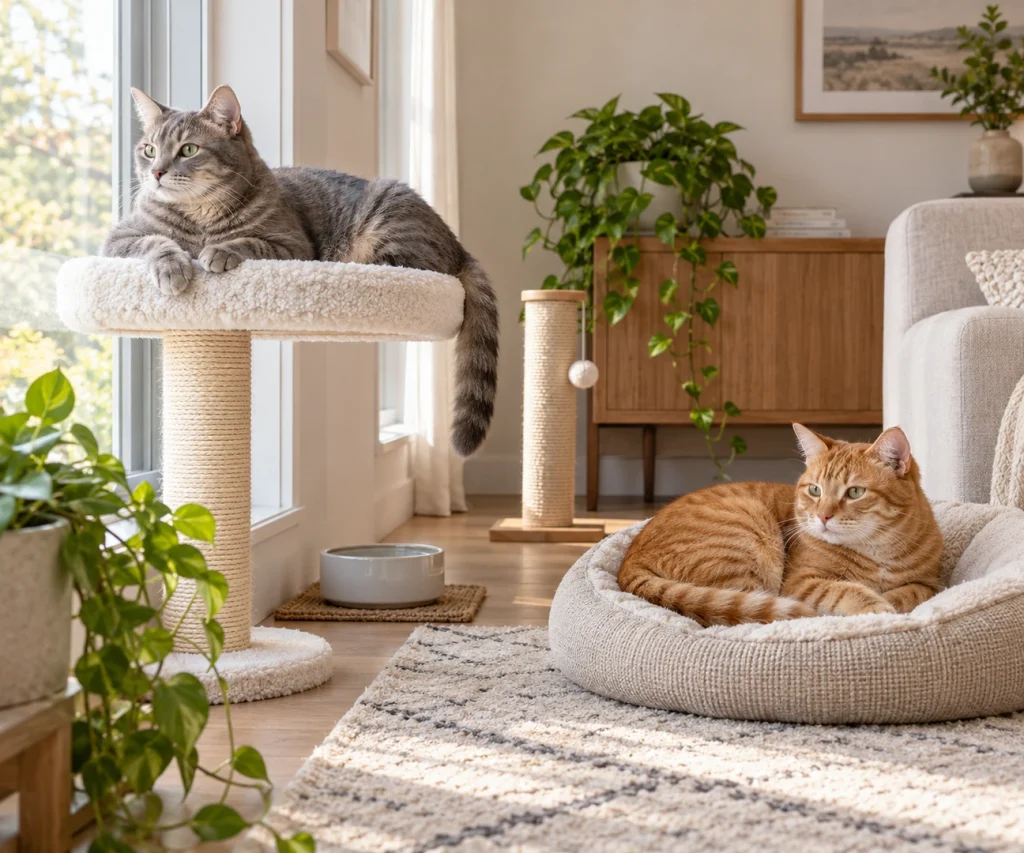
A lot of tension between cats comes down to competition for space and resources. International Cat Care recommends providing one of each key resource per cat plus one extra, spread around different parts of the home — so a two-cat household would have three of each. This applies to:
- litter boxes — our litter box calculator can help you check you have enough
- food bowls, placed in separate feeding stations, ideally out of sight of each other
- water bowls, placed away from food
- scratching posts, both vertical and horizontal
- beds and high resting places
Why location matters, not just numbers
Four litter boxes lined up in one room work almost like one large box: a single cat can still guard the whole area. The AAFP and ISFM Feline Environmental Needs Guidelines recommend placing each key resource in its own location, separate from other resources, and providing at least as many safe places each big enough for a single cat as there are cats in the household.
The guidelines also note that cats in multi-cat homes often learn to “time share” popular resting and eating places, and that fighting usually happens only as a last resort when a cat can’t escape. More routes in and out of rooms, more vertical space and more hiding places all make it easier for cats to avoid each other instead of clashing.
Routine and play
The AAFP/ISFM guidelines note that a lack of opportunity for predatory play can lead to frustration and misdirected aggression. Short daily play sessions with each cat individually give that energy an outlet — see signs your cat is bored for ideas. Predictable mealtimes can also take pressure off the busiest moments of the day; our cat feeding schedule generator can help you plan a routine, and you’ll find more planners among our free cat care tools.
When to call your veterinarian
Contact your vet if:
- either cat has a wound, swelling, limp or signs of pain after a fight
- cats that used to get along have started fighting suddenly
- fights are becoming more frequent or more intense
- one cat is hiding most of the time, avoiding parts of the home, or has stopped using the litter box normally
- either cat shows other changes, such as eating less, sleeping more or reacting badly to being touched
If conflict continues after your vet has ruled out medical causes and you’ve made changes at home, ask for a referral to a qualified clinical animal behaviorist. Our guides to cat aggression and cat anxiety explain the wider causes of aggression and stress in more depth.
Frequently asked questions
Is it normal for cats to play fight?
Yes. Play fighting is common, especially between kittens, young cats and cats that are closely bonded. Quiet wrestling, both cats taking part and a relaxed atmosphere afterwards are good signs.
How do I know if my cats are playing too rough?
Watch for rising noise, one cat trying to escape, fur being pulled out, bites that cause injury, or one cat avoiding the other afterwards. If you’re still unsure whether your cats are playing or fighting, redirect them with a toy and see whether both choose to come back to the game.
Should I let my cats fight it out?
No. Cats don’t settle disagreements by fighting, and repeated fights tend to damage the relationship further. Interrupt safely without using your hands, separate them if needed, and work out what is causing the tension.
Why do my cats groom each other and then fight?
Grooming sessions sometimes end with a swat or a brief scuffle. If it’s short, quiet and the cats are otherwise relaxed together, it usually isn’t a concern. If it regularly turns into hissing and chasing, treat it like any other sign of tension.
Why are my cats suddenly fighting each other?
Pain or illness, redirected aggression after a frightening event, unfamiliar smells after a vet visit, and changes in access to resources are all possible reasons. Because some causes are medical, a vet check for both cats is the right first step.
Do kittens normally wrestle and bite each other?
Yes. Kittens play-fight a lot, and research suggests their interactions are much more likely to be playful than conflict-related. Gentle bites without injury, frequent role swaps and quick recovery afterwards are all normal.
Should I separate cats after a serious fight?
Yes. International Cat Care advises keeping them in separate rooms for 24–48 hours until both are calm, having both cats checked by a vet, and reintroducing them gradually if tension continues.
Sources
- Gajdoš-Kmecová N, et al. (2023). An ethological analysis of close-contact inter-cat interactions determining if cats are playing, fighting, or something in between. Scientific Reports, 13.
- International Cat Care. Conflict between cats.
- International Cat Care. Multi-cat households.
- International Cat Care. Introducing cats.
- ASPCA. Aggression between cats in your household.
- Ellis SLH, et al. (2013). AAFP and ISFM Feline Environmental Needs Guidelines. Journal of Feline Medicine and Surgery, 15, 219–230.
This article is for general information and is not a substitute for veterinary advice. If you are worried about your cats’ behavior or health, contact your veterinarian. See our veterinary disclaimer.