

Ringworm in cats is a fungal skin infection, not a worm. It usually shows up as patches of hair loss with scaly or crusty skin, often on the face, ears, tail or feet, and it is usually not very itchy. It is rarely dangerous to a healthy cat, but it is contagious to other animals and to people, and the spores it sheds can contaminate your home, which is why vets treat it rather than simply waiting for it to clear.
This guide explains what ringworm in cats looks like, which cats are most at risk, how vets confirm it, how treatment and home cleaning work, what does not work, and what to do if someone in the household develops a rash. It is based on the World Association for Veterinary Dermatology consensus guidelines and other veterinary sources listed at the end.
Table of Contents
Ringworm in cats at a glance
- Cause: fungi called dermatophytes. In cats, the most common is Microsporum canis.
- Typical signs: hair loss, scaling, crusts and broken hairs, often around the head, ears, paws or tail. Itching is usually mild or absent.
- Most at risk: kittens, longhaired cats and cats in crowded settings such as shelters.
- Diagnosis: a vet confirms it, usually with a Wood’s lamp, microscopy and a fungal culture. It cannot be diagnosed reliably by appearance.
- Treatment: oral antifungal medication together with whole-coat topical treatment, plus home cleaning, until tests show the infection has cleared.
- People: it can spread to humans. Anyone in the household with a new scaly or ring-shaped rash should see a doctor.
What ringworm is, and what it is not
Despite the name, ringworm has nothing to do with worms. The CDC describes it simply as an infection caused by fungi. The name comes from the ring-shaped rash it often causes in people. In cats the lesions are frequently not ring-shaped at all, which is one reason it is easily mistaken for something else. If you are dealing with actual intestinal parasites, our guide to worms in cats covers those.
The fungi that cause ringworm feed on keratin, the protein in hair, skin and claws. According to the 2017 consensus guidelines of the World Association for Veterinary Dermatology, Microsporum canis, the most common cause in cats, is not part of the normal skin flora of cats. Infection usually comes from contact with an infected animal, most often another cat, or with contaminated objects.
The same guidelines describe ringworm in most healthy cats as a self-limiting infection that clears within weeks to months. That does not mean it should be left alone. Treatment is recommended to shorten the illness and to stop it spreading to other animals and people while it runs its course.
Which cats are most at risk
Any cat can get ringworm, but the Merck Veterinary Manual notes that kittens are the most likely to be infected, and that kittens and longhaired cats may have more persistent and widespread infections. Other situations that raise the risk include:
- Crowded or high-turnover environments such as shelters, rescues, catteries and multi-cat homes.
- A newly adopted cat or kitten joining the household. A gradual introduction, with the newcomer in its own room at first, gives you time to spot skin problems before the cats share space; our guide on how to introduce cats explains the process.
- Cats with a weakened immune system, for example due to other illness.
Indoor-only cats are not immune. Spores can arrive on a new pet, on bedding or grooming tools, or on a visitor’s animal.
Signs of ringworm in cats
What the lesions can look like
The WAVD guidelines list a wide range of possible changes, in any combination:
- patchy or irregular hair loss, often with broken, stubbly hairs
- scaling or dandruff-like flakes
- crusts and small bumps
- redness or darkened skin
- changes to the claws or claw beds
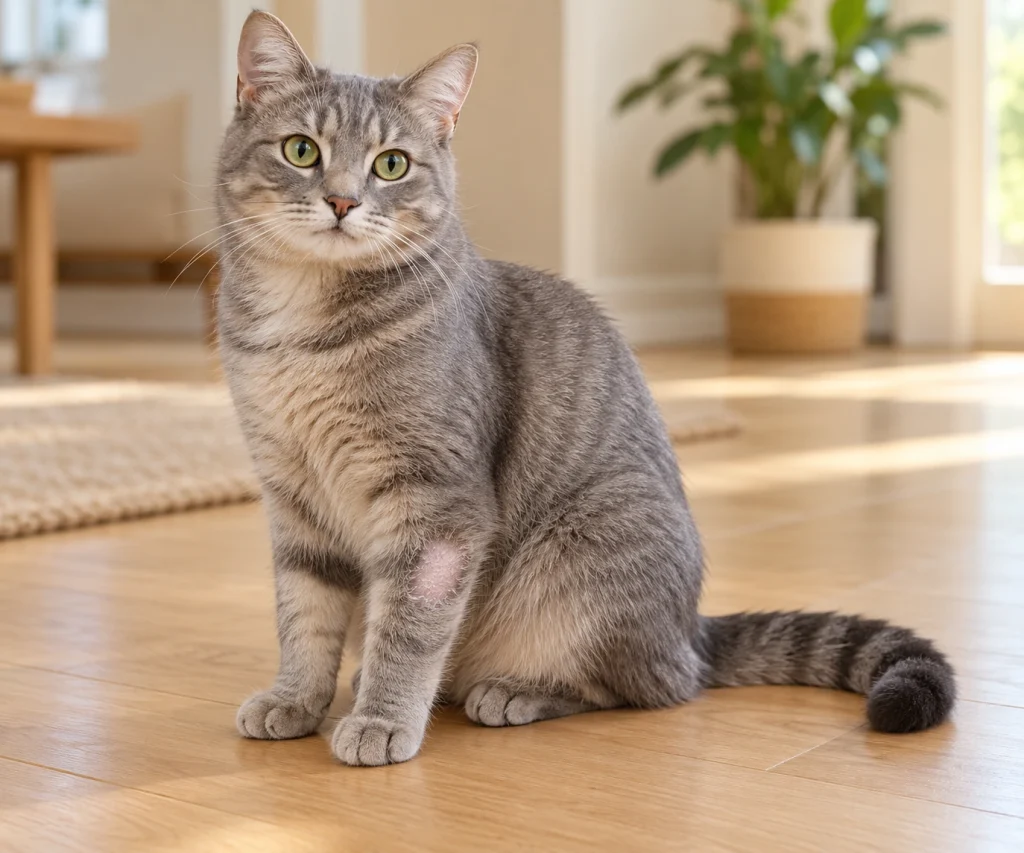
Lesions are typically asymmetrical, and itching varies but is usually mild or absent. The Merck Veterinary Manual notes that common locations are the face, ears, tail and feet. Some cats develop many small crusty bumps, and widespread infections can produce larger lesions. Others, especially some longhaired cats, may show very little at all while still carrying the fungus.
Conditions that can look similar
Hair loss and scaly skin in cats have many possible causes, and several of them are far more common than ringworm. That is why a vet’s diagnosis matters:
| Condition | How it can differ |
|---|---|
| Flea allergy | Usually very itchy, often affecting the lower back, tail base and neck; flea dirt may be visible. |
| Food or environmental allergy | Usually itchy, often around the head and neck; may come with ear problems. |
| Overgrooming | Hair is licked or chewed off, often on the belly or inner legs, with the skin underneath often looking normal. |
| Mites and other parasites | Often itchy; some types cause heavy scaling. Diagnosed with skin tests. |
| Ringworm | Typically mild or no itch, with broken hairs and scaling, often on the head, ears, paws or tail. |
These patterns overlap, and a cat can have more than one problem at once. Treat the table as a reason to see your vet, not as a way to diagnose your cat at home.
How ringworm spreads
Ringworm spreads through direct contact with an infected animal and through contaminated objects. The Merck Veterinary Manual highlights broken hairs carrying fungal spores as an important source of spread. Those hairs end up on bedding, furniture, carpets, brushes, carriers, cat trees and clothing.
Contact does not always lead to infection. Whether a cat becomes infected depends on the fungus involved and on the cat’s age, health and immunity. Healthy adult cats often resist infection better than kittens.
The WAVD guidelines also distinguish between infected cats and fomite carriers: cats that test positive only because spores are sitting on their coat, without an active infection of their own. In one shelter study cited in the guidelines, most of the culture-positive cats turned out to be carriers rather than truly infected. This is one reason careful testing and home cleaning both matter.
How vets diagnose ringworm
There is no single perfect test. The WAVD guidelines state that no one test is a gold standard, so vets usually combine several:
Wood’s lamp examination
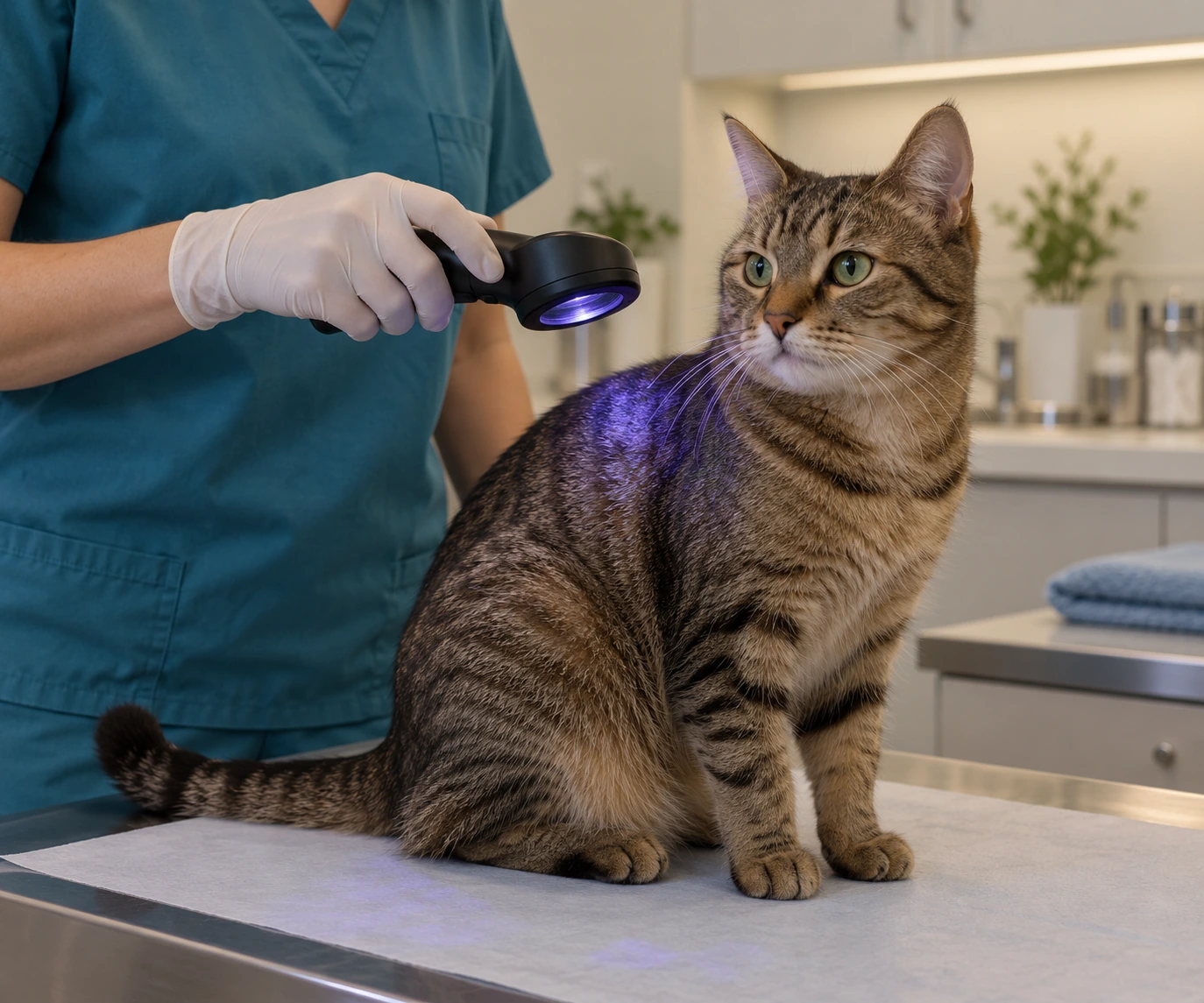
A Wood’s lamp is a special ultraviolet light. Hairs infected with Microsporum canis often glow apple-green under it. When the WAVD authors pooled studies of first examinations, 72% of animals with naturally occurring infection were Wood’s lamp positive. That still leaves a meaningful share that do not glow, fluorescence is harder to find in cats that have already been treated, and results depend heavily on good equipment and technique. A negative Wood’s lamp check alone does not rule ringworm out.
Microscopy and fungal culture
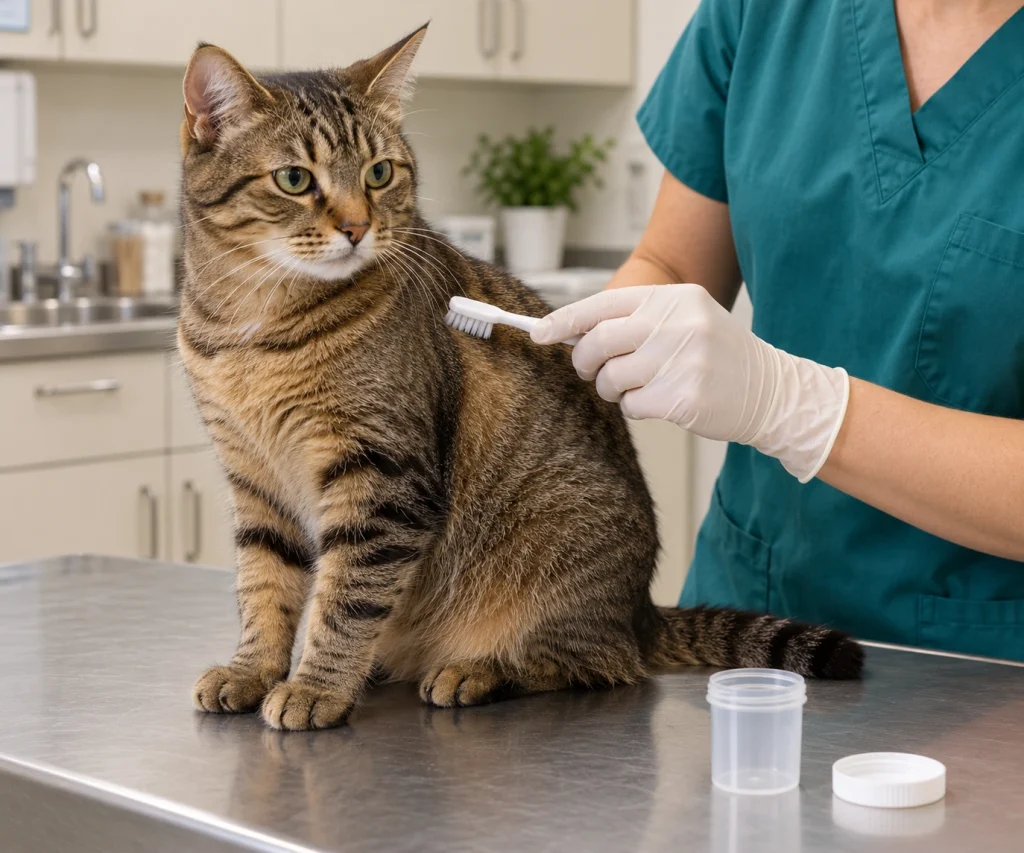
Vets can examine plucked hairs under a microscope to look for fungal elements. A fungal culture, often taken by brushing the coat with a new toothbrush, identifies the species and is also used to monitor treatment. The Merck Veterinary Manual notes that culture is the most accurate method but can take up to 3 weeks to give a result.
PCR testing
PCR tests detect fungal DNA and return results faster. The WAVD guidelines caution that a positive PCR does not necessarily mean an active infection: DNA from dead fungus after successful treatment, or from spores on a carrier’s coat, can also produce a positive result. Vets interpret PCR alongside the cat’s lesions and other tests.
How ringworm in cats is treated
Treatment is prescribed by a vet and is tailored to the cat, its age and health, and the household. The WAVD guidelines state that successful treatment requires oral antifungal medication used together with topical treatment of the whole coat. One without the other is less effective.
Oral antifungal medication
The guidelines identify itraconazole and terbinafine as the most effective and safe oral treatments for cats. They specify itraconazole from a licensed, non-compounded source, because compounded versions may not deliver a reliable dose. Griseofulvin also works but has more potential side effects, and ketoconazole and fluconazole are considered less effective options. Your vet will choose the drug, dose and schedule; never give a cat human antifungal tablets.
Topical treatment of the whole coat
Topical treatment kills spores on the hair and reduces contamination of your home. The guidelines recommend twice-weekly whole-body application of lime sulfur, enilconazole or a miconazole and chlorhexidine shampoo. Spot-treating a single patch with a cream does not treat spores elsewhere in the coat.
Clipping hair around lesions, and sometimes more widely in longhaired cats, can reduce the number of infected hairs being shed. The Merck Veterinary Manual notes that shaving may be recommended for longhaired cats. Ask your vet before clipping, since it should be done gently to avoid irritating the skin. Juggling daily tablets and twice-weekly baths for several weeks is easier with a written plan; MyyCat’s Cat Medication Schedule Generator can organize the schedule your vet prescribes.

When treatment can stop
Treatment usually continues until tests, not just appearances, show the infection has cleared. Hair can regrow while the fungus is still present. According to the WAVD guidelines, a negative fungal culture in a cat with no lesions and a negative Wood’s lamp examination is compatible with cure, and some protocols require two or three negative cultures in a row. In one shelter study cited in the guidelines, using combined oral and topical treatment, the average time to cure was 18 days and all cats were cured by day 49. Individual pet cats vary, so follow your vet’s monitoring plan rather than a fixed calendar.
Treatments that do not work
- Lufenuron. This flea product was once promoted for ringworm. The WAVD guidelines are clear that it has no role in treating or preventing ringworm.
- Ringworm vaccines. The guidelines state that antifungal vaccines do not protect against infection.
- Waiting it out. Ringworm may clear on its own in healthy cats, but untreated cats keep shedding spores into the home and can infect other pets and people in the meantime.
- Home remedies and human creams without veterinary advice. Cats groom off what is applied to their skin, and treating one patch does not deal with spores elsewhere on the coat.
Cleaning your home during treatment
Home cleaning is part of treatment, not an optional extra. The WAVD guidelines emphasize that infective material is easily removed from the environment, that physical cleaning matters most, and that anything that can be washed can be decontaminated. Cleaning also prevents spores on surfaces from re-contaminating your cat and causing false positive culture results. A practical routine:
- Remove hair first. Vacuum, dust and wipe up hair regularly in areas your cat uses. Disinfectants work poorly on surfaces still covered in hair and dirt.
- Wash what you can. Machine-wash bedding, blankets, washable toys and soft carrier pads, and discard items that cannot be cleaned and are heavily contaminated.
- Clean, then disinfect hard surfaces. Wash with detergent and water first, then apply a disinfectant your vet recommends. The Merck Veterinary Manual advises thorough cleaning of the cat’s environment with a dilute bleach solution. Use bleach only on surfaces it will not damage, keep pets away until surfaces are dry, and never mix bleach with other cleaners.
- Clean grooming tools and carriers. Brushes, combs and carriers carry hair and spores between cats.
- Keep the treated cat’s area simple. Fewer soft furnishings and hard-to-clean surfaces make the job easier while treatment continues.
Living with a cat being treated
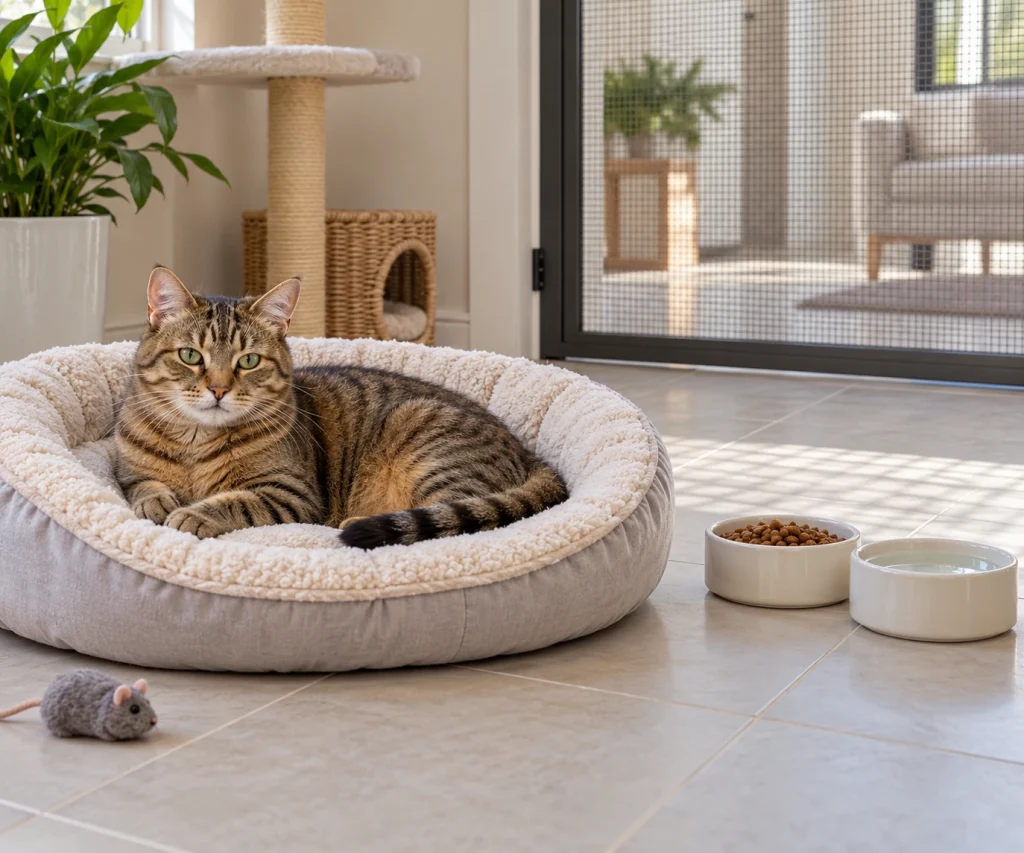
Your vet may suggest keeping the infected cat in one easy-to-clean room for part of the treatment period to limit spread. The WAVD guidelines add an important caution: confinement should be used carefully and for the shortest time possible. Ringworm is curable, but poor socialization in kittens or newly adopted cats can cause lifelong behavior problems.
- Give a confined cat company, play and enrichment every day. Long isolation is stressful, and our guide to cat anxiety explains the signs to watch for.
- Ask your vet whether other cats and dogs in the home should be examined or tested, since animals can carry spores without obvious lesions.
- Wash your hands after handling the cat, its bedding or its treatment products, and wear gloves when applying topical treatments.
- Watch young kittens closely. Ringworm is uncomfortable rather than dangerous for most cats, but a kitten that stops eating or seems unwell needs a vet promptly.
Can people catch ringworm from cats?
Yes. The CDC lists contact with an infected pet as one of the ways ringworm spreads to people. In people it typically causes an itchy, scaly, often ring-shaped rash, which can look red on lighter skin and grey or brown on darker skin. The CDC notes that anyone can get ringworm, but people with weakened immune systems may be especially at risk.
The WAVD guidelines put the risk in perspective: animal-to-human transmission happens, but serious complications are exceedingly rare, and human skin infections respond to treatment. Sensible precautions are enough for most households:
- Wash your hands with soap and water after handling your cat or its supplies, as the CDC recommends for cat owners generally.
- Avoid cuddling the infected cat against bare skin until your vet says the infection has cleared.
- Take extra care if anyone in the home is immunocompromised.
- If a family member develops a new rash, they should see a doctor and mention the cat’s diagnosis. Do not use the cat’s medication on people.
When to see a vet
Book a vet appointment if you notice patchy hair loss, scaly or crusty skin, broken hairs or claw changes, especially in a kitten, a newly adopted cat or a cat that has been in a shelter or boarding facility. Contact your vet promptly if your cat:
- has lesions that are spreading quickly or covering large areas
- has open, oozing or painful sores
- is lethargic, losing weight or not eating
- is a very young kitten, or has another illness that affects its immune system
- is not improving, or is getting worse, on prescribed treatment
- lives with someone who has developed a new skin rash
Skin changes can also be part of a broader illness, so mention any other changes you have noticed; our guide on how to tell if your cat is sick covers the subtler signs. This article is general information and not a substitute for veterinary advice; see our veterinary disclaimer.
Frequently asked questions
Is ringworm in cats an emergency?
Usually not. Ringworm is uncomfortable and contagious but rarely dangerous to a healthy adult cat. It still needs a vet visit to confirm the diagnosis and start treatment, and a kitten or a cat that is unwell in other ways should be seen promptly.
How long is a cat with ringworm contagious?
A cat should be treated as contagious until your vet confirms the infection has cleared, usually with negative fungal cultures. Lesions can heal and hair can regrow before the fungus is gone, so appearance alone is not a reliable guide.
Can indoor cats get ringworm?
Yes. Spores can be brought in on a new pet, on bedding, carriers or grooming tools, or by contact with another animal. Indoor cats are less exposed than outdoor or shelter cats, but they are not immune.
Will ringworm in cats go away on its own?
In many healthy cats it eventually clears without treatment, but that can take weeks to months. During that time the cat keeps shedding spores into the home and can infect other animals and people, which is why vets recommend treatment.
Should I keep my cat away from my other pets?
Often, yes, for part of the treatment period, but follow your vet’s advice. Other pets may need to be examined or tested, and any confinement should be kept as short and as enriched as possible.
Can I use a human antifungal cream on my cat?
Not without your vet’s advice. Treating a single patch does not deal with spores elsewhere on the coat, and cats lick off what is put on their skin. Vets recommend whole-coat topical treatment combined with oral medication.
Sources
- Moriello KA, Coyner K, Paterson S, Mignon B. Diagnosis and treatment of dermatophytosis in dogs and cats: Clinical Consensus Guidelines of the World Association for Veterinary Dermatology. Veterinary Dermatology. 2017;28:266-e68.
- Merck Veterinary Manual. Ringworm (dermatophytosis) in cats.
- Merck Veterinary Manual. Dermatophytosis in dogs and cats.
- Centers for Disease Control and Prevention. About ringworm.
- Centers for Disease Control and Prevention. What causes ringworm.
- Centers for Disease Control and Prevention. Healthy pets: cats.