
Grain Free Cat Food: Benefits, Risks, and What the Evidence Says
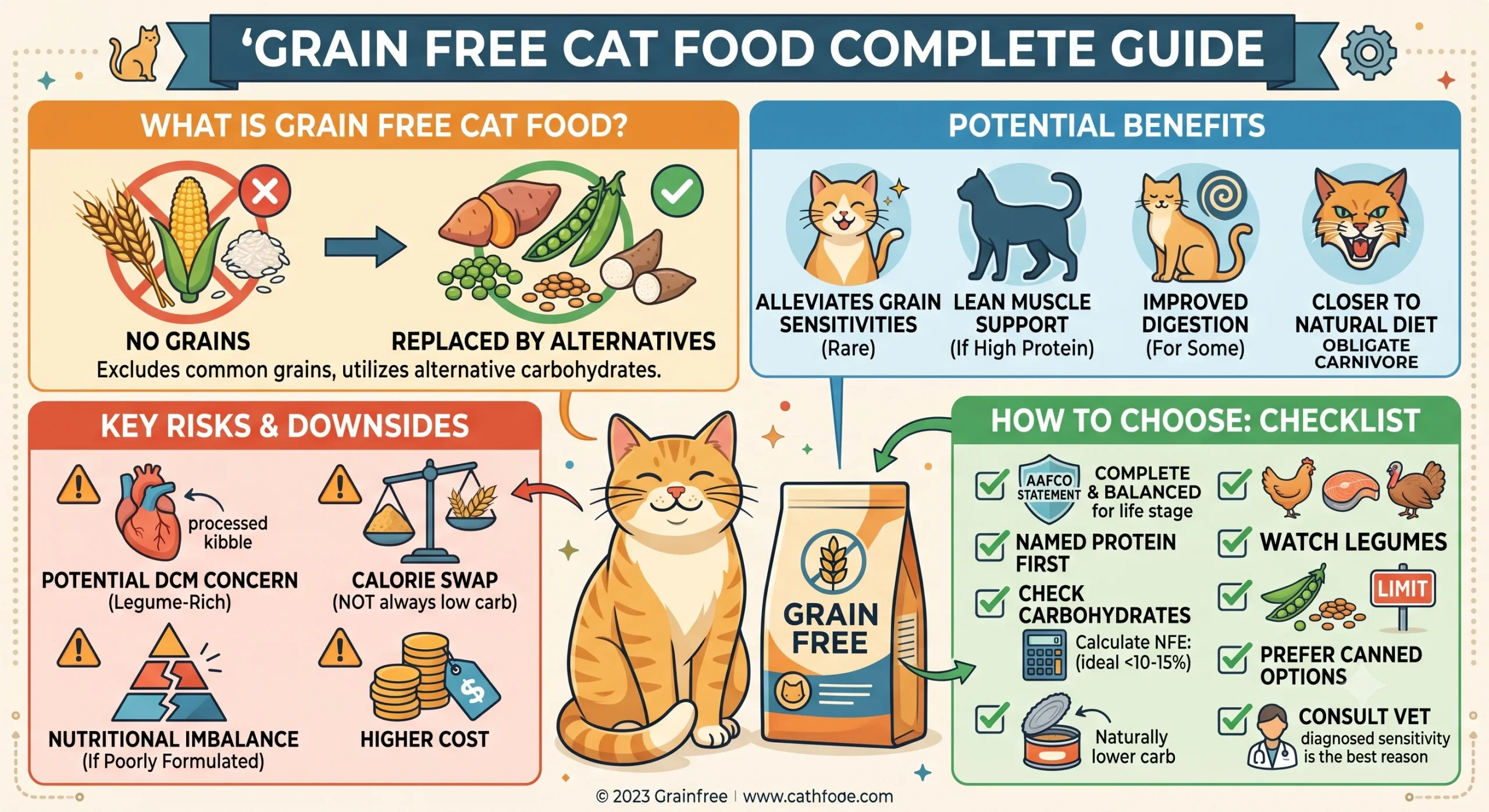
Grain-free cat food is heavily marketed, but the words grain free do not tell you whether a food is healthier, higher in protein, lower in carbohydrates, or more appropriate for your cat. A grain-free diet simply excludes cereal grains such as wheat, corn, rice, barley, and oats.
For most healthy cats, there is no established health benefit to choosing a food solely because it is grain free. The more useful questions are whether the diet is complete and balanced for the cat’s life stage, whether the manufacturer has strong nutritional expertise and quality control, whether the calorie level fits the cat, and whether there is a medical reason to avoid a particular ingredient.
Table of Contents
What Does Grain-Free Cat Food Mean?
Grain-free foods replace grains with other ingredients. In dry foods, those alternatives may include potatoes, peas, lentils, chickpeas, tapioca, or other starch sources. Therefore:
- Grain free does not mean carbohydrate free. A grain-free dry food may still contain substantial starch.
- Grain free does not mean high protein. Protein content depends on the complete formulation.
- Grain free does not mean limited ingredient. A grain-free product can contain many protein and carbohydrate sources.
- Grain free does not mean hypoallergenic. A cat can react to ingredients in either a grain-free or grain-inclusive diet.
If you want to compare the approximate macronutrient composition of foods, use the MyyCat Cat Food Label Calculator. Remember that guaranteed-analysis calculations are estimates and do not measure ingredient quality or digestibility.
Do Cats Need Grains?
Cats are obligate carnivores with specific requirements for nutrients such as taurine, arachidonic acid, and preformed vitamin A. That does not mean every non-meat ingredient is harmful or useless.
Cats do not have a specific nutritional requirement for wheat, corn, rice, or another grain as an ingredient. However, appropriately processed grains can provide digestible energy and nutrients in a properly formulated cat food. Tufts Cummings School of Veterinary Medicine notes that the vast majority of cats are efficient at digesting and using nutrients from grains.
The important distinction is between a cat’s nutrient requirements and the individual ingredients used by a competent manufacturer to meet those requirements. Our cat protein sources guide explains feline protein needs in more detail.
Is Grain-Free Cat Food Healthier?
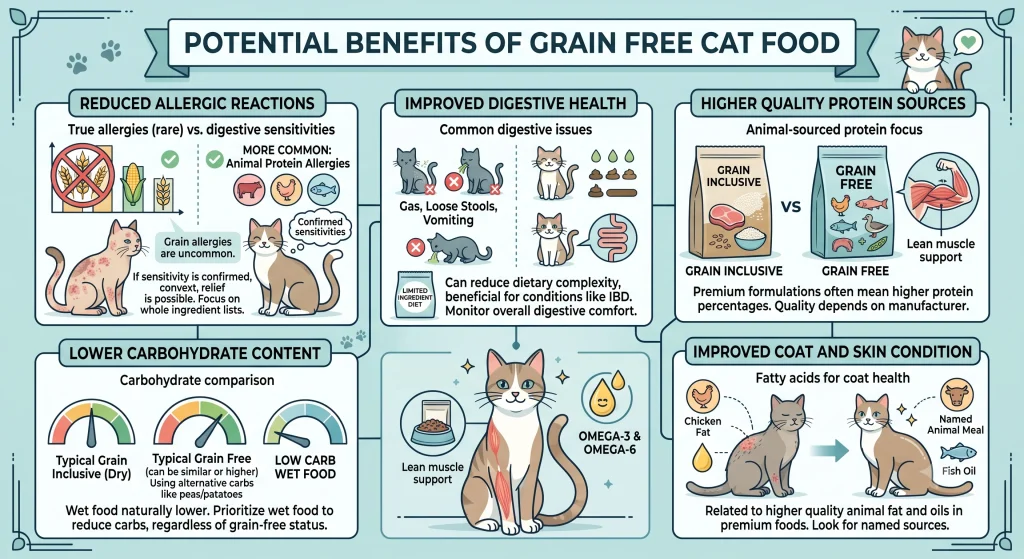
Not inherently. Two foods can both be grain free and have very different calorie densities, protein sources, nutrient profiles, manufacturing controls, and feeding purposes. Likewise, a well-formulated grain-inclusive food can be an appropriate choice for a healthy cat.
A grain-free food may happen to be high in protein, low in calories, high in moisture, or suitable for a particular cat, but those characteristics must be evaluated separately. They are not guaranteed by the grain-free label.
Does Grain-Free Food Prevent Food Allergies?
No. Grain-free food should not be used as a general allergy-prevention strategy.
Food allergy can occur in cats, but grains are not automatically the culprit. Tufts notes that allergies to specific grains are no more common than allergies to animal proteins such as chicken, beef, and dairy. If a cat has chronic itching, recurrent skin disease, vomiting, or diarrhea, guessing at the allergen by buying a grain-free food can delay a proper diagnosis.
A veterinary elimination-diet trial uses a carefully selected diet and strict avoidance of unapproved foods and treats. For the diagnostic process, see our Cat Food Allergies Guide.
What About Digestive Problems?
A cat with vomiting or diarrhea may improve after a diet change, but improvement does not prove that grains were the problem. The new diet may differ in protein source, fat, fiber, digestibility, calorie density, additives, or many other variables.
Persistent gastrointestinal signs deserve investigation rather than repeated food experimentation. See our guides to cat diarrhea and cat vomiting for warning signs that require veterinary attention.
Does Grain-Free Mean Low-Carbohydrate?
No. Removing grains does not remove the need for starch in many dry-food manufacturing processes. Grain-free dry foods may use peas, lentils, potatoes, tapioca, or other carbohydrate-containing ingredients instead.
If carbohydrate level matters for a medical reason, evaluate the actual diet rather than the front-of-package claim. This is particularly important for cats with diabetes. Our Diabetes in Cats guide explains why dietary management should be individualized with veterinary supervision.
Grain-Free Food and Dilated Cardiomyopathy: What Do We Actually Know?
This topic needs careful wording. The FDA investigation into diet-associated non-hereditary dilated cardiomyopathy (DCM) has focused primarily on dogs. Many reported diets contained peas, lentils, other pulses, or potatoes high in the ingredient list, and many were labeled grain free. However, reports have also involved grain-containing diets.
The FDA states that it does not know the specific connection between these diets and non-hereditary DCM and does not consider legumes or pulses inherently dangerous. Therefore, it would be inaccurate to tell cat owners that grain-free food has been proven to cause heart disease in cats.
For a cat with known or suspected heart disease, dietary decisions should be made with the veterinarian managing the case. You can also read our Cat Heart Disease Guide.
Should You Avoid Peas and Legumes?
There is not enough evidence to label peas, lentils, chickpeas, or other pulses as inherently unsafe for cats. Their presence also does not automatically make a food poor quality.
Instead of using an arbitrary rule such as “never buy a food with legumes in the first five ingredients,” evaluate the entire diet and the manufacturer behind it. The FDA specifically notes that pulses have been used in pet foods for many years without evidence that they are inherently dangerous.
How to Choose a Cat Food: Better Criteria Than “Grain Free”
Use the following questions as a more useful checklist:
- Is it complete and balanced? Check the nutritional adequacy statement and make sure it is appropriate for your cat’s life stage.
- Who formulates the food? Nutritional expertise, formulation practices, feeding research, and quality control matter.
- How many calories does it provide? Portion size must match your cat’s individual energy needs.
- Does your cat maintain a healthy body condition? Monitor weight, body condition, and muscle condition rather than relying on marketing claims.
- Does your cat have a medical condition? Kidney disease, diabetes, urinary disease, food allergy, gastrointestinal disease, and other conditions can change dietary priorities.
- Will your cat reliably eat it? A nutritionally appropriate diet is only useful if the cat consumes enough of it.
The FDA explains that a food labeled complete and balanced is intended to provide the required nutrients as a sole diet for the stated life stage. For portion planning, see How Much Should I Feed My Cat? and the Cat Food Amount Calculator.
Do Not Judge Food Quality by the First Ingredient Alone
A common rule says that the first ingredient must always be a named meat and that foods containing grains or by-products near the top are automatically inferior. That is too simplistic.
Ingredient lists are ordered by weight before processing, so ingredients with more water can appear higher even when they contribute less dry matter. The list also does not tell you the digestibility, bioavailability, final nutrient profile, manufacturing quality, or whether the finished diet has been properly formulated.
Choose the complete diet rather than trying to rank foods from one or two ingredients on the label.
Wet vs. Dry Matters Separately From Grain-Free Status
Wet and dry foods differ substantially in moisture and calorie density. A wet diet is not automatically superior because it is grain free, and a dry diet is not automatically poor because it contains grains.
Wet food can be useful for increasing dietary water intake, while dry food may be practical for measured portions, food puzzles, or some household routines. For more detail, see our wet cat food guide and Cat Hydration Guide.
Grain-Free Food for Cats With Diabetes
Do not use “grain free” as a shortcut for a diabetic diet. Some grain-free foods remain relatively high in carbohydrate, while dietary goals for diabetic cats involve the complete nutrient and calorie profile, insulin treatment, body condition, concurrent disease, and monitoring.
If your cat has diabetes, choose the diet with your veterinarian rather than switching based on a grain-free label alone.
Grain-Free Food for Cats With Kidney Disease
Grain-free status is not a treatment criterion for chronic kidney disease. Therapeutic kidney diets are formulated around clinically important nutritional goals such as phosphorus management and appropriate nutrient balance; simply choosing a high-protein grain-free food can miss those goals.
See our Kidney Disease in Cats guide before making diet changes for a cat with diagnosed kidney disease.
Grain-Free vs. Limited-Ingredient Diets
These terms are not interchangeable:
- Grain free: excludes cereal grains but may contain many other ingredients.
- Limited ingredient: generally refers to a diet marketed with a narrower ingredient selection, but that alone does not make it suitable for diagnosing food allergy.
- Veterinary elimination diet: is selected and fed under a controlled diagnostic plan for suspected adverse food reactions.
If food allergy is genuinely suspected, do not assume an over-the-counter grain-free or limited-ingredient product can substitute for a properly conducted veterinary elimination trial.
How to Switch Cat Food Safely
If you and your veterinarian decide to change foods, transition gradually when clinically appropriate rather than making an abrupt switch. A gradual change can improve acceptance and reduce gastrointestinal upset in many cats.
Follow our step-by-step guide to changing cat food. If your cat stops eating during a transition, do not keep waiting for hunger to force acceptance; cats should not go prolonged periods without adequate food. See Cat Not Eating? for warning signs.
Key Takeaways
- Grain free is a description, not a quality rating. It tells you what is excluded, not whether the diet is nutritionally superior.
- Most cats do not need a grain-free diet. There is no established general health advantage for healthy cats simply from removing grains.
- Grains are not automatically harmful. Appropriately processed grains can be used as part of a complete and balanced feline diet.
- Grain free does not mean low carb. Potatoes, peas, lentils, tapioca, and other ingredients can supply starch.
- Food allergies require diagnosis. Switching to grain free is not a reliable allergy test.
- Do not overstate DCM evidence in cats. The major FDA investigation concerns non-hereditary DCM in dogs, and the causal relationship remains unresolved.
- Evaluate the entire food. Nutritional adequacy, manufacturer expertise, quality control, calories, life stage, and the individual cat matter more than marketing labels.
FAQ
Is grain-free cat food better for cats?
Not inherently. A grain-free food can be appropriate, but healthy cats do not generally need grains removed from the diet. Evaluate the complete formulation and your cat’s individual needs.
Are grains bad for cats?
No. Cats do not require grains as specific ingredients, but appropriately processed grains are not automatically harmful and can contribute usable nutrients and energy to a properly formulated diet.
Does grain-free mean low-carbohydrate?
No. Many grain-free dry foods use starches from potatoes, peas, lentils, tapioca, or other sources. Check the actual nutrient profile rather than relying on the label.
Can grain-free food help cat allergies?
Only when the problematic ingredient is actually removed. Grain allergy is not the default explanation for feline food allergy, and a grain-free label does not guarantee an appropriate elimination diet.
Can grain-free cat food cause heart disease?
A direct causal relationship between grain-free diets and heart disease in cats has not been established. The FDA’s major investigation has centered on non-hereditary DCM in dogs, and the agency says the specific dietary connection remains unresolved.
Are peas and lentils dangerous for cats?
They should not be described as inherently dangerous based on current evidence. The FDA notes that pulses have been used in pet foods for years without evidence that they are inherently unsafe.
Is grain-free food good for diabetic cats?
Grain-free is not the same as low-carbohydrate and is not, by itself, a diabetes treatment. Cats with diabetes need an individualized feeding and insulin-management plan.
Should I switch if my cat is healthy on a grain-inclusive food?
There is no evidence-based need to switch solely because the current food contains grains. If the diet is complete and balanced, appropriate for the life stage, and your cat is doing well, discuss any major change with your veterinarian.
Sources & References
- Tufts Cummings School of Veterinary Medicine: Nutrition FAQs
- FDA: “Complete and Balanced” Pet Food
- FDA: Potential Causes of Non-Hereditary DCM in Dogs
- FDA: Pet Food Regulation and Ingredients
MyyCat provides educational information for cat caregivers and is not a substitute for individualized veterinary or veterinary nutrition advice.