
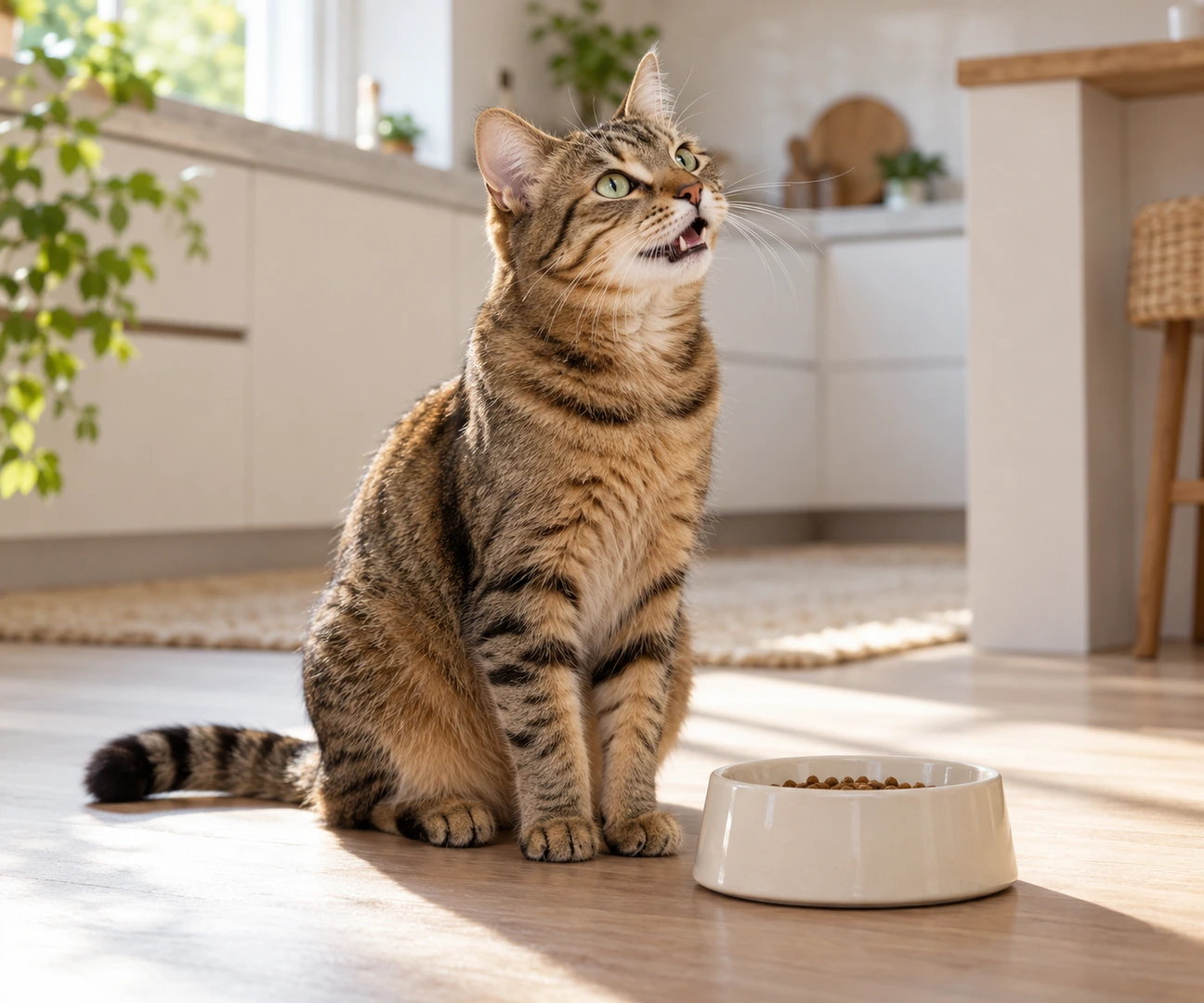

Quick answer: If you keep asking yourself “why does my cat meow so much?”, the most likely answer is that meowing works. Most adult cats meow to get a person to do something — feed them, pay attention to them, open a door or let them in or out. If your cat has always been talkative and the meowing reliably gets results, it is usually learned communication rather than a problem. But a cat that suddenly meows much more, sounds different, or is older and starts yowling at night should be checked by a vet, because pain, an overactive thyroid, kidney disease, high blood pressure, sensory decline and age-related cognitive changes can all show up as extra vocalizing.
This guide explains what is actually known about why cats meow, the common reasons a cat meows a lot, how to tell normal chattiness from a warning sign, and how to respond without accidentally making the meowing worse.
Table of Contents
Why cats meow at people in the first place
Kittens meow to get their mother’s attention when they are cold or hungry. According to the ASPCA, adult cats largely stop meowing at other cats but keep meowing at people throughout their lives, probably because it works. Research reviews describe the meow the same way: it appears to be rare between adult cats and in cat colonies, but typical of cat–human interaction (Prato-Previde et al., 2020). Cats talk to each other mainly through body language, touch and scent; with us, the voice gets results.
That is the key to understanding a “talkative” cat. A meow is best thought of as a request for attention, not a word with a fixed meaning.
Can you tell what a meow means from the sound alone?
Not very reliably, and this is where many “meow translation” charts overpromise. Three studies have tested it:
- In a 2003 study, people listened to meows recorded from 12 cats in five situations. They classified the context better than chance, but only modestly, and people who had lived with cats did better. The authors concluded meows behave more like general attention-getting calls than labels for specific situations (Nicastro & Owren, 2003).
- A small 2015 study of 10 owners found that some owners could identify the context of their own cat’s meows, but not those of an unfamiliar cat (Ellis, Swindell & Burman, 2015, Anthrozoös).
- In a 2020 online study, 225 adults heard meows recorded from 10 cats while waiting for food, being brushed, or briefly alone in an unfamiliar room. Accuracy was never significantly above chance; the food-related meow was recognised best. Cat owners and women performed somewhat better (Prato-Previde et al., 2020). All 10 cats belonged to one owner and one breed, which limits how far the result generalises.
The practical takeaway: you will understand your cat’s meowing far better by looking at when, where and what happens next than by analysing the pitch. International Cat Care also points out that individual cats develop their own meowing styles, partly shaped by how their people respond (International Cat Care). If you’d like to read further on how cats communicate, our cat behavior and care books are collected in one place.
Common everyday reasons a cat meows a lot
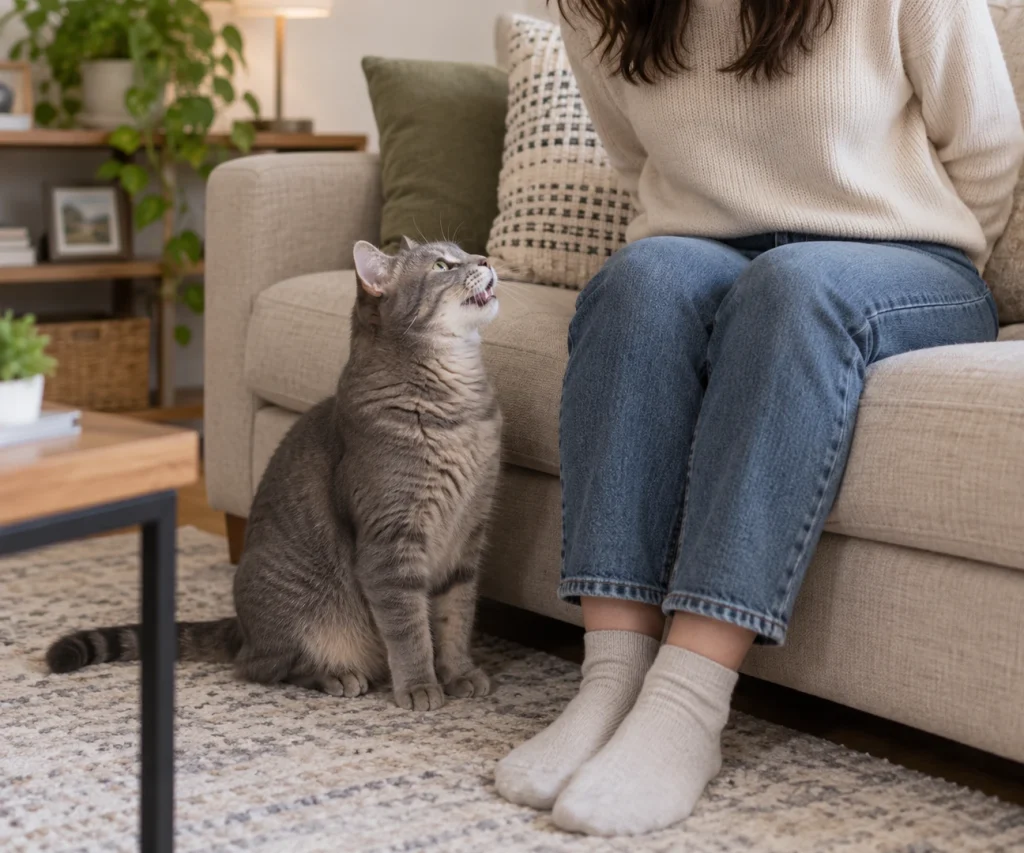
The ASPCA lists greeting, asking for attention, asking for food and asking to go in or out as the most common reasons cats meow. In real homes, these usually look like this:
Food
Meowing that peaks before meals, when someone walks into the kitchen, or in the early morning is usually food-related. If food has ever arrived after a meowing session, the cat has learned that meowing is part of how breakfast happens. Feeding at set times helps; our free cat feeding schedule generator can help you plan meals that don’t depend on who complains loudest.
Attention and social contact
Many cats seek interaction with their people, and some ask for it loudly. The ASPCA notes that cats left alone for long stretches each day may be more likely to meow for attention. This is ordinary social behavior — there’s no evidence that it reflects “manipulation” in any human sense; the cat has simply learned what works.
Boredom and too little to do
An indoor cat with few outlets for play, hunting-style activity and exploration may meow more simply because asking you for something is the most interesting option available. If the meowing comes with restlessness, destructive play or sleeping all day and racing around at night, read our guide on how to tell if your cat is bored.
Doors, windows and going outside
Meowing at doors and windows is common in cats that want access to a room or the outdoors. The ASPCA warns that a cat moving from indoor-outdoor to indoor-only life may meow at doors and windows for weeks or even months while it adjusts. If that meowing turns into slipping out whenever the door opens, see our door-dashing training plan.
Breed and individual personality
Some cats are simply more vocal. Siamese cats in particular are often described as prone to frequent meowing and yowling. If your cat has always been chatty and is otherwise healthy, that may just be who they are.
Heat and mating behavior
Unspayed females in heat often become more affectionate, roll on the floor and meow or yowl a lot. The ASPCA describes heat as lasting roughly four to ten days and recurring every 18 to 24 days through the breeding season if the cat isn’t mated — and indoor cats may cycle year-round. Intact males may pace and yowl when they detect a female in heat. Spaying or neutering is the most effective way to reduce this kind of vocalizing; discuss timing with your vet.
Stress and change
A move, a new person or pet, a lost companion or a change in routine can all coincide with more vocalizing. It is reasonable to say a stressed cat may meow more, but meowing alone doesn’t prove anxiety — look for other signs such as hiding, changes in appetite or litter box habits, or overgrooming. Our guide to cat anxiety covers those signs in more detail. If the meowing starts when you leave and is concentrated around the door, also see helping a cat cope with being alone.
Normal chattiness or something to worry about?
There is no veterinary definition of “too much” meowing, so the useful question isn’t only “why does my cat meow so much?” What matters most is change — compared with your cat’s own normal — and what comes with it.
| Usually normal | Worth a vet check |
|---|---|
| The cat has always been vocal | Meowing has increased noticeably or started suddenly |
| Meowing is tied to clear triggers (meals, your arrival, a closed door) | Meowing has no obvious trigger, or happens at random times and at night |
| The meow sounds the same as it always has | The voice sounds hoarse, strained or very different |
| The cat is eating, drinking, playing and using the litter box normally | Meowing comes with changes in appetite, thirst, weight, litter habits, mobility or behavior |
| The cat settles once the request is met | The cat seems restless, confused or unable to settle |
Medical reasons a cat may meow more
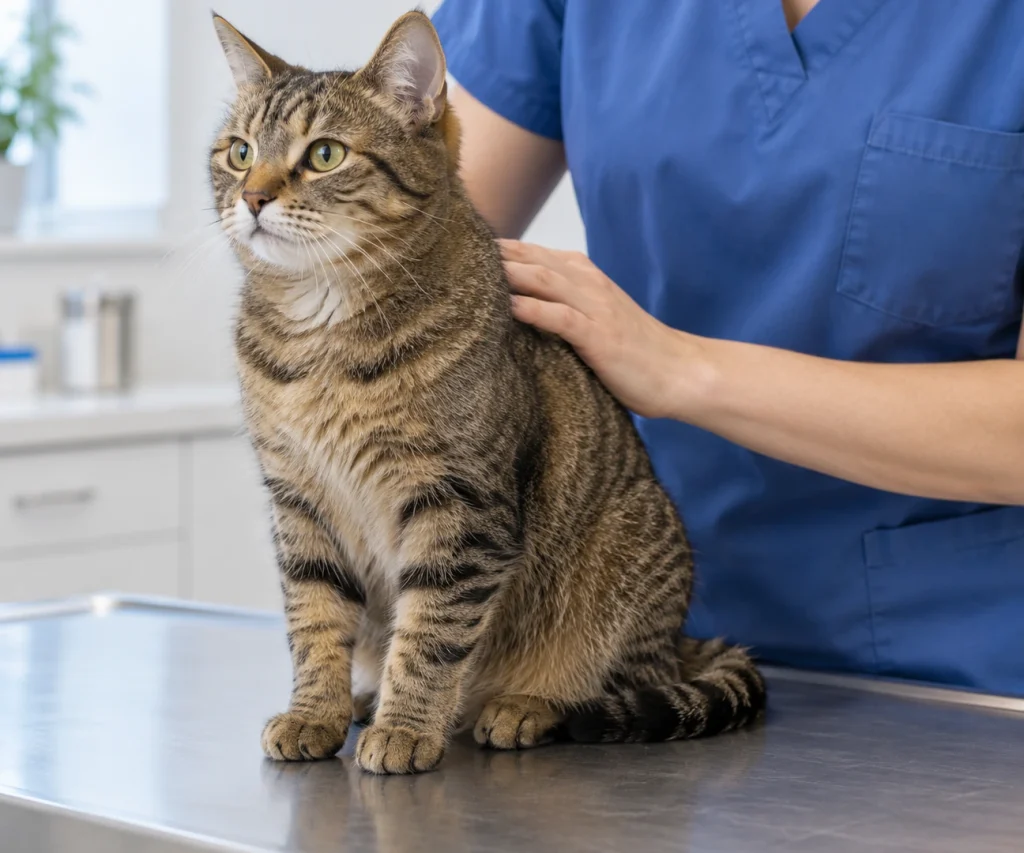
The ASPCA recommends that a cat who meows a lot be checked by a vet, even if it has a history of meowing for food, because numerous diseases can make cats feel unusually hungry, thirsty, restless or irritable. Veterinary behavior references from VCA Animal Hospitals specifically mention pain, hormonal (endocrine) disease and high blood pressure as causes to rule out, especially in middle-aged and older cats. This article can’t diagnose your cat, but these are the conditions vets commonly consider:
- Hyperthyroidism. An overactive thyroid is common in older cats. The Cornell Feline Health Center lists weight loss, increased appetite, increased thirst and urination, and hyperactivity among its signs, and the ASPCA names it as a cause of excessive meowing. See our guide to hyperthyroidism in cats.
- Kidney disease. Also common in older cats and named by the ASPCA as a possible cause of excessive meowing. Learn the signs in our kidney disease guide.
- High blood pressure. International Cat Care explains that hypertension in cats is often secondary to conditions such as kidney disease or hyperthyroidism, may cause few obvious signs until it damages the eyes, and can show up as sudden blindness. Sudden loss of vision needs prompt veterinary attention.
- Pain. Arthritis and dental disease are common in older cats, and the Canadian Veterinary Medical Association lists painful problems like these among the reasons older cats vocalize. Our cat arthritis guide describes the subtle mobility changes to watch for.
- Hearing or vision loss. Cats losing their hearing or sight may vocalize more, and may meow loudly without realizing how loud they are.
- Changes to the voice itself. A hoarse or noticeably different meow should be examined by a vet, as inflammation of the larynx and other problems can change the sound (PetMD).
Older cats and cognitive changes
Some senior cats develop cognitive dysfunction, an age-related decline sometimes compared to dementia. The ASPCA notes that older cats with this kind of confusion may meow when they become disoriented.
You may see a widely quoted claim that “28% of cats aged 11–14 and 50% over 15 have dementia.” That oversimplifies the source. A 2010 review in the Journal of Feline Medicine and Surgery (Landsberg, Denenberg & Araujo) describes a questionnaire of owners of 154 cats aged 11–21. Those percentages refer to cats showing behavioral changes — and some of those cats had other medical problems. In the oldest cats, the most common changes were in activity levels and excessive vocalization. The same review stresses that cognitive dysfunction can only be diagnosed after other medical causes — including pain, sensory loss and high blood pressure — have been ruled out, and that older cats can have more than one problem at once.
In other words, new meowing in an older cat is a reason to book a check-up, not something to accept as “just old age.” Our cat life stage calculator can help you see whether your cat has reached the senior years.
When to contact a vet
Book a veterinary appointment if:
- Your cat’s meowing has increased suddenly or noticeably without an obvious reason
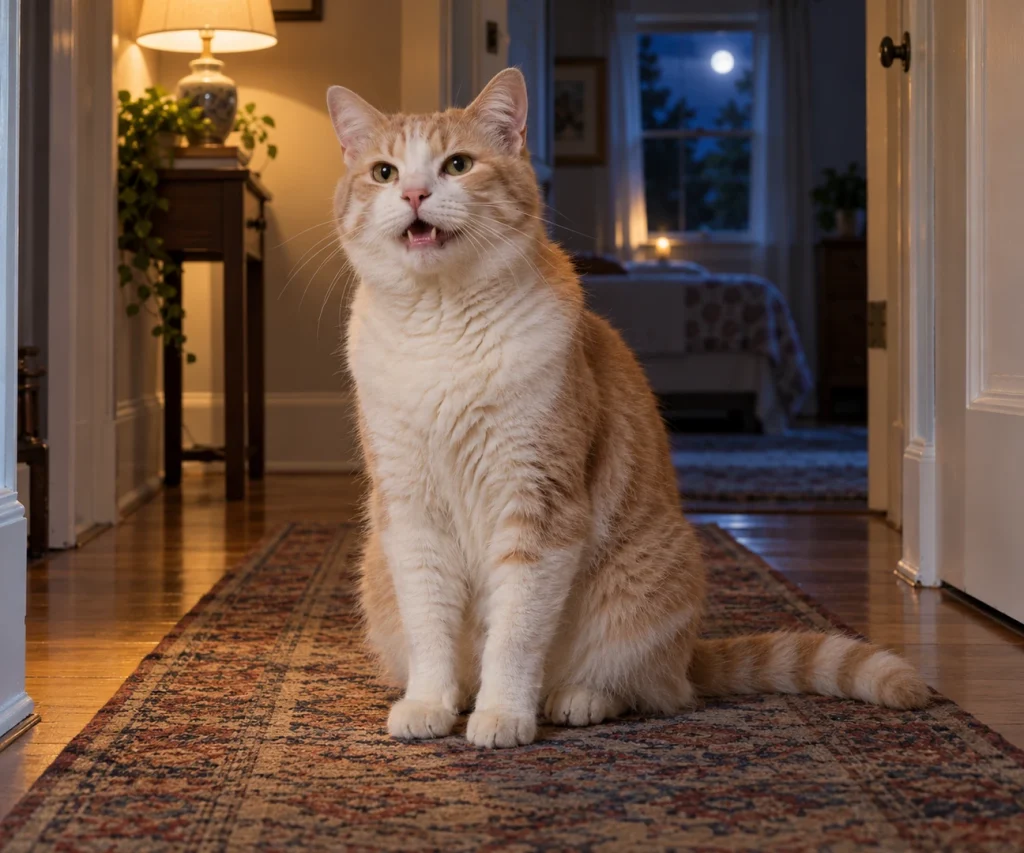
- Your cat is middle-aged or older and has started meowing more, especially at night
- The meow sounds hoarse, strained or different
- Meowing comes with weight loss, a bigger appetite, more drinking or urinating, vomiting, hiding, stiffness or reluctance to jump
- Your cat seems confused, wanders aimlessly or gets “lost” in familiar rooms
Seek care urgently if your cat:
- Cries while straining in the litter box or produces little or no urine — this can be a urinary blockage, which is an emergency, especially in male cats
- Seems suddenly unable to see, bumps into things or has dilated pupils that don’t change
- Yowls with signs of pain, has trouble breathing, collapses, or can’t use its back legs
For a broader checklist of illness signs, see how to tell if your cat is sick. If you want to note changes to discuss with your vet, our cat weight calculator and water intake calculator give you a simple reference point, and you’ll find other planners among our free cat care tools.
How to respond to a cat that meows a lot
Once medical causes have been ruled out, the goal is to meet your cat’s needs while no longer rewarding the meowing itself.
1. Keep a short log
The ASPCA suggests noting when your cat meows and what makes it stop. A few days of notes (time, place, what you did, what happened next) usually reveals the pattern — food, a door, your arrival, or nighttime — and answers “why does my cat meow so much?” more reliably than guessing.
2. Check the basics first
Before deciding your cat is “just demanding,” make sure the water bowl isn’t empty, the litter box is clean and reachable, and your cat isn’t shut in somewhere. The ASPCA specifically advises against ignoring meowing unless you’re certain it’s a request for something your cat simply wants. In a multi-cat home, our litter box calculator can help you check whether there are enough boxes to go around.
3. Reward quiet, not noise
For attention-related meowing, give attention when your cat is quiet. If the meowing starts, wait for a brief pause before responding, rather than responding to the loudest moment. Even scolding can count as attention.
Be prepared for it to get worse before it gets better. VCA notes that rewarding even a few outbursts keeps the behavior going, and that when the reward stops, the meowing may at first become more intense as the cat tries harder. Consistency from everyone in the household matters more than any single technique.
4. Take the “ask” out of mealtimes
Feed at set times and avoid feeding in response to meowing. For early-morning food requests, the ASPCA suggests a timed automatic feeder, so the cat’s attention shifts from you to the feeder.
5. Build a fuller day
Regular play that mimics hunting, puzzle feeders, climbing spaces and window views give a cat more to do than ask you for things. For cats that are noisy at night, VCA recommends a stimulating daytime routine with regular food, social play and toys to help shift activity away from the night. Our guide to cat night behavior covers nighttime activity in more depth.
6. Be patient with life changes
If the meowing follows a move, a loss or a new arrival, expect an adjustment period. Keep routines predictable and give your cat safe places to retreat to.
What not to do
- Don’t punish. The ASPCA and VCA both advise against scolding or physically punishing a cat for meowing. It is unlikely to stop the behavior and may make your cat fearful of you.
- Don’t give in “just this once.” Occasional rewards keep meowing going.
- Don’t assume an older cat is just being demanding. New vocalizing in a senior cat deserves a vet visit first.
- Don’t rely on meow “translation” charts or apps. Research suggests people can’t reliably decode a single meow without context.
Frequently asked questions
Why does my cat meow so much all of a sudden?
A sudden increase can follow a change at home, a new routine or heat in an unspayed cat, but it can also be an early sign of pain or illness. Because the causes overlap, a vet check is the sensible first step — especially if your cat is older or anything else has changed.
Why does my older cat meow loudly at night?
Nighttime vocalizing in senior cats is commonly linked with medical issues such as hyperthyroidism, high blood pressure, pain or sensory loss, and with age-related cognitive changes. A vet needs to rule out medical causes before cognitive dysfunction can be considered.
Should I ignore my cat when it meows?
Only once you’re sure its needs are met and it is meowing for something it simply wants, such as attention or an extra meal. In that case, respond when it’s quiet. Never ignore meowing that might mean something is wrong.
Do cats meow to each other?
Rarely, as adults. Kittens meow to their mother, and adult cats may yowl at each other during the breeding season, but meowing between adult cats appears to be uncommon. It is mostly directed at people.
Does a lot of meowing mean my cat is in pain?
Not necessarily, but it can. Pain is one of the medical causes vets consider. Meowing combined with hiding, reluctance to jump, changes in grooming or appetite, or crying in the litter box is more concerning than meowing at mealtimes.
Will spaying or neutering stop the meowing?
It is the most effective way to reduce meowing and yowling linked to heat and mating behavior. It won’t change meowing that is about food, attention or a medical problem.
This article is for general information and is not a substitute for veterinary advice. If you are worried about your cat’s behavior or health, contact your veterinarian. See our veterinary disclaimer.