

A raw food diet for cats means feeding uncooked meat, organs and sometimes bone, either as a commercial product or a homemade recipe. Supporters say it is closer to what cats evolved to eat. The evidence for health benefits is weak, while the risks are well documented: raw pet foods are far more likely than cooked foods to carry bacteria such as Salmonella and Listeria, homemade recipes are often nutritionally incomplete, and since late 2024 raw pet food and raw milk have been linked to fatal H5N1 bird flu infections in pet cats.
This guide explains what a raw diet actually involves, what the research does and doesn’t show, what the FDA, CDC and the American Veterinary Medical Association (AVMA) say, and how commercially cooked diets compare. If you have already decided to feed raw, it also sets out the practical steps that reduce the risk to your cat and your household, and the warning signs that need a vet.
Table of Contents
The short answer
Cats are obligate carnivores, but that means they need nutrients found in animal tissue, not that the meat has to be raw. Cooking does not stop a food from meeting a cat’s needs, and complete and balanced commercial cat foods are formulated to do exactly that. Published reviews have found little more than modest differences in digestibility in favor of raw diets, with no health benefit proven. Against that sit consistent findings of bacterial contamination, the risk of nutritional imbalance in homemade recipes, injury from bones and, most recently, H5N1 bird flu.
For those reasons the AVMA discourages feeding raw or undercooked animal protein to cats and dogs, and the CDC and Los Angeles County health officials have advised owners not to feed cats raw milk or other raw animal products. If you still choose raw, the safest version is a commercial product labeled complete and balanced, handled like raw meat for people, and never fed in a household that includes someone at higher risk from foodborne infection.
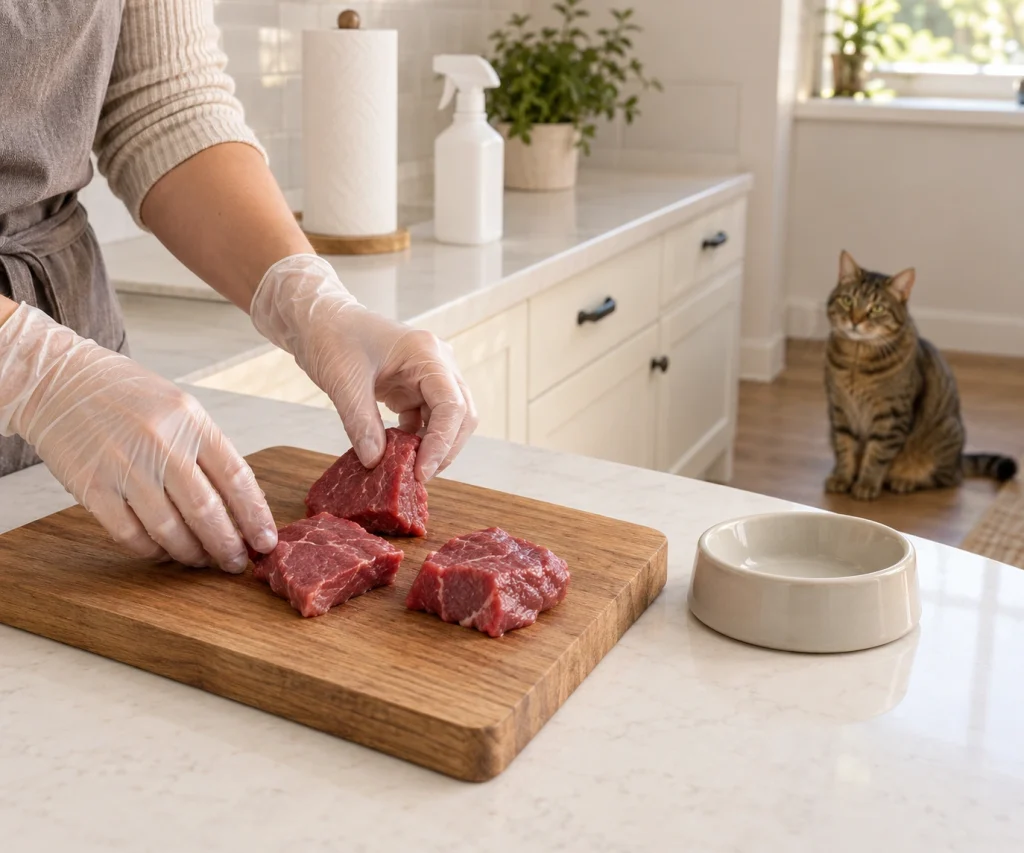
What a raw food diet for cats actually means
“Raw feeding” covers several quite different products. The differences matter, because they affect both nutritional completeness and safety.
| Type | What it is | Key questions to ask |
|---|---|---|
| Commercial frozen raw | Uncooked meat, organs and sometimes ground bone, sold frozen as patties, nuggets or tubs | Is it labeled complete and balanced for your cat’s life stage? What pathogen controls does the maker use? |
| Freeze-dried raw | Raw ingredients with the water removed, sold shelf-stable as meals, toppers or treats | Is it a complete meal or only a topper or treat? Freeze-drying is not the same as cooking. |
| High-pressure processed (HPP) raw | Raw food treated with very high pressure instead of heat | HPP is intended to reduce bacteria, but it is not cooking, and claims vary between products. |
| Homemade raw | Recipes prepared at home from raw meat, organs, bone and supplements | Was the recipe formulated by a board-certified veterinary nutritionist? Most published recipes are not complete. |
| Raw toppers, treats and raw milk | Raw products added to an otherwise cooked diet | Small amounts still carry the same pathogen risks. Raw milk is specifically linked to H5N1 in cats. |
The phrase to look for on any cat food, raw or cooked, is the nutritional adequacy statement, such as “complete and balanced” for a stated life stage. In the United States a food can earn that statement in one of two ways: by being formulated to meet one of the cat food nutrient profiles published by the Association of American Feed Control Officials (AAFCO), or by passing a feeding trial run to AAFCO procedures. Products labeled for “intermittent or supplemental feeding” are not meant to be a cat’s whole diet.
AAFCO itself does not regulate, test, approve or certify pet foods. It writes model standards and regulations that states and federal agencies can adopt, and enforcement falls to the FDA and state regulators. So “meets AAFCO standards” describes how a manufacturer formulated or tested its food, not an independent approval. MyyCat’s Cat Food Label Calculator can help you compare the nutrient figures on raw, wet and dry labels on the same dry-matter basis.
Claimed benefits, and what the evidence shows
Most arguments for raw feeding rest on biology, owner reports and marketing rather than controlled studies in cats. Two independent reviews are useful here. A 2013 review in the Journal of the American Veterinary Medical Association by Freeman and colleagues concluded that the risks of raw meat-based diets outweigh any minimal benefits. A 2019 review in the Journal of Small Animal Practice by Davies and colleagues found that, beyond some plausible claims about digestibility and stool quality, the health claims for raw feeding remain a mixture of anecdote and opinion.
“Cats are obligate carnivores, so they should eat raw meat”
The first half is true. Cats need nutrients that come from animal tissue, and they need more protein than many other species. Our guide to protein sources in cat food explains what that means in practice. The second half doesn’t follow. Cooking does not turn animal protein into plant protein, and cooked commercial foods are formulated to supply everything a cat needs. What matters is whether the whole diet is complete and balanced, not whether the meat was heated.
Digestibility and smaller stools
This is the claim with the most support. Studies have found that some raw diets are slightly more digestible than some commercial foods, and owners often report smaller, firmer stools. Freeman and colleagues described the differences found as modest and noted that no health benefit had been shown to follow from them. Better digestibility on its own also says nothing about safety or completeness.
Shinier coat, cleaner teeth, more energy
These are the claims owners hear most often, and they are the least supported. Both reviews found no good-quality evidence for them in cats. Owner impressions are real experiences, but they can’t separate the effect of raw food from other changes, such as a switch away from a poorer diet, a change in calories, more attention to feeding or simple expectation. Claims that raw diets prevent or treat disease should be treated with particular caution, as should the “natural” framing that also surrounds labels such as grain-free cat food.
The main risks of a raw food diet for cats
Bacteria in raw pet food
The clearest data come from a study by the FDA’s Center for Veterinary Medicine, published by Nemser and colleagues in 2014. Of 196 raw pet food samples tested, 32 were positive for Listeria monocytogenes and 15 for Salmonella. Among 480 dry and semimoist pet food samples bought from stores, only two dry cat foods tested positive for a pathogen. The FDA concluded that raw pet food was more likely than the other types tested to be contaminated with disease-causing bacteria.
Studies in other countries point the same way. The Davies review describes surveys in Europe and North America that have repeatedly found Salmonella in a proportion of frozen commercial raw diets, including a Dutch study that found it in 20% of samples and Listeria monocytogenes in 54%. The review also notes that raw pet foods commonly exceed hygiene thresholds for gut bacteria, and that these bacteria often carry resistance to important antibiotics.
A cat may not show any illness from these bacteria. The AVMA points out that apparently healthy cats and dogs can carry infections without symptoms and still shed the organisms, putting other animals and people at risk. When cats do become ill, signs such as vomiting and diarrhea are the most common.
Bird flu (H5N1) and raw food
This is the risk most raw-feeding guides have not caught up with. Cats are highly susceptible to the H5N1 avian influenza virus, and the FDA warns that infected cats can become severely ill or die. In January 2025 the FDA said it had tracked H5N1 cases in domestic and wild cats in California, Colorado, Oregon and Washington State that were associated with eating contaminated food. It now requires cat and dog food manufacturers that use uncooked or unpasteurized poultry or cattle materials to treat H5N1 as a known or reasonably foreseeable hazard in their food safety plans.
A CDC report published in May 2026 describes what happened in Los Angeles County between December 2024 and January 2025. Nineteen domestic cats became ill after eating commercially purchased raw milk, raw meat or raw pet food. Nine tested positive for H5N1, and fourteen of the nineteen died or were euthanized. Some of the products involved tested positive for the virus. Of 139 people identified as exposed to the sick cats, one veterinary professional had antibody evidence of H5N1 infection after caring for an infected cat. The report’s advice to owners is direct: don’t feed cats raw milk or other raw animal products.
Signs of H5N1 in cats listed by the American Animal Hospital Association (AAHA) include fever, lethargy, loss of appetite, discharge from the eyes or nose, breathing difficulty and neurological signs such as poor coordination, tremors, seizures and loss of vision. Any of these in a cat that eats raw food or raw milk is an emergency.
Risks to the people in your household
Raw pet food is raw meat in your kitchen. The AVMA notes that people who handle contaminated raw pet food can become ill, and that cats and dogs carrying these bacteria without symptoms pose a particular risk to young children, older adults, pregnant people and anyone with a weakened immune system. Davies and colleagues make the same point: pet-owning households often include people more likely to be seriously affected by Salmonella.
Nutritional imbalances, especially in homemade raw diets
Formulating a complete diet for a cat is harder than it looks. In a 2019 study by Wilson and colleagues at UC Davis, researchers examined 114 recipes for home-prepared cat food from websites and books, 94 of which contained enough information to analyze. None provided all essential nutrients at the levels recommended by the National Research Council for adult cats. Many were short of three or more nutrients, some provided less than half the recommended amounts of nutrients such as choline, iron, zinc, thiamin, vitamin E and manganese, and 7% included potentially toxic ingredients such as garlic or onion. The study looked at homemade recipes in general, not only raw ones, but raw recipes share the same formulation problem.
Freeman and colleagues also concluded that raw meat-based diets carry a high risk of nutritional deficiencies and excesses, particularly when they are prepared at home. A cat can look well on an unbalanced diet for months before problems appear, which is why “my cat is thriving” is not proof that a recipe is complete.
Bones
Some raw diets include whole or ground bone as a calcium source. Freeman and colleagues list fractured teeth and gastrointestinal obstruction or perforation among the risks of feeding bones. Cooked bones are no safer, because they become brittle and can splinter.
Do freezing, freeze-drying or HPP make raw food safe?
Not reliably, and not in the way cooking does. Freezing preserves food but does not dependably kill bacteria. Davies and colleagues note that freeze-thawing harms many parasites but has much less effect on many bacteria, with the effect varying by organism. Freeze-drying removes water. It is a preservation method, not a cooking step, and freeze-dried raw meals, toppers and treats should be handled with the same care as frozen raw food. MyyCat’s cat treats guide covers the same issue for freeze-dried treats.
High-pressure processing (HPP) is intended to reduce bacterial contamination without heat, and some manufacturers use it as a safety step. It is still not equivalent to cooking, and how well it works can vary by product and process. When the FDA described the steps manufacturers can use against H5N1, it named processing steps capable of inactivating viruses, such as heat treatment, together with sourcing from healthy flocks and herds. The AVMA likewise describes pasteurization and cooking to a safe internal temperature as the traditional ways to reduce or eliminate pathogens.
What veterinary and public health bodies say
| Organization | Position on raw feeding |
|---|---|
| American Veterinary Medical Association (AVMA) | Discourages feeding any raw or undercooked animal-sourced protein to cats and dogs because of risks to animal and human health. Supports diets processed to reduce or eliminate pathogens. |
| U.S. Food and Drug Administration (FDA) | Found raw pet food more likely to carry disease-causing bacteria than the other pet foods it tested. Since 2025 requires manufacturers using uncooked poultry or cattle materials to address H5N1 in their food safety plans. |
| CDC and Los Angeles County public health officials | Advise pet owners not to feed cats raw milk or other raw animal products, after cat deaths linked to H5N1. |
| American Animal Hospital Association (AAHA) | Advises against raw milk for cats and recommends cooking raw pet food or not feeding it, to reduce bird flu risk. |
| AAFCO | Publishes the nutrient profiles behind “complete and balanced” claims in the U.S. Does not regulate, test, approve or certify individual pet foods. |
These positions are about risk, not about any single brand. They also don’t mean every raw product will make a cat sick. They mean that, across the evidence, raw feeding adds risks that cooked diets largely avoid, without proven benefits that would offset them.
Raw food diet for cats vs cooked diets
Many owners who are drawn to raw food want something less processed, more meat-focused or higher in moisture than dry kibble. Those goals can usually be met with cooked foods.
| Commercial raw | Commercial wet (canned or pouch) | Commercial dry | |
|---|---|---|---|
| Heat treatment | None (may be freeze-dried or HPP) | Cooked in the can or pouch | Cooked during manufacture |
| Bacterial contamination risk | Highest of the pet foods tested by the FDA | Low | Low, though not zero |
| H5N1 concern | Linked to cat infections and deaths | Not linked to the reported cases | Not linked to the reported cases |
| Moisture | High (unless freeze-dried) | High | Low |
| Completeness | Varies; check the nutritional adequacy statement | Check the nutritional adequacy statement | Check the nutritional adequacy statement |
| Handling | Treat as raw meat; frozen storage and careful thawing | Refrigerate after opening | Store dry and sealed |
If moisture is the attraction, a complete and balanced wet food delivers it without the pathogen risk. Our guides to wet food for cats and cat hydration explain the options. Lightly cooked “fresh” commercial diets are another route for owners who want a less processed food, as long as the label carries a complete and balanced statement for your cat’s life stage.
If you still choose to feed raw: how to reduce the risks
Owners are entitled to make their own decision. If you decide to feed a raw food diet to your cat, these steps don’t remove the risks, but they lower them.
- Talk to your vet first. Freeman and colleagues recommend discussing raw feeding with a veterinarian or veterinary nutritionist. Tell your vet whenever your cat is unwell, too, because a raw diet changes which infections they consider.
- Choose commercial over homemade. Pick a product with a complete and balanced statement for your cat’s life stage. If you want to feed homemade food, raw or cooked, use a recipe formulated for your individual cat by a board-certified veterinary nutritionist.
- Never feed raw milk. Raw milk has been specifically linked to H5N1 deaths in cats.
- Ask the manufacturer about safety controls. Ask how it controls pathogens and H5N1 risk and whether it tests finished products, and check recall announcements regularly.
- Handle it like raw meat for people. The FDA advises thawing in the refrigerator or microwave rather than on the counter, not rinsing raw meat, washing your hands for at least 20 seconds after handling it, and cleaning and disinfecting surfaces, bowls and utensils afterward. Pick up uneaten food promptly.
- Limit face contact. The FDA suggests avoiding letting your cat lick your face after a raw meal.
- Change diets gradually. A sudden switch can upset digestion. Our guide on how to change cat food safely explains a gradual transition.
- Feed by calories and monitor weight. Raw foods vary widely in energy density. MyyCat’s Cat Food Amount Calculator estimates daily amounts for healthy adult cats from the calorie content on the label, and the Cat Body Condition Score Calculator helps you track whether your cat is staying at a healthy weight.
Some veterinary sources suggest cooking a raw product before serving it to reduce the bird flu risk. If you do this, check with the manufacturer or your vet first. Cooking can change a food’s nutrient content, and any bone in the product becomes a splintering hazard once cooked.
Households and cats that should avoid raw feeding
Raw feeding is a particularly poor fit when anyone in the home is at higher risk of serious foodborne illness: babies and young children, older adults, pregnant people, and anyone whose immune system is weakened by illness or treatment. This is the group the AVMA and the Davies review single out.
Be cautious with cats too. Kittens are still growing and are especially sensitive to nutritional imbalance, so any raw food must be labeled complete and balanced for growth. For cats with a chronic illness, a weakened immune system or a condition that needs a prescribed diet, such as kidney disease or a food allergy, the diet should be chosen with your vet rather than changed independently.
Warning signs after eating raw food
Contact your vet promptly if a cat on a raw diet develops vomiting, diarrhea, blood in the stool or reduced appetite, or seems lethargic. Mention the diet, including any raw toppers, treats or milk. A cat that stops eating needs attention quickly; see our guide to a cat not eating.
Treat these signs as an emergency in any cat that has eaten raw food or raw milk: fever with marked lethargy, breathing difficulty, discharge from the eyes or nose together with illness, or neurological signs such as poor coordination, a head tilt, tremors, seizures or sudden blindness. Phone ahead before going in, so the clinic can take precautions, keep other cats away from the sick cat, and keep the remaining food in sealed packaging in case it needs testing.
If anyone in the household develops symptoms after contact with a sick cat or its food, they should contact their own doctor and mention the exposure. For other early signs of illness in cats, see how to tell if your cat is sick. This article is general information and not a substitute for veterinary advice; see our veterinary disclaimer.
Frequently asked questions
Is a raw food diet good for cats?
The evidence doesn’t show that it is better than a complete and balanced cooked diet. Independent reviews found only modest digestibility differences and no proven health benefits, while raw diets carry well-documented risks of bacterial contamination, nutritional imbalance and, more recently, H5N1 bird flu.
Do vets recommend raw food for cats?
Major veterinary bodies do not. The AVMA discourages feeding raw or undercooked animal protein to cats and dogs. Individual vets vary, but if you are considering raw food, discuss it with your vet so they can weigh it against your cat’s health and your household.
Is freeze-dried raw cat food safer?
Not necessarily. Freeze-drying removes water but is not a cooking step and does not reliably eliminate bacteria. Handle freeze-dried raw meals, toppers and treats with the same care as frozen raw food.
Can cats get bird flu from raw food?
Yes. The FDA has linked H5N1 cases in cats in several U.S. states to contaminated food, and a CDC report describes cats in Los Angeles County that became ill or died after eating raw milk, raw meat or raw pet food. Cooking and pasteurization inactivate the virus.
Can I make a safe homemade raw diet for my cat?
It is difficult. In a UC Davis analysis, none of the 94 analyzable homemade cat food recipes met all of a healthy adult cat’s essential nutrient needs. If you want to feed homemade food, ask your vet to refer you to a board-certified veterinary nutritionist, and remember that a raw homemade diet still carries pathogen risks.
What is the best alternative to raw food for cats?
A commercial cooked diet labeled complete and balanced for your cat’s life stage. Wet foods provide the high moisture many raw feeders want, and lightly cooked fresh diets suit owners who prefer less processed food.
Sources
- American Veterinary Medical Association. Raw or undercooked animal-source protein in cat and dog diets (policy).
- U.S. Food and Drug Administration. Cat and dog food manufacturers required to consider H5N1 in food safety plans. January 17, 2025.
- U.S. Food and Drug Administration. Get the facts! Raw pet food diets can be dangerous to you and your pet.
- Vaughan A, de St. Maurice A, et al. Serologic evidence of highly pathogenic avian influenza A(H5N1) virus infection in a veterinary professional exposed to an infected domestic cat — Los Angeles County, California, December 2024–January 2025. MMWR. 2026;75(17).
- Nemser SM, et al. Investigation of Listeria, Salmonella, and toxigenic Escherichia coli in various pet foods. Foodborne Pathogens and Disease. 2014;11(9).
- Freeman LM, Chandler ML, Hamper BA, Weeth LP. Current knowledge about the risks and benefits of raw meat-based diets for dogs and cats. Journal of the American Veterinary Medical Association. 2013;243(11):1549.
- Davies RH, Lawes JR, Wales AD. Raw diets for dogs and cats: a review, with particular reference to microbiological hazards. Journal of Small Animal Practice. 2019;60(6):329–339.
- Wilson SA, Villaverde C, Fascetti AJ, Larsen JA. Evaluation of the nutritional adequacy of recipes for home-prepared maintenance diets for cats. Journal of the American Veterinary Medical Association. 2019. Summary: UC Davis.
- American Animal Hospital Association. Prevention of bird flu in cats: practical steps for owners.
- Association of American Feed Control Officials. Understanding pet food.
- Murphy CM, Schertz ON, Strawn LK. A consumer’s guide: overview of pet food labels. Virginia Cooperative Extension.
[…] linked to severe illness and deaths in cats that ate raw pet food or raw milk. Our article on the raw food diet for cats covers that evidence in detail. If you are set on a homemade diet for a kitten, ask your vet for a […]