
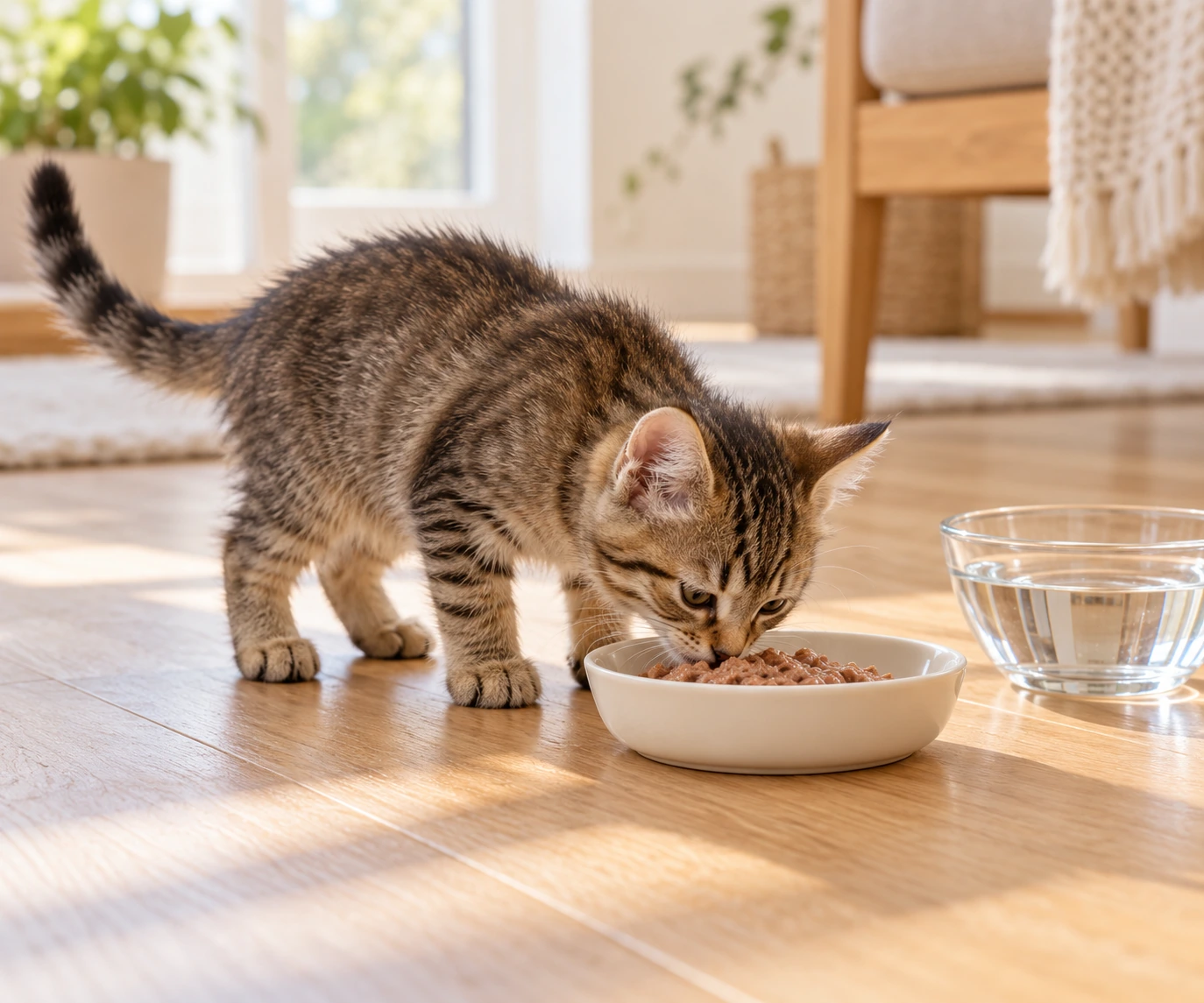

If you are wondering what to feed a kitten, the short answer is a commercial kitten food labeled “complete and balanced” for growth (or for all life stages), offered as several small meals a day, with fresh water always available. Kittens grow fast, need far more energy for their size than adult cats, and are less forgiving of nutritional gaps, which is why ordinary adult food, dog food, milk and most homemade or raw diets are poor choices.
This guide explains how to choose a kitten food and read its label, how feeding changes from weaning to the first birthday, how much and how often to feed, why neutering is a turning point for weight, which foods and drinks to avoid, and when to switch to adult food. It also covers the warning signs that mean a kitten needs a vet. For exact daily amounts based on your kitten’s weight and food, MyyCat’s calculators do the arithmetic for you.
Table of Contents
The short answer
- Food: a commercial food with a nutritional adequacy statement saying it is complete and balanced for growth, or for all life stages.
- Format: wet, dry or a mix can all work if the food is complete. RSPCA Australia suggests starting with wet food and adding dry food as the kitten grows.
- Meals: several small meals a day while kittens are young, adjusted to the kitten’s weight gain and body condition.
- Drink: fresh water, not cow’s milk.
- Switch to adult food: at around one year of age or once the kitten reaches maturity, whichever comes later. Large breeds can take longer.
- Watch out for: rapid weight gain after neutering, and any kitten that stops eating, has ongoing vomiting or diarrhea, or isn’t gaining weight.
Why kittens need different food from adult cats
A kitten is building bone, muscle and organs at a pace it will never match again, and that shows up in its energy needs. The 2021 AAHA/AAFP Feline Life Stage Guidelines give an example: a growing kitten at 10 weeks of age needs around 200 kcal per kilogram of body weight per day, compared with about 80 kcal/kg/day at 10 months. Energy needs per kilogram fall steadily as growth slows, which is why a kitten’s portions have to be reviewed regularly rather than set once.
Growth also raises the stakes for getting nutrients right. Like adult cats, kittens need nutrients that come from animal tissue, including the amino acid taurine. Research published in 1987 by Pion and colleagues linked low blood taurine in cats to a serious but reversible form of heart muscle failure, one reason taurine is now treated as an essential nutrient in complete cat foods. It is also why kittens should never live on dog food: RSPCA Australia warns that puppy and dog foods lack the taurine cats need. Minerals matter too. The Merck Veterinary Manual notes that kittens fed all-meat diets are commonly affected by rickets, because meat alone does not supply calcium and phosphorus in the right balance.
The practical lesson is that a growing kitten needs a food designed for growth, not a “close enough” substitute. Our guide to protein sources in cat food explains why animal protein matters so much for cats in general.
What to feed a kitten: how to choose the right food
Start with the nutritional adequacy statement
The most important words on a kitten food are usually in small print. In the United States, the FDA explains that a food labeled “complete and balanced” is intended to be fed as a pet’s sole diet. The Association of American Feed Control Officials (AAFCO) publishes two sets of cat nutrient profiles: one for growth and reproduction, which covers growing kittens and pregnant or nursing cats, and one for adult maintenance. A food can earn the complete and balanced statement either by being formulated to meet the relevant profile or by passing a feeding trial run to AAFCO procedures.
For a kitten, look for a statement that names growth, or all life stages. An “all life stages” food is formulated to cover growth as well as adulthood, so it is suitable for kittens. A food labeled only for adult maintenance is not designed for a growing kitten. Products labeled for “intermittent or supplemental feeding”, such as most treats and toppers, are not meant to be a kitten’s main diet.
AAFCO itself does not regulate, test, approve or certify individual pet foods; it publishes model standards that regulators adopt, and enforcement is carried out by the FDA and state authorities. Outside the United States, the World Small Animal Veterinary Association (WSAVA) treats the nutrient profiles of FEDIAF, the European pet food industry federation, as the equivalent reference. MyyCat’s Cat Food Label Calculator can help you compare the nutrient figures of wet and dry kitten foods on an equal, dry-matter basis.
Wet, dry or both?
There is no single right format, provided the food is complete and balanced for growth. Each has trade-offs:
| Wet kitten food | Dry kitten food | |
|---|---|---|
| Moisture | High; contributes to daily water intake | Low; fresh water is essential |
| Calories per bite | Lower, so portions look larger | Higher, so it is easy to overfeed by eye |
| Convenience | Spoils if left out; refrigerate opened food | Easy to store and measure; suits food puzzles |
| Texture for young kittens | Soft and easy for newly weaned kittens | Can be softened with water for very young kittens |
| Cost | Usually higher per calorie | Usually lower per calorie |
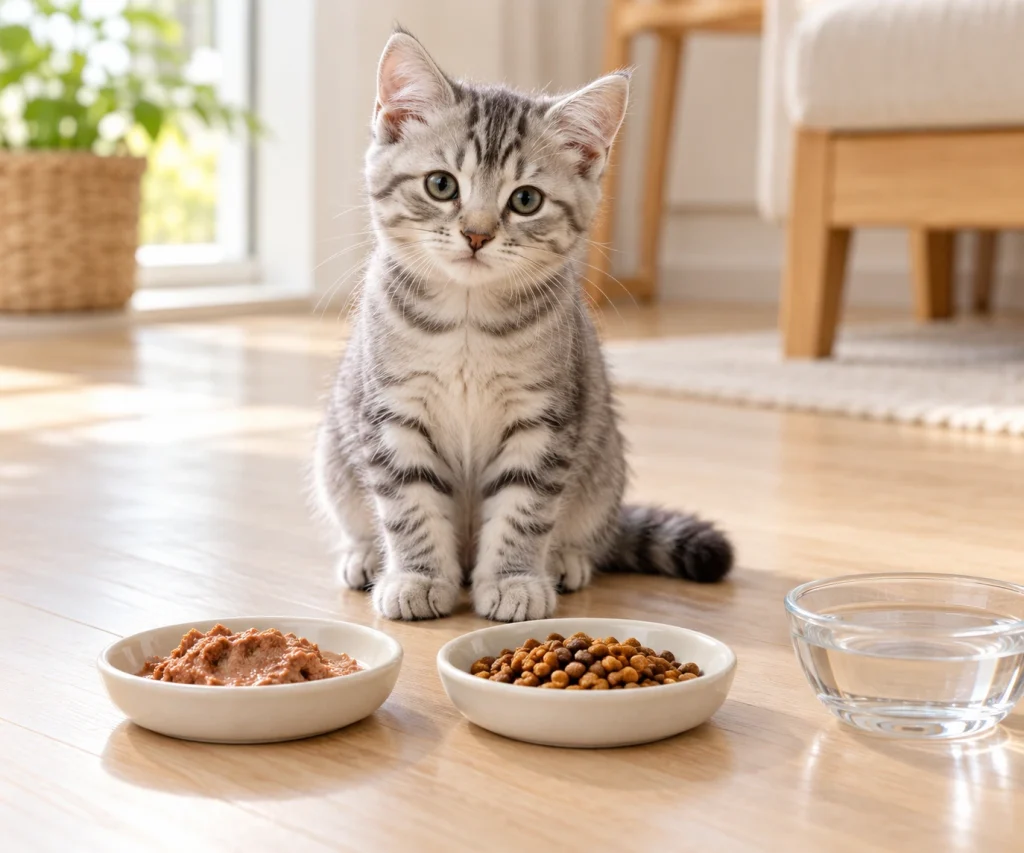
Offering both textures has a practical advantage. The AAHA/AAFP guidelines note that kittens’ food preferences are strongly influenced by their mother, although they can change later with experience. RSPCA Australia suggests starting with wet food and introducing dry food as kittens grow. A kitten used to more than one texture can be easier to feed later, for example if a vet recommends a particular diet. Our guides to wet food for cats and cat hydration explain the role of moisture in more detail.
Questions worth asking the manufacturer
The World Small Animal Veterinary Association (WSAVA) does not endorse or certify pet food brands. What it offers instead is a set of questions to ask any manufacturer, and its advice is to be cautious about a brand that can’t or won’t answer them:
- Do you employ a qualified nutritionist, such as someone with a PhD in animal nutrition or board certification in veterinary nutrition?
- Who formulates your diets, and what are their credentials?
- Which nutrient profiles does the food meet (AAFCO or FEDIAF), and what quality-control and safety testing do you carry out?
- What research has been done on your products, and is any of it published in peer-reviewed journals?
- Who makes the food, and where?
Don’t be swayed by “premium”, “holistic” or “grain-free”
WSAVA describes terms such as “holistic” and “premium” as of little practical value for judging a food’s nutrition. Price, packaging and buzzwords don’t tell you whether a food suits a growing kitten. The adequacy statement, the calorie content and the manufacturer’s answers do. The same applies to grain-free cat food, which is not automatically better for kittens.
Feeding a kitten from weaning to the first birthday
What to feed a kitten changes as it grows. The ages below are general guides. Kittens develop at different rates, and breed matters, so use them alongside your vet’s advice and your kitten’s weight trend.
| Age | What to feed | Notes |
|---|---|---|
| Newborn to about 3 weeks | Mother’s milk, or a kitten milk replacer for orphaned kittens | Bottle-feeding needs specific guidance from a vet or rescue. Never use cow’s milk. |
| About 3–5 weeks onward | Weaning onto a complete, balanced kitten food | The AAHA/AAFP guidelines say weaning onto commercially balanced kitten food can start at 3–5 weeks. Soft or moistened food is easiest. |
| Weaned kittens (around 2–6 months) | Complete kitten food for growth, several small meals a day | Energy needs per kilogram are at their highest. Weigh regularly; portions change quickly. |
| About 6–12 months | Kitten food continues | Growth slows and energy needs per kilogram fall. Neutering often happens in this period; see below. |
| From about 12 months, or later for large breeds | Gradual change to a complete adult food | VCA advises switching at one year or at maturity, whichever is later. Large breeds such as Maine Coons may take up to 18 months to mature. |
If you have adopted a kitten that was weaned elsewhere, ask what it has been eating and keep feeding that food for the first days. Changing food at the same time as changing homes adds stress, and a sudden switch can upset digestion. When you are ready to change, our guide on how to change cat food safely explains a gradual transition.
How much and how often to feed a kitten
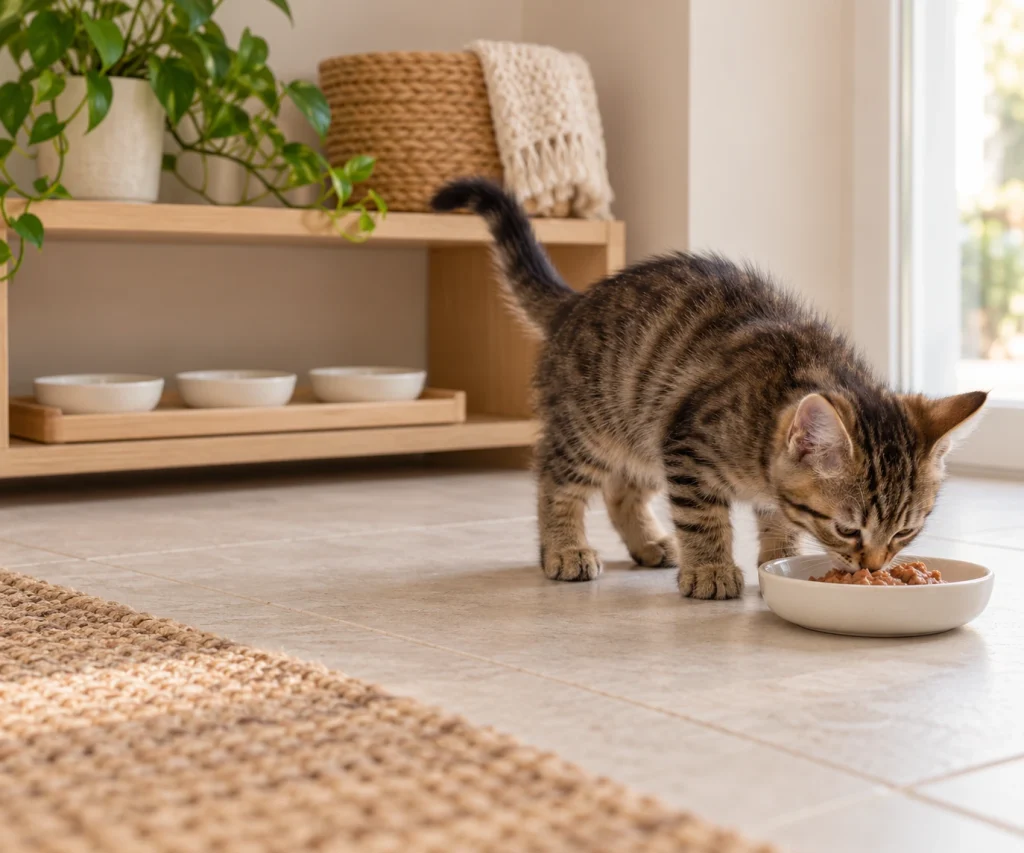
Kittens have small stomachs and high energy needs, so they do best with several small meals rather than one or two large ones. RSPCA Australia recommends feeding growing kittens at least four meals a day. As the kitten approaches adulthood, the number of meals can gradually come down. MyyCat’s Cat Feeding Schedule Generator can help you space meals evenly around your day.
The right amount depends on the kitten’s current weight and the calorie content of the food, which varies a lot between products. The feeding guide on the package is a reasonable starting point, but it is an average. MyyCat’s Kitten Feeding Calculator estimates a daily calorie target for a healthy, weaned kitten and converts it into grams of your specific wet or dry food. It uses a starting formula published in the Merck Veterinary Manual and is not a prescription, so adjust with your vet based on growth.
The best check on any amount is the kitten itself:
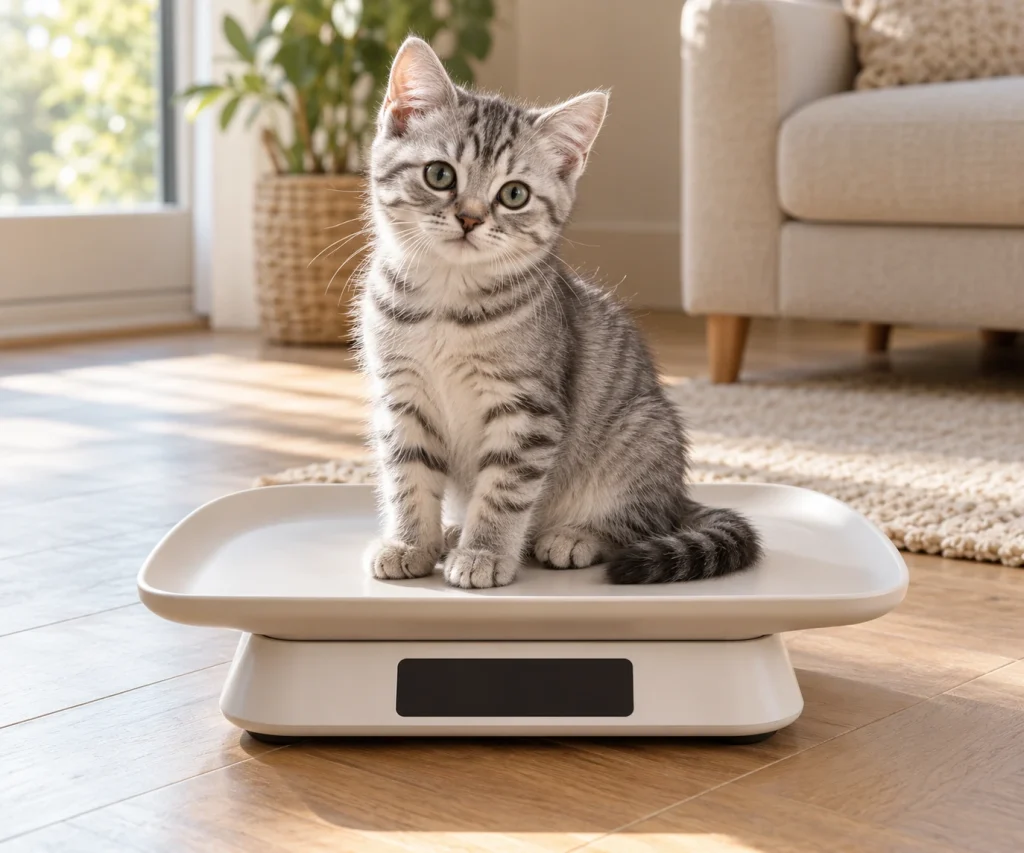
- Weigh regularly. A kitten should gain weight steadily. MyyCat’s Kitten Growth Tracker lets you log weights and see the trend over time, which is useful to share with your vet.
- Check body condition. You should be able to feel the ribs under a light layer of fat. The Cat Body Condition Score Calculator explains how to assess it.
- Measure, don’t guess. Weighing food in grams is more reliable than scoops or cups, especially with calorie-dense dry food.
- Count treats. Treats add calories but are not complete nutrition. Keep them small and count them within the day’s total; our cat treats guide covers healthier options.
Some owners leave dry food out all day for young kittens, while others prefer measured meals. Meals make it easier to notice a change in appetite and to control weight later on, especially after neutering. The AAHA/AAFP guidelines also suggest that food puzzles or hiding small portions around the home can satisfy a kitten’s natural urge to stalk and pounce.
Neutering and the risk of weight gain
Neutering is one of the most important nutritional turning points in a kitten’s first year. The AAHA/AAFP guidelines note that neutering is associated with weight gain and describe it as an ideal time to review a kitten’s nutritional needs and obesity risk. They also state that obesity prevention starts with kittens.
Part of the reason is appetite. In a small study of nine adult male cats, Wei and colleagues found that cats ate more immediately after neutering and that food intake stayed raised for months when food was freely available. Over six months the cats gained around 20% in body weight, mainly as fat. The study involved adult males rather than kittens and had no comparison group of intact cats, so it doesn’t give a precise figure for every cat. Its practical message is consistent with the guidelines, though: after neutering, a kitten’s appetite can outpace its needs.
In practice, ask your vet at the neutering appointment whether your kitten’s portions should change. Keep weighing regularly afterward, and switch from free-feeding to measured meals if you haven’t already. Preventing excess weight is far easier than taking it off later; our guide to helping a cat lose weight safely shows how much effort that takes.
Foods and drinks kittens should not have
| Food or drink | Why to avoid it |
|---|---|
| Cow’s milk and dairy | The ASPCA notes that milk and dairy products can cause diarrhea and other digestive upset. Water is the right drink after weaning. |
| Dog or puppy food | Not formulated for cats; RSPCA Australia warns it lacks the taurine cats need. |
| Adult-only cat food as the main diet | Formulated for maintenance, not growth. |
| Onions, garlic, chives | The ASPCA says these can cause gastrointestinal irritation and red blood cell damage leading to anemia. |
| Chocolate, coffee, caffeine | Can cause vomiting, diarrhea, abnormal heart rhythm, tremors, seizures and even death, according to the ASPCA. |
| Grapes and raisins | The ASPCA links exposure to kidney damage. |
| Xylitol (in some sugar-free products) | The ASPCA lists it as a cause of low blood sugar and potential liver damage. |
| Alcohol and raw yeast dough | Both are on the ASPCA’s list of foods to keep away from pets. |
| Raw meat, raw eggs and bones | Can carry bacteria such as Salmonella and E. coli; bones can cause injury. |
If you think your kitten has eaten something toxic, contact your vet or an animal poison control service straight away rather than waiting for signs.
Raw and homemade diets for kittens
When owners think about what to feed a kitten, homemade and raw diets often come up. They are especially risky for kittens because growth leaves little margin for error. The Merck Veterinary Manual notes that many homemade diets for cats are deficient in minerals and fail to achieve a proper calcium-to-phosphorus ratio, and that animals fed all-meat diets are commonly affected by rickets. Its advice is to feed a high-quality commercial food or a diet designed by a credentialed veterinary nutritionist.
Raw diets add the risk of bacteria and, more recently, H5N1 bird flu, which has been linked to severe illness and deaths in cats that ate raw pet food or raw milk. Our article on the raw food diet for cats covers that evidence in detail. If you are set on a homemade diet for a kitten, ask your vet for a referral to a board-certified veterinary nutritionist rather than following a recipe from the internet.
When and how to switch to adult cat food
VCA Animal Hospitals recommends switching to adult food at one year of age or when the cat reaches maturity, whichever is later. Most cats reach maturity, which VCA defines as 80–90% of their predicted adult size, between about 9 and 12 months, but larger breeds such as Maine Coons may take up to 18 months. Staying on kitten food too long has a cost of its own: VCA notes that kitten food may be too rich for adult cats and can lead to excess weight gain.
Make the change gradually. VCA suggests mixing increasing amounts of the new food into the old over 7 to 14 days, slowing down if loose stools or vomiting appear, and calling your vet if problems last beyond 24 hours. If you feed an all life stages food, there may be no need to switch products at all, but portions usually still need to fall as growth ends. Once your cat is an adult, our guide to how much to feed a cat takes over.
When to call the vet about your kitten’s eating
Young kittens can go downhill quickly, so problems with eating deserve prompt attention. Contact a vet if your kitten:
- refuses food or eats much less than usual (see our guide to a cat not eating)
- is lethargic, weak or unusually quiet
- has persistent vomiting or diarrhea
- is not gaining weight, or is losing weight
- has a pot belly, poor coat or visible worms in its stool (our guide to worms in cats explains the common intestinal parasites)
A kitten that is very young, very small, or both, can deteriorate quickly, so don’t wait to see whether things improve on their own. Early vet visits are also a good chance to ask about diet alongside your kitten’s vaccination schedule. This article is general information and not a substitute for veterinary advice; see our veterinary disclaimer.
Frequently asked questions
Can kittens eat adult cat food?
A taste won’t hurt, but adult maintenance food shouldn’t be a kitten’s main diet because it isn’t designed for growth. Choose a food labeled complete and balanced for growth or for all life stages.
Can kittens drink cow’s milk?
No. Milk and dairy products can cause diarrhea and digestive upset. Unweaned kittens that can’t nurse need a kitten milk replacer and guidance from a vet or rescue; weaned kittens need fresh water.
How many times a day should a kitten eat?
Several small meals a day. RSPCA Australia recommends at least four meals a day for growing kittens, with the number of meals gradually reducing as the kitten approaches adulthood. Your vet can tailor this to your kitten.
Is wet or dry food better for kittens?
Either can be suitable if it is complete and balanced for growth. Wet food adds moisture and is easy for young kittens to eat; dry food is convenient but easier to overfeed. Many owners feed a mix so the kitten accepts both textures.
When should a kitten switch to adult food?
Usually at about one year, or later for slow-maturing large breeds such as Maine Coons. Change gradually over one to two weeks to avoid stomach upsets.
Can I make my own kitten food at home?
Only with a recipe designed for your kitten by a credentialed veterinary nutritionist. Homemade diets for cats are often deficient in minerals, and all-meat diets are linked to bone problems such as rickets in kittens.
Sources
- American Animal Hospital Association and American Association of Feline Practitioners. 2021 AAHA/AAFP Feline Life Stage Guidelines: nutrition and weight management, kittens.
- U.S. Food and Drug Administration. “Complete and balanced” pet food.
- Association of American Feed Control Officials. Understanding pet food.
- World Small Animal Veterinary Association Global Nutrition Committee. Selecting a pet food for your pet.
- Merck Veterinary Manual. Disorders associated with calcium, phosphorus and vitamin D in cats.
- Pion PD, Kittleson MD, Rogers QR, Morris JG. Myocardial failure in cats associated with low plasma taurine: a reversible cardiomyopathy. Science. 1987.
- Wei A, et al. Early effects of neutering on energy expenditure in adult male cats. PLoS ONE. 2014.
- VCA Animal Hospitals. When to switch a kitten to adult food.
- RSPCA Australia. What should I feed my kitten?
- ASPCA Animal Poison Control. People foods to avoid feeding your pets.