

How Much Should I Feed My Cat? A Practical Portion and Calorie Guide
There is no single number of cups, cans, or calories that is right for every cat. A healthy feeding amount depends on your cat’s ideal body weight, body condition, age, neuter status, activity, health, and the calorie density of the food.
Package feeding directions can provide a starting point, but your cat’s weight and body condition tell you whether that starting point is working. The goal is to feed enough complete and balanced food to maintain a healthy body condition without unintentionally promoting weight gain or loss.
If you want a quick estimate, use the MyyCat Cat Calorie Calculator and then convert that calorie target into an actual food amount with the Cat Portion Calculator. Treat calculator results as estimates rather than prescriptions.
Table of Contents
What Determines How Much a Cat Should Eat?
Energy needs vary considerably between cats. Important factors include:
- Ideal body weight and current body condition
- Kitten, adult, mature, or senior life stage
- Neuter status
- Activity level and lifestyle
- Pregnancy or lactation
- Current illness or recovery
- Whether weight gain or medically supervised weight loss is needed
- The calories contained in the specific food and treats
The AAHA/AAFP Feline Life Stage Guidelines specifically note that feline energy requirements are influenced by life stage, body condition, muscle condition, neuter status, health, and activity.
Start With Body Condition, Not Just the Scale
Body weight alone cannot tell you whether a cat is too thin, ideal, or overweight. Veterinarians use a Body Condition Score (BCS), commonly on a 1-to-9 scale, along with muscle condition and weight history.
At an ideal body condition, the ribs should be palpable with a light fat covering and a waist should be visible when viewed from above. If you are unsure, try the MyyCat Body Condition Score tool and confirm your assessment at your cat’s next veterinary visit.
If your cat is already overweight, do not simply calculate food from the current overweight body weight and assume that amount is appropriate. Weight-loss targets should be based on ideal body condition and should be planned carefully because overly aggressive calorie restriction can be dangerous in cats. Our cat weight-loss guide explains the process in more detail.
How to Estimate Your Cat’s Calorie Needs
Veterinary nutrition planning often begins with an estimate of resting energy requirement (RER), followed by adjustment for the individual cat.
Step 1: Estimate Resting Energy Requirement
One commonly used equation for animals within an appropriate weight range is:
RER (kcal/day) = 30 × body weight in kilograms + 70
For example, a 4.5 kg (about 10 lb) cat has an estimated RER of approximately 205 kcal/day. This is a mathematical starting point, not automatically the exact number of calories that cat should be fed.
Step 2: Adjust for the Individual Cat
Daily energy needs are estimated by applying an appropriate factor and then monitoring the result. The correct adjustment depends on life stage, activity, neuter status, body condition, and health. AAHA/AAFP guidance emphasizes adjusting intake to maintain or achieve an appropriate body condition rather than relying on a universal calories-per-pound rule.
This is why two cats of the same weight may need different amounts of food.
Step 3: Check the Food’s Calorie Density
Find the calorie statement on the package. Depending on the product, it may list kcal per cup, can, pouch, or kilogram. Then calculate how much of that specific food provides your estimated daily calorie target.
For example, if a cat’s individualized target were 200 kcal/day and a wet food contained 100 kcal per can, two cans would provide 200 kcal before treats or other foods are counted. If you feed both wet and dry food, count calories from both.
Step 4: Measure the Portion Accurately
A digital kitchen scale is usually more precise for dry food than estimating by eye. Small measuring errors can matter because cats have relatively modest daily calorie requirements. Recheck body weight and body condition regularly and adjust the amount gradually when necessary.
How Much Should a Kitten Eat?
Kittens need substantially more energy relative to their body size than adults because they are growing. Their requirements also change quickly during the first year. The AAHA/AAFP guidelines note that a 10-week-old kitten can have a much higher energy requirement per kilogram than a kitten approaching adulthood.
Feed a complete and balanced food formulated for growth and follow the product’s feeding guidance as a starting point, adjusting for growth and body condition with veterinary input. For a full life-stage guide, see What to Feed a Kitten. You can also monitor growth trends with the Kitten Growth Tracker.
How Much Should an Adult Cat Eat?
For a healthy adult cat, the appropriate amount is the amount that maintains ideal body condition and muscle mass. A calculated energy requirement and the package feeding guide can both serve as starting points, but neither replaces monitoring.
Neutering can increase the risk of weight gain, and free-choice access to calorie-dense food can make overconsumption easier in some cats. If your cat begins gaining weight, reassess total calories, including treats, rather than assuming the main meal is the only source.
How Much Should a Senior Cat Eat?
Senior cats should not automatically be placed on a low-calorie diet simply because of age. Aging cats vary: some gain excess fat, while others lose weight or muscle. Changes in appetite or unexplained weight loss can also be signs of disease.
Monitor body condition, muscle condition, weight, appetite, and health. If an older cat is losing weight despite eating well, veterinary assessment is important; conditions such as hyperthyroidism, kidney disease, diabetes, dental disease, and other problems can affect weight or appetite.
What About Overweight Cats?
Do not crash-diet an overweight cat. Rapid or severe food restriction can put cats at risk of serious metabolic complications, including hepatic lipidosis. Weight loss should be gradual and nutritionally complete.
Veterinary weight-loss diets can be useful because they are formulated to provide essential nutrients while calories are restricted. AAHA cautions that simply feeding much less of a maintenance diet can also reduce the intake of essential vitamins and minerals.
Use the MyyCat safe weight-loss guide for a structured overview, and work with your veterinarian if your cat is obese or has another health condition.
Wet Food vs. Dry Food: Does the Portion Change?
Yes, because calorie density differs dramatically among foods. Do not compare portions simply by volume.
Wet food contains much more water, so it is generally less calorie-dense by weight than dry food. Dry food can also be complete and balanced. The better choice depends on the individual cat, the product, health needs, owner circumstances, and total calorie intake.
For more detail, read our guide to wet cat food and cat hydration guide. Hydration is important, but it is too simplistic to claim that every cat must eat wet food or that dry food itself causes obesity.
How Often Should You Feed a Cat?
There is no single meal frequency that is mandatory for every healthy adult cat. Measured meals make total intake easier to monitor, while food puzzles and multiple small portions can support natural foraging behavior for some cats.
If you prefer to leave food available, measure the entire daily allowance rather than repeatedly topping up the bowl. In multi-cat homes, make sure one cat is not consuming another cat’s portion.
AAHA recommends a specific feeding plan that accounts for the diet, amount, feeding frequency, treats, snacks, and supplements rather than evaluating any one of these in isolation.
How Much Can Treats Add?
Treat calories count toward the daily total. AAHA recommends that the main source of complete and balanced nutrition provide at least 90% of total calorie intake, leaving treats and other extras at no more than about 10% for most healthy pets.
Our cat treats guide explains how to choose treats, and the Cat Treat Calculator can help estimate a reasonable calorie allowance.
How to Choose a Complete and Balanced Cat Food
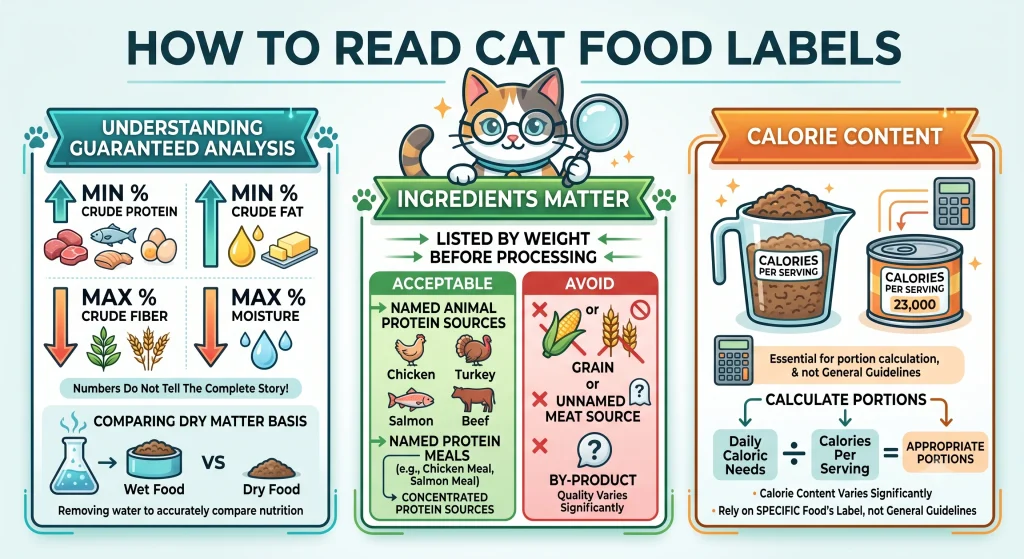
Do not judge a cat food only by whether meat is the first ingredient or whether an ingredient sounds appealing to a human. Ingredient lists are ordered by weight before processing and do not, by themselves, reveal the finished diet’s nutrient quality, digestibility, safety, or suitability.
For a healthy cat, look for a diet that is complete and balanced for the appropriate life stage, check the calorie content, and choose a manufacturer that provides adequate nutritional information and quality control. Cats are obligate carnivores with specific nutrient requirements, but those requirements are better assessed from the complete diet than from marketing claims about individual ingredients.
For a deeper explanation of feline protein requirements, see our cat protein sources guide. If you are considering grain-free food, read our grain-free cat food guide rather than assuming “grain-free” automatically means healthier.
Changing Your Cat’s Food
When changing diets, a gradual transition is often easier on the digestive system and may improve acceptance. AAHA/AAFP guidance describes transitioning gradually over roughly 7–10 days when clinically appropriate.
Use our step-by-step guide to changing cat food safely. If your cat develops persistent vomiting, diarrhea, itching, or other signs that raise concern about a dietary reaction, our cat food allergy guide explains why diagnosis is more complicated than simply avoiding a suspected ingredient.
Common Feeding Mistakes
- Feeding by eye: repeatedly topping up the bowl makes total daily intake difficult to know.
- Using one calorie number for every cat: energy needs vary substantially among individuals.
- Ignoring treats: snacks, table food, supplements, and food used for medication can add meaningful calories.
- Following the package guide without monitoring: feeding directions are a starting point, not proof that the portion is right for your cat.
- Reducing food aggressively for weight loss: cats need safe, nutritionally complete calorie restriction.
- Assuming seniors always need fewer calories: older cats should be assessed individually for fat, muscle, appetite, and disease.
- Judging food by the first ingredient alone: the complete nutrient profile and nutritional adequacy matter more than ingredient-list marketing.
- Ignoring unexplained appetite changes: eating much more or less than usual can be medically important.
When Appetite Changes Need Veterinary Attention
A calculated portion is useful only for a healthy cat that is eating normally. If your cat suddenly stops eating, eats markedly less, loses weight unexpectedly, or becomes unusually hungry, do not simply change the portion and wait.
Read Cat Not Eating? Common Causes, Warning Signs, and What to Do if intake drops. Persistent appetite or weight changes deserve veterinary assessment, especially in kittens, senior cats, and cats with known medical conditions.
Key Takeaways
- There is no universal daily calorie number for cats. Start with an estimate and adjust according to body condition, weight trend, life stage, activity, neuter status, and health.
- Use calories, not cups alone. Different foods can provide very different calories in the same volume.
- Measure food consistently. A kitchen scale can improve precision for dry food.
- Count treats and extras. They contribute to the same daily calorie total.
- Monitor body condition and muscle condition. The scale is only one part of nutritional assessment.
- Do not crash-diet an overweight cat. Weight loss should be gradual and nutritionally complete.
- Investigate unexplained weight or appetite changes. They may reflect illness rather than an incorrect portion.
FAQ
How much should I feed my cat per day?
The correct amount depends on your cat’s ideal body weight, body condition, age, activity, neuter status, health, and the calorie density of the food. Use a calorie calculation and the food label as starting points, then adjust according to weight and body condition.
How many calories does a 10-pound cat need?
A 10-pound cat does not automatically have one fixed calorie requirement. The RER equation gives a useful starting estimate, but actual daily energy needs vary. A veterinarian can help establish a target if the cat is overweight, underweight, growing, pregnant, nursing, or ill.
How many times a day should I feed my cat?
Healthy adult cats can be fed using different schedules. Measured meals or measured daily portions make calorie intake easier to track. Kittens generally need more frequent feeding because of growth and their smaller stomach capacity.
Can I free-feed dry food?
Some cats maintain an ideal condition with a measured daily amount available over time, but unrestricted topping-up can make overconsumption and appetite monitoring more difficult. Whatever method you use, track the total daily amount.
How much wet food should I feed?
Check the kcal per can or pouch rather than assuming a fixed number of cans. Wet foods vary substantially in calorie density and package size.
Is wet or dry food better?
Both wet and dry diets can provide complete and balanced nutrition. Wet food provides substantially more water, while dry food is more calorie-dense and convenient for some feeding strategies. The best choice depends on the individual cat and the specific diet.
How do I know if I am feeding too much?
Track weight and body condition over time. If the cat is accumulating excess body fat or steadily gaining beyond an appropriate weight, total calorie intake may need adjustment. Have your veterinarian confirm the cat’s ideal body condition before making a major reduction.
Should senior cats eat less?
Not necessarily. Senior cats vary widely in body composition and health. Some need calorie control, while others struggle to maintain weight or muscle. Feed according to the individual cat rather than age alone.
Sources & References
- AAHA/AAFP Feline Life Stage Guidelines: Nutrition and Weight Management
- AAHA/AAFP: Nutrition and Weight in Young Adult Cats
- AAHA: Feeding Plans for Healthy, Appropriate-Weight Cats and Dogs
- 2021 AAHA/AAFP Feline Life Stage Guidelines — peer-reviewed full text
MyyCat provides educational information for cat caregivers and is not a substitute for individualized veterinary or veterinary nutrition advice.
[…] you are unsure about the appropriate amount to feed your cat, read our guide on how much you should feed your cat before adding extra treats or food-based […]