
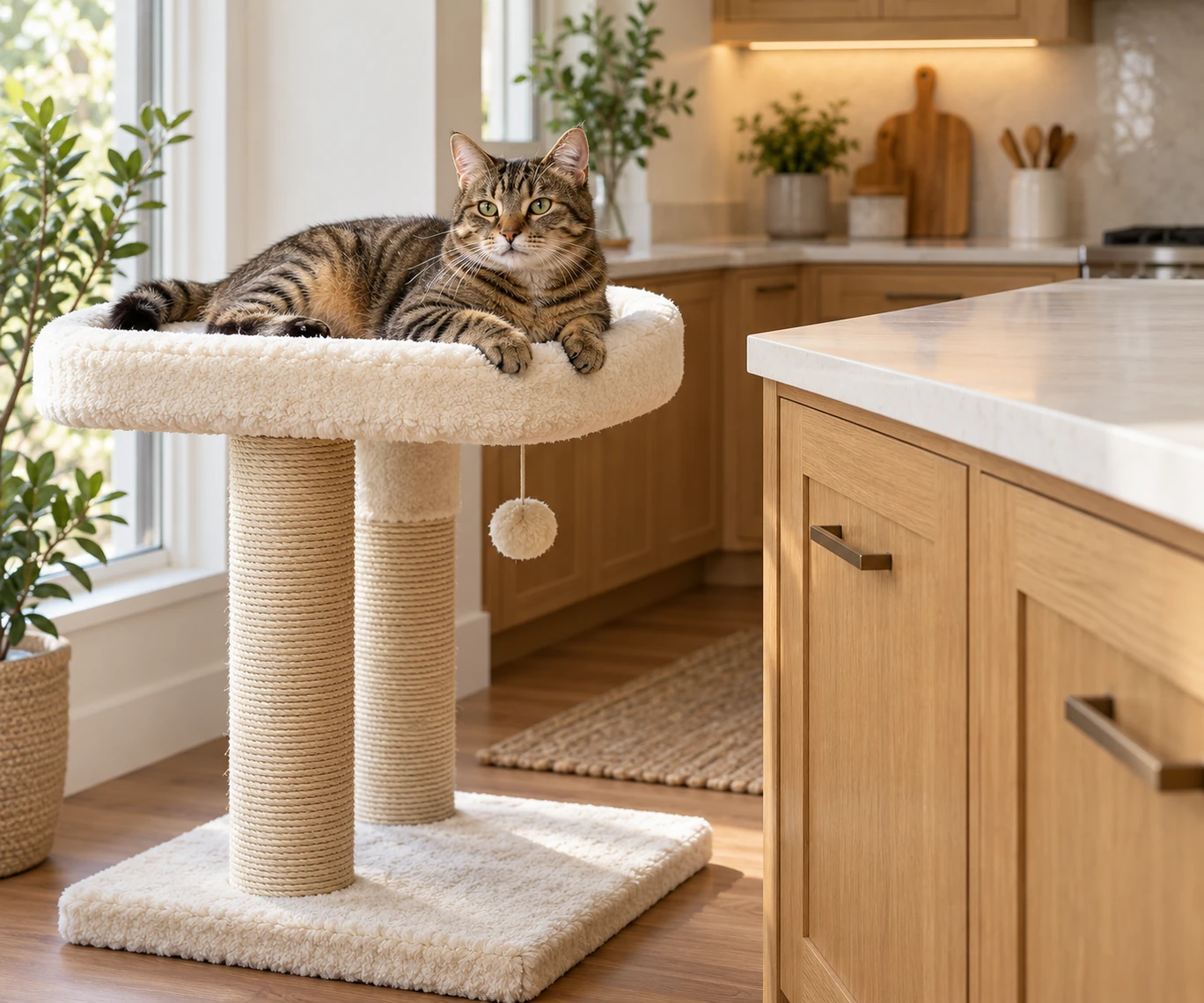

You turn around to grab a pan, and your cat is already on the counter, nose in the butter dish. You lift them down, and thirty seconds later they are back. If that sounds familiar, you are not dealing with a “bad” cat. You are dealing with a cat who has learned that counters pay off. The good news is that you can change what pays off, and the kindest way to keep cats off counters is to make the floor and a better high spot more rewarding than the countertop.
Quick answer: To keep cats off counters, remove the rewards (food, crumbs, warm spots and the best view), give your cat an attractive raised perch where they can still watch you, and reward them with treats, praise or play every time they choose that spot. Practise in the moments your cat usually jumps up, such as while you cook. Feline veterinary guidance warns that yelling, water sprays and startling devices tend to create fear and new problems without removing the reason your cat jumps.
Table of Contents
Why Cats Jump on Counters
Before training, it helps to know what your cat is getting out of it. In its positive reinforcement toolkit on undesirable behavior, the American Association of Feline Practitioners (AAFP) lists three common reasons cats jump onto counters: there is no suitable perch elsewhere, the cat has learned to link counters with food, or the cat simply wants to be close to their people.
In everyday life, these usually look like:
- Food and smells. Even one lucky crumb or an unattended plate teaches your cat that the counter is worth checking again and again.
- Height and a good view. The AAFP and International Society of Feline Medicine note in their Feline Environmental Needs Guidelines that access to an elevated area increases a cat’s vertical space and allows them to monitor their surroundings.
- Warmth. Spots near the stove, a sunny window or the top of a warm appliance can be very attractive.
- Being near you. If the kitchen is where you spend your evenings, your cat may just want to be part of the action.
- Boredom. A cat with little to do will find their own entertainment. If this sounds like your cat, our guide on how to tell if your cat is bored is a good companion read.
Watch your cat for a few days and note when they jump up and what they do once they are there. A cat who heads straight for the fruit bowl is telling you something different from a cat who sits by the window above the sink. Your plan should target the real reward.
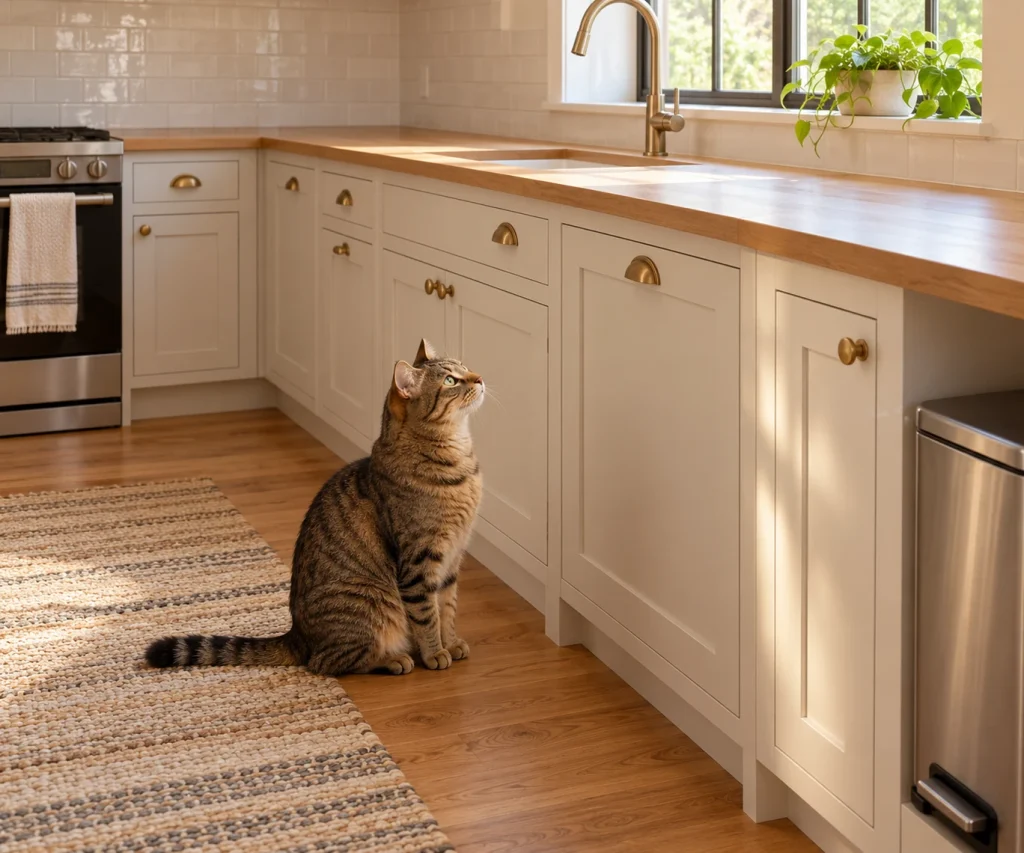
Why Punishment and Startle Tactics Backfire
Many popular tips involve spraying water, shouting, clapping, or using mats and devices that startle a cat. The AAFP toolkit is direct about this: even if a caregiver yells, squirts water or uses a deterrent such as a scat mat, which it says will likely cause fear-anxiety and additional undesirable behaviors, the cat will keep jumping onto the counter because the food reward outweighs the unpleasant experience.
The same toolkit warns that verbal or physical punishment, including squirt bottles, can increase a cat’s protective emotions, lead to more undesirable behaviors and damage the relationship between you and your cat. The Anti-Cruelty Society likewise cautions that physical punishment will not help train your cat and will instead make them fear you.
There is also a practical problem: punishment only works, if at all, while you are watching. Many cats simply learn to wait until you leave the room. Teaching your cat where they should be works whether you are there or not, because the better option is always available.
First, Rule Out Hunger and Health Changes
If your cat has suddenly started searching counters for food, especially an adult or senior cat who never used to, consider whether something has changed. A new diet, smaller portions, or a weight-loss plan can make a cat hungrier. If you are reducing your cat’s food, follow a structured plan like the one in our guide on how to help your cat lose weight safely, and use puzzle feeders to spread meals out.
A sudden increase in appetite can also be a sign of illness. The Cornell Feline Health Center lists weight loss, increased appetite and increased thirst and urination as the most common signs of hyperthyroidism, which mostly affects middle-aged and older cats. Increased hunger and thirst can also be a sign of diabetes in cats. If your cat seems hungrier than usual, is drinking more, or is losing weight, book a vet check before treating it as a training problem. You can read more in our cat hyperthyroidism guide.
Step 1: Set Up Your Kitchen for Success
The first step to keep cats off counters is to make sure the counter stops paying off. Training goes much faster that way. Every time your cat finds food up there, they are being rewarded for jumping, and that undoes your practice. The AAFP toolkit’s advice is simple: never leave food on accessible surfaces. The Anti-Cruelty Society adds securing garbage and using latches or gates where needed.
- Put all food away in cupboards, the fridge or sealed containers. Do not leave plates, bread, butter or fruit out.
- Wipe counters after cooking so there are no crumbs or smells left to investigate.
- Secure the bin with a lid your cat cannot open, or keep it in a closed cupboard.
- Clear the most tempting spots, such as the windowsill behind the sink, if you can.
- Close the kitchen door or use a gate when you cannot supervise, at least during the early weeks of training.
- Check for safety hazards. Hot hobs, knives and some human foods can be dangerous. Our cat treats guide covers which foods to keep away from your cat.
Management is not cheating. It stops your cat from practising the behavior you want to change, while training builds the habit you want instead.
Step 2: Create a Better “Yes” Spot
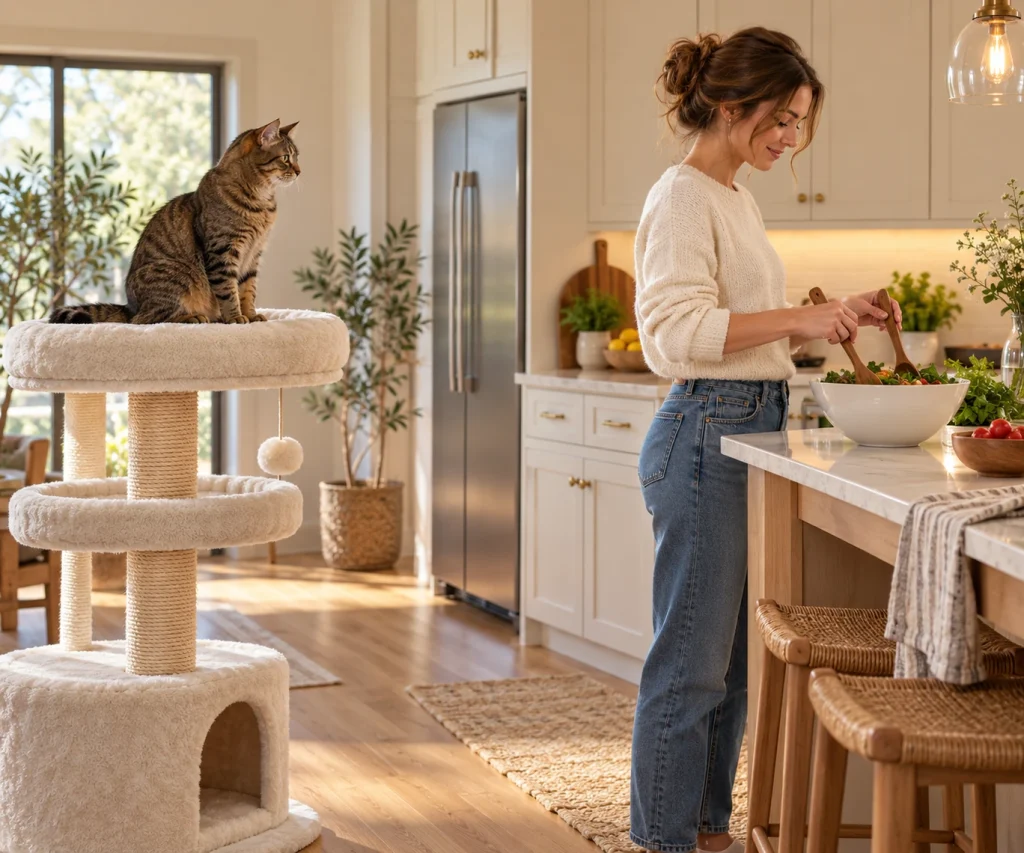
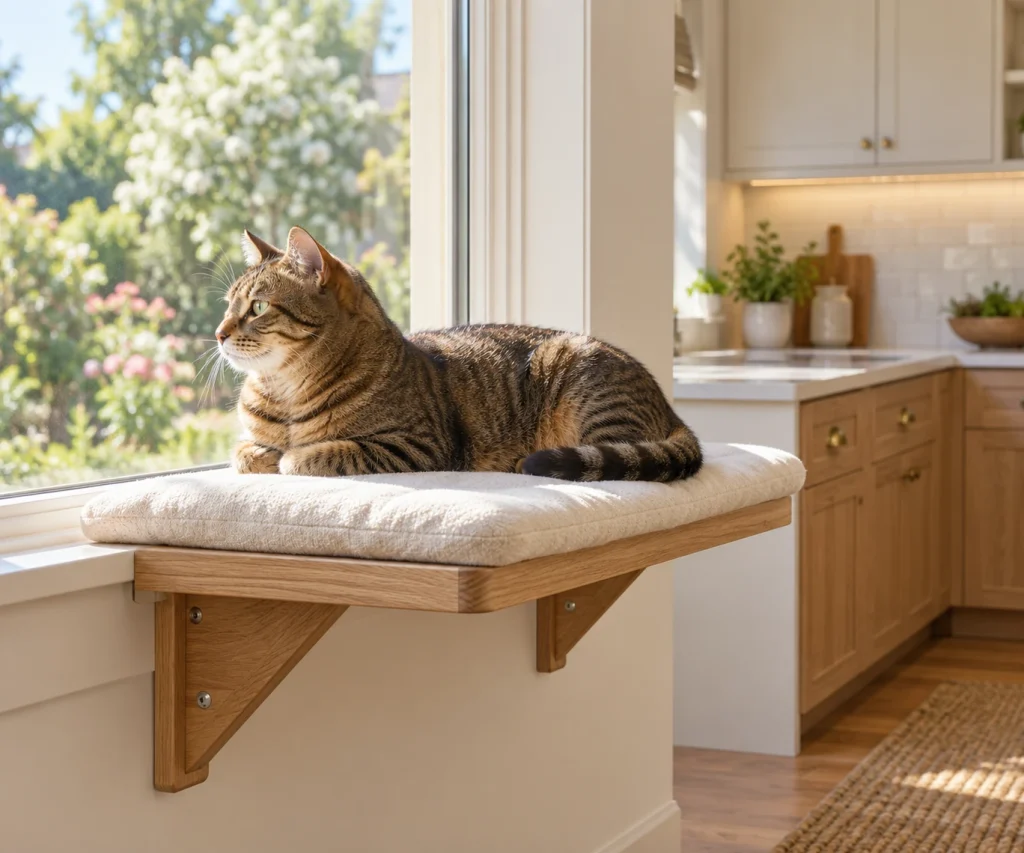
Cats need height, so if you want to keep cats off counters for good, offer a better option instead of trying to take height away. The AAFP toolkit recommends providing high, desirable perches at a level where your cat can see you working in the kitchen but cannot jump from the perch onto the counter. It also suggests warm options, such as a sunny window spot or a heated cat bed.
Good choices include:
- A sturdy cat tree placed at the edge of the kitchen or just outside it, with a clear view of where you work.
- A wall shelf or window perch with a non-slip surface.
- A stable stool or chair with a soft mat on top, as a simple starting point.
The Feline Environmental Needs Guidelines say perches should be wide and long enough for your cat to stretch out fully, and that a slight hammock-style dip can help a cat feel more hidden. Whatever you choose, it must be stable. A perch that wobbles will not feel safe, and your cat will go back to the solid counter.
Make the spot appealing with familiar bedding that smells of your cat, and place it where your cat already wants to be: near you, near the window, or near the warm part of the room.
Step 3: Train Your Cat to Choose the Perch
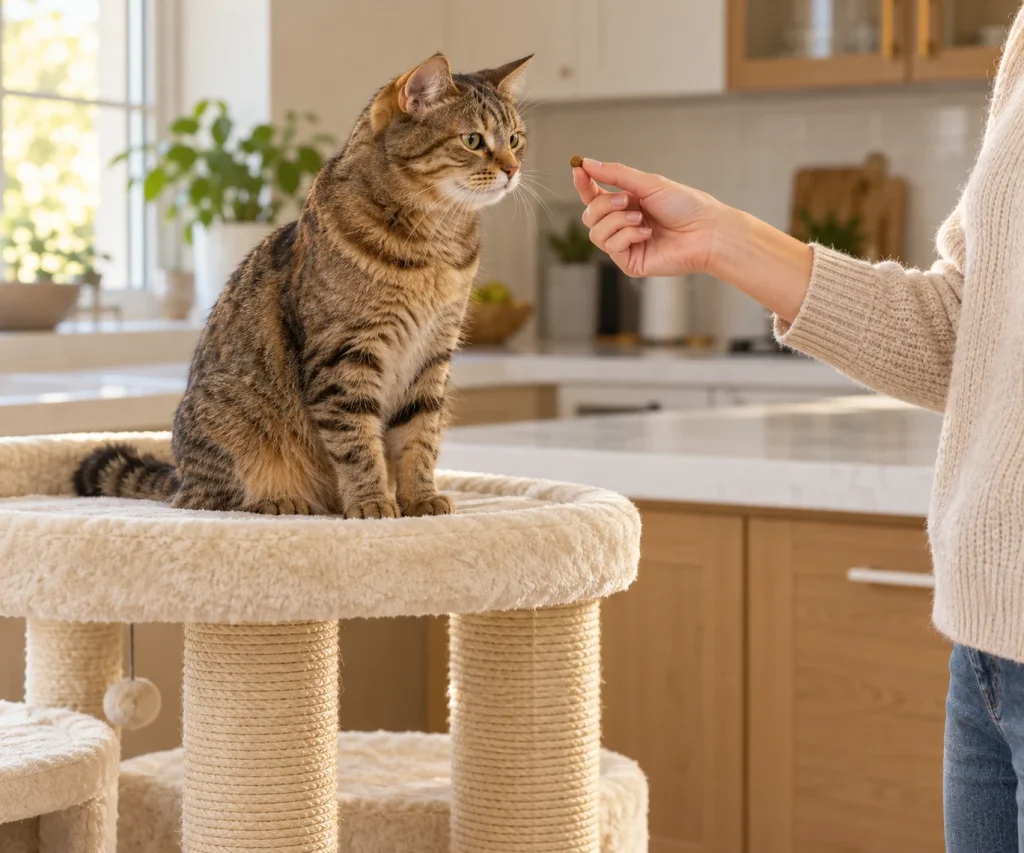
This is the core of the training. The AAFP Cat Friendly guidance on training is built on positive reinforcement: reward what you want your cat to do. The AAFP toolkit specifically suggests using treats to reinforce perch use through luring and capturing. Use small, high-value treats your cat loves, and count them as part of their daily food. Our cat treat calculator can help you keep the amount sensible.
- Reward the perch on its own. At a quiet time, not while you are cooking, place a treat on the perch. When your cat jumps up to eat it, add a calm “good” and another treat. Repeat a few times, then stop while your cat is still keen.
- Capture it. Whenever you notice your cat on the perch by choice, walk over and quietly reward them there. This teaches them that the perch is where good things happen, even when you have not asked.
- Add a cue. Once your cat reliably hops up for a lure, say a short word such as “up” or “perch” just before you point or toss a treat onto it. Reward as soon as all four paws are on the perch. Over many repetitions, the word itself starts to mean “go to your spot”.
- Build a little duration. Instead of one treat and done, give a second and third treat a few seconds apart while your cat stays on the perch. Slowly stretch the gaps. Staying there is now worth more than hopping down.
- Practise in the real situation. Now start using the perch while you cook or unpack shopping, the exact moments your cat usually jumps on the counter. Before your cat has a chance to jump, cue them to the perch and reward them frequently at first. The Anti-Cruelty Society suggests that predictable trigger times are also the ideal moment to offer a food puzzle or toy away from the counter.
- Fade the treats gradually. As the habit forms, reward less often and mix in praise, a chin scratch or a short play session. Keep the occasional surprise treat going so the perch never loses its value.
Keep sessions short and upbeat. A few minutes, a few times a day, usually works better than one long session. If your cat walks away, end the session; cats learn best when they choose to take part.
What to Do When Your Cat Is on the Counter
Mistakes will happen, especially early on. How you respond matters:
- Stay calm. Do not shout, clap, spray or push your cat off. Startling them can cause fear and does not tell them where they should be.
- Do not reward the counter. Avoid feeding, petting or chatting to your cat while they are up there.
- Redirect. Use your cue, lure with a treat, or move a wand toy towards the perch or the floor. If you need to lift your cat down, do it gently and place them on their perch.
- Reward the right choice. As soon as your cat lands on the perch or floor, reward them there.
- Check what was on the counter. If there was food or crumbs, tighten up your management so it does not happen again.
Quick Guide: Common Situations
| Situation | What to try | What to avoid |
|---|---|---|
| Cat jumps up while you cook | Cue the perch before you start and reward often; offer a food puzzle away from the counter | Feeding scraps from the counter |
| Cat jumps up at night or when you are out | Clear and wipe counters, secure the bin, close the kitchen door | Leaving food or dishes out |
| Cat sits on the windowsill above the sink | Add a window perch elsewhere with a similar view | Expecting your cat to give up the view with nothing in return |
| Cat follows you and jumps up for attention | Schedule play sessions and reward calm time on the perch | Petting or talking to your cat while they are on the counter |
| Cat is on the counter right now | Calmly lure or lift them to the perch and reward there | Shouting, spraying water or pushing them off |
What About Sticky Tape, Mats and Sprays?
You will see many products sold to keep cats off counters. Some shelters suggest mild texture changes, such as double-sided tape, while other devices rely on sudden noise, air or water. The AAFP toolkit cautions that deterrents such as scat mats will likely cause fear-anxiety, and that the food reward often outweighs the unpleasant experience anyway.
At MyyCat we prefer to build training around management and rewards rather than deterrents. If you do try something, avoid anything that sprays, startles, shocks or could hurt your cat, use it only as a short-term backup while you train the perch, and stop if your cat seems anxious. A deterrent on its own does not teach your cat where they can go, and the perch does.
Troubleshooting: When Progress Stalls
My cat ignores the perch
Check the basics: is it stable, high enough, comfortable, and does it have a view of you? Try moving it closer to where your cat already jumps up, adding warmth or familiar bedding, and rewarding more generously for a few days.
It works when I’m there, but not when I’m out
This usually means the counter still pays off sometimes. Look for food, crumbs, warmth or a view your cat is getting while you are away. Closing the kitchen door when you are out is a simple fix while the habit is still forming.
My cat jumps up to get my attention
Make sure your cat’s needs are met elsewhere. Regular play sessions, puzzle feeders and attention given when your cat is calm on the floor or perch can reduce attention-seeking. Our guide to cat separation anxiety training may also help if your cat struggles when you are not around.
I have more than one cat
Give each cat their own high spot, so no one has to compete for the only perch. Train each cat separately at first, then practise together once each one knows the routine.
My cat seems stressed or guards food
If your cat is anxious, aggressive around food, or the behavior has changed suddenly, talk to your vet. Stress can show up in many ways, and our guide to cat anxiety explains common signs. Your vet can also refer you to a veterinary behaviorist if you need more support.
How Long Does It Take?
There is no fixed timeline, and no method can promise to keep cats off counters overnight. Some cats switch to a good perch quickly, especially when the counter stops offering food. Others, particularly cats who have been rewarded on counters for years, need weeks of consistent practice. Progress is rarely a straight line, so expect the occasional relapse, return to an earlier step, and keep rewards generous.
It also helps to be realistic about what you want. Cats are natural climbers, and it may be easier to keep them off one or two key surfaces, such as the kitchen counter and dining table, than to keep them off every raised surface in the home.
Frequently Asked Questions
What is the best way to keep cats off counters?
Combine management with rewards: clear food away, offer a stable perch with a view, and reward your cat every time they choose it. Many cats can learn to prefer a perch over the counter this way. Results vary from cat to cat, and management, such as clearing counters and closing doors, remains important.
Is it okay to use a spray bottle?
Feline veterinary guidance advises against it. The AAFP toolkit says punishment, including squirt bottles, can increase fear, lead to more unwanted behaviors and damage your relationship with your cat. Redirecting and rewarding the right choice is the kinder and more lasting approach.
Why does my cat only jump up when I’m cooking?
Cooking brings food smells, activity and your attention together in one place. Use this as your main practice time: cue the perch before you start and reward your cat often for staying there.
Should I start training a kitten?
Yes. Kittens learn quickly, and it is much easier to teach a good habit from the start than to undo a well-rewarded one later. Keep sessions very short and playful, and kitten-proof the kitchen while they learn.
More From MyyCat
Looking for more help with training? Read our guides on cat carrier training and how to stop a cat from biting, explore our free cat care tools, or browse our cat care books.
This article is for general information and is not a substitute for professional veterinary advice. If your cat’s behavior or appetite changes suddenly, please contact your veterinarian. Read our full veterinary disclaimer.
Sources & References
- American Association of Feline Practitioners: Positive Reinforcement Training Educational Toolkit, Addressing Undesirable Behavior
- AAFP and ISFM Feline Environmental Needs Guidelines
- AAFP Cat Friendly Homes: Cat Training Techniques for Caregivers
- The Anti-Cruelty Society: Keeping Cats Off Countertops and Tables
- Cornell Feline Health Center: Hyperthyroidism in Cats