
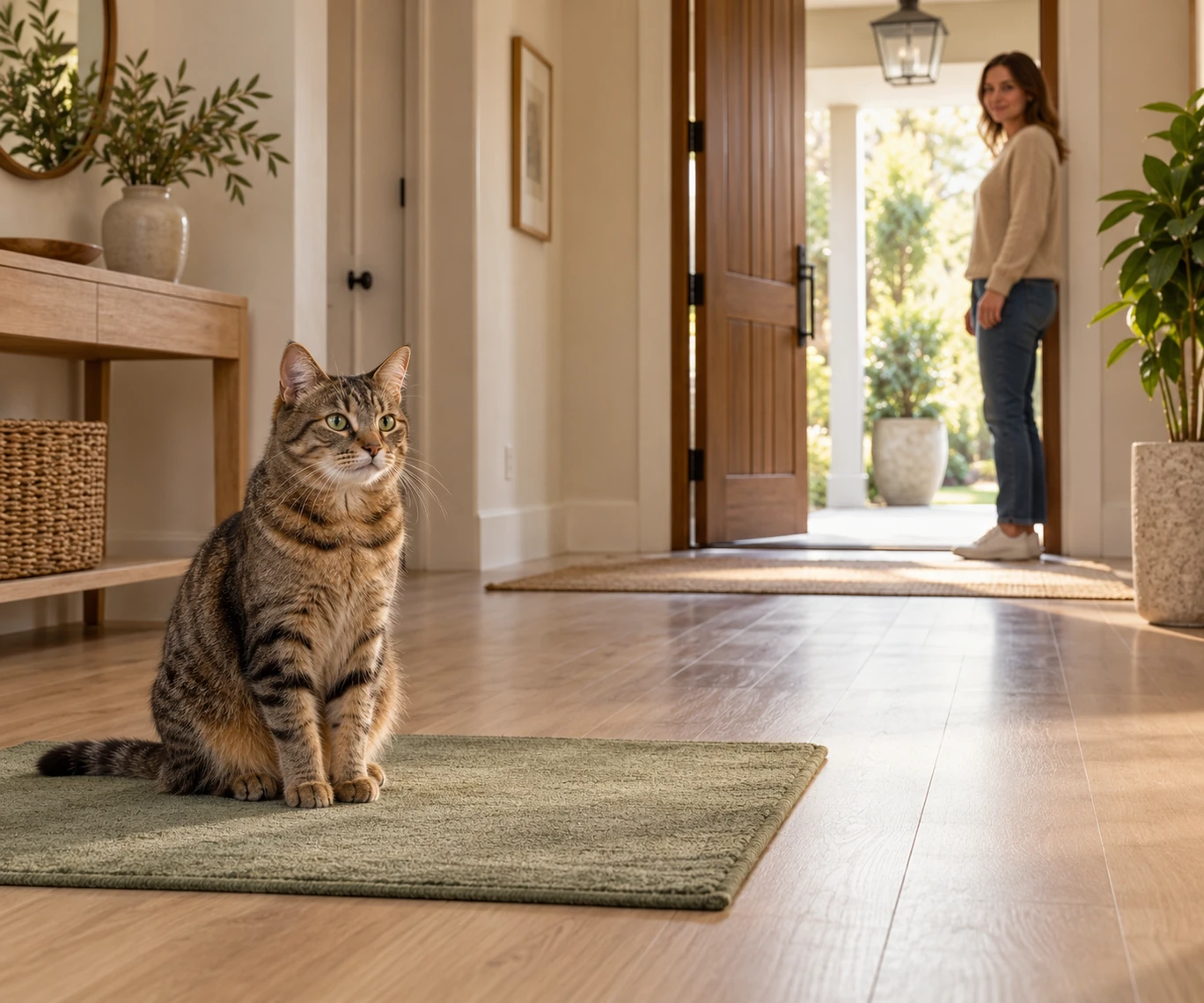

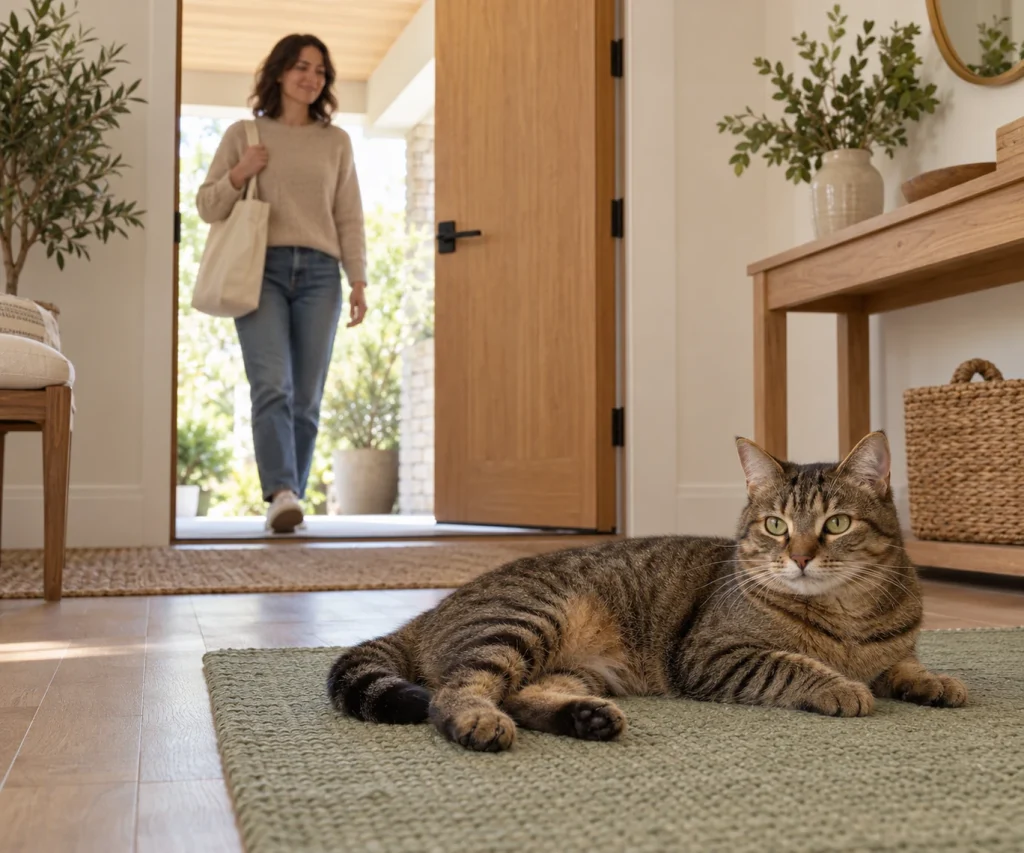
You open the front door with shopping bags in both hands, and a blur of fur shoots past your ankles. Some cats wait by the door every time it opens; others hide nearby and slip out when you least expect it. Either way, a cat running out the door can end up lost, hurt or in traffic within seconds. This guide shows you how to stop a cat from running out the door with management you can set up today and a step-by-step training plan that teaches your cat a safer habit.
Quick answer: To stop a cat from running out the door, make the door boring and a nearby spot rewarding. Move all greetings and goodbyes away from the entrance, teach your cat to wait on a perch or mat a few steps from the door, and reward them there while you practise touching the handle, opening the door a crack and, gradually, coming and going. Add enrichment indoors so the outside is less tempting, and avoid scaring or punishing your cat at the door.
Table of Contents
Why Cats Run Out the Door
Door-dashing is usually a mix of curiosity, instinct and learning. The Humane Society of Huron Valley points out that cats are, at their core, a predator species, and the outdoors offers things many indoor homes lack, such as sunlight, smells, bark to scratch and high places to climb.
Common drivers include:
- Curiosity and hunting instinct. Birds, insects and new smells pull a cat towards the gap.
- Boredom. A cat with little to do indoors may treat the door as the most exciting thing in the house. Our guide on signs your cat is bored can help you spot this.
- Habit and accidental rewards. If your cat greets you at the door and gets fuss, or has got out before and enjoyed it, the door has become a place where good things happen.
- Hormones. Unneutered cats have a strong drive to find a mate. The ASPCA notes that neutered males do not have the desire to roam away from home in search of a mate.
- Wanting to avoid something indoors. Tension with another pet, a new baby or building work can make some cats look for a way out.
Cat behavior consultant Pam Johnson-Bennett describes two types of door darters: the obvious ones who wait by the door, and the covert ones who hide nearby and slip out unnoticed. Knowing which type you have tells you where to focus.
When to Check With Your Vet First
If an adult cat who never cared about the door suddenly becomes restless, vocal or desperate to get out, consider whether something has changed in their health. The Cornell Feline Health Center lists hyperactivity among the possible signs of hyperthyroidism, a condition that mostly affects middle-aged and older cats. You can read more in our cat hyperthyroidism guide.
Ask your vet about neutering if your cat is not neutered, and book a check-up if the change comes with weight loss, increased appetite or thirst, or other unusual behavior. Our guide on how to tell if your cat is sick lists warning signs worth knowing.
Why Scaring Your Cat Away From the Door Backfires
It is tempting to clap, shout or use a spray bottle when your cat heads for the door. The American Association of Feline Practitioners (AAFP) warns that verbal or physical punishment, including squirt bottles, can increase a cat’s protective emotions, lead to more undesirable behaviors and damage the human-cat relationship.
At the door, fear brings an extra risk. A frightened cat may bolt rather than retreat, and a cat who already associates people at the door with being startled may start hiding nearby and darting out at speed. Teaching your cat a better place to be is safer and works whether or not you catch them in the act.
Stage 1: Prepare Your Home
Training takes time, so start with management that protects your cat from day one.
- Check your cat’s microchip. The American Veterinary Medical Association (AVMA) advises making sure the chip is registered, asking your vet to scan it at least once a year, and keeping your contact details up to date.
- Create a buffer zone. Where you can, close an inside door, such as a hallway or porch door, before opening the outside door. This gives you a second barrier while training.
- Know where your cat is before you open the door, especially if you have a covert darter. Check under nearby furniture and behind coats or shoes.
- Use a physical shield when you come in. Pam Johnson-Bennett suggests holding a piece of cardboard or plastic in front of your feet as you enter to stop your cat slipping past you.
- Tell everyone in the household, including children and regular visitors, about the plan so the door is handled the same way every time.
- Make indoors more interesting. The AAFP and ISFM Feline Environmental Needs Guidelines include providing opportunities for play and predatory behavior. Daily play with a wand toy, puzzle feeders, window perches and safe climbing spots all help.
Stage 2: Choose a “Waiting Spot” and Rewards
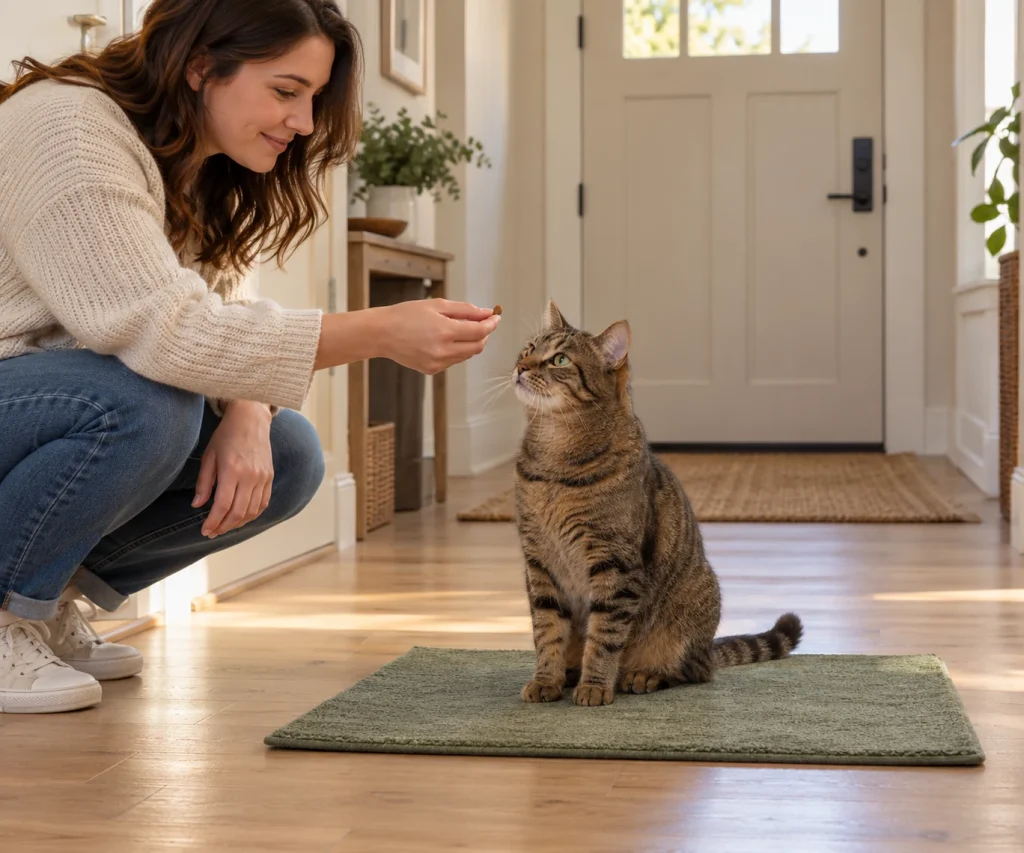
The heart of the plan is giving your cat a better job than guarding the door. Pick a station a few steps away from the entrance, out of the direct line between your cat and the gap. Good options include:
- A sturdy cat tree or shelf with a view of the hallway
- A chair or stool with a non-slip mat
- A washable mat or cat bed on the floor, if your cat prefers to stay low
Then choose rewards that beat the excitement of the door. Small, soft, high-value treats work well for most cats, and some prefer a lick of a paste treat or a quick wand-toy chase. Count treats as part of your cat’s daily food; our cat treat calculator can help.
If your cat already uses a perch from our guide on how to keep cats off counters, you can use the same skill here. A cat who already knows “go to your spot” will learn this much faster.
Stage 3: Teach Your Cat to Go to the Station
Start with the door closed and your cat calm. The AAFP Cat Friendly guidance on training is built on positive reinforcement: reward the behavior you want to see.
- Lure. Place a treat on the station or guide your cat there with a treat in your hand. Reward as soon as all four paws are on it.
- Capture. Whenever your cat chooses the station on their own, quietly walk over and reward them there.
- Add a cue. Once your cat hops up reliably, say a short word such as “place” or “spot” just before you lure. In a Vetstreet article on door-dashing, trainer Mikkel Becker explains that adding the verbal cue teaches your cat to go to the perch in response to the word alone.
- Build a few seconds of waiting. Give a second and third treat while your cat stays, then slowly stretch the gaps between rewards.
Keep sessions short and stop while your cat is still keen. Do not move on until your cat goes to the station on cue and stays for a few seconds with nothing happening at the door.
Stage 4: Move Greetings and Goodbyes Away From the Door
Many cats wait at the door because that is where they get attention. Both the Humane Society of Huron Valley and Pam Johnson-Bennett recommend moving all hellos and goodbyes away from the entrance to a spot your cat enjoys, and pairing them with great food rewards or a puzzle feeder.
- When you come home, walk past your cat calmly, go to the station, and greet them there with a treat or a short play session.
- When you leave, cue your cat to the station a minute before you go and leave a puzzle feeder or a scatter of treats there. The Humane Society of Huron Valley also suggests tossing a few treats away from the door as you head out.
Over time, your cat starts to expect arrivals and departures to mean good things at the station, not a chance at the gap.
Stage 5: Practise With the Door, One Small Step at a Time
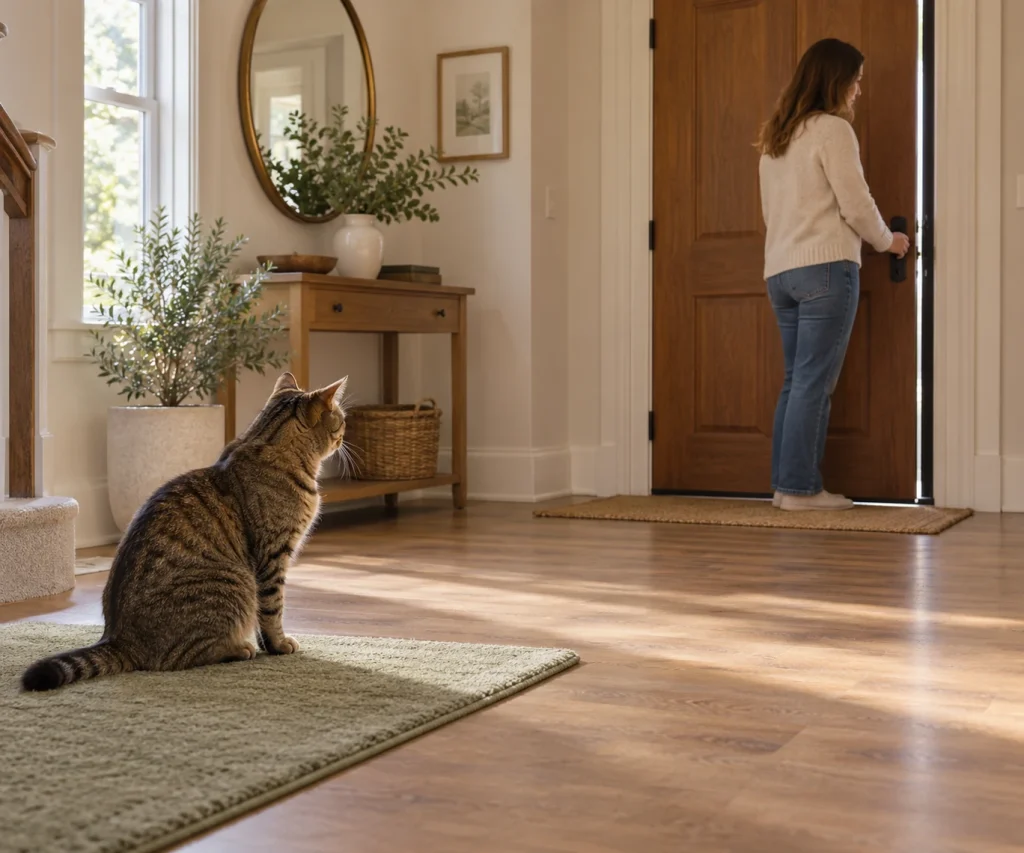
Now add the door itself, gradually. In the Vetstreet method, the trainer increases how much the door opens, from slightly turning the knob to fully opening it, while the cat stays on the perch. If the cat jumps off, you close the door straight away, reset your cat on the perch and try again.
Practise each step several times before moving on. A sensible progression looks like this:
- Cat on station, you stand near the door. Reward.
- Touch the handle or jingle your keys. Reward.
- Turn the handle without opening. Reward.
- Open the door a crack and close it again. Reward.
- Open it a little wider for a moment. Reward.
- Step through and straight back. Reward.
- Step out, close the door, wait a few seconds, then come back in and reward at the station.
Use a screen door, an inner hallway door or a closed porch while practising, so a mistake does not mean your cat ends up outside. Some owners find it easier to practise first with an interior door, such as a bedroom door, and then repeat the whole sequence at the front door.
When not to move to the next step
Stay at the current step, or go back one, if your cat:
- Leaves the station or creeps towards the door
- Stares intently at the gap, with a crouched body or twitching tail
- Ignores treats they would normally take
- Seems tense, hides or tries to get away
Slow progress is still progress. Rushing ahead teaches your cat that the door can still pay off.
Stage 6: Use It in Real Life and With Other People
Once your cat waits reliably during practice, start using the routine for everyday comings and goings. Then practise with situations that are harder for your cat:
- Different family members opening the door
- Visitors arriving and leaving
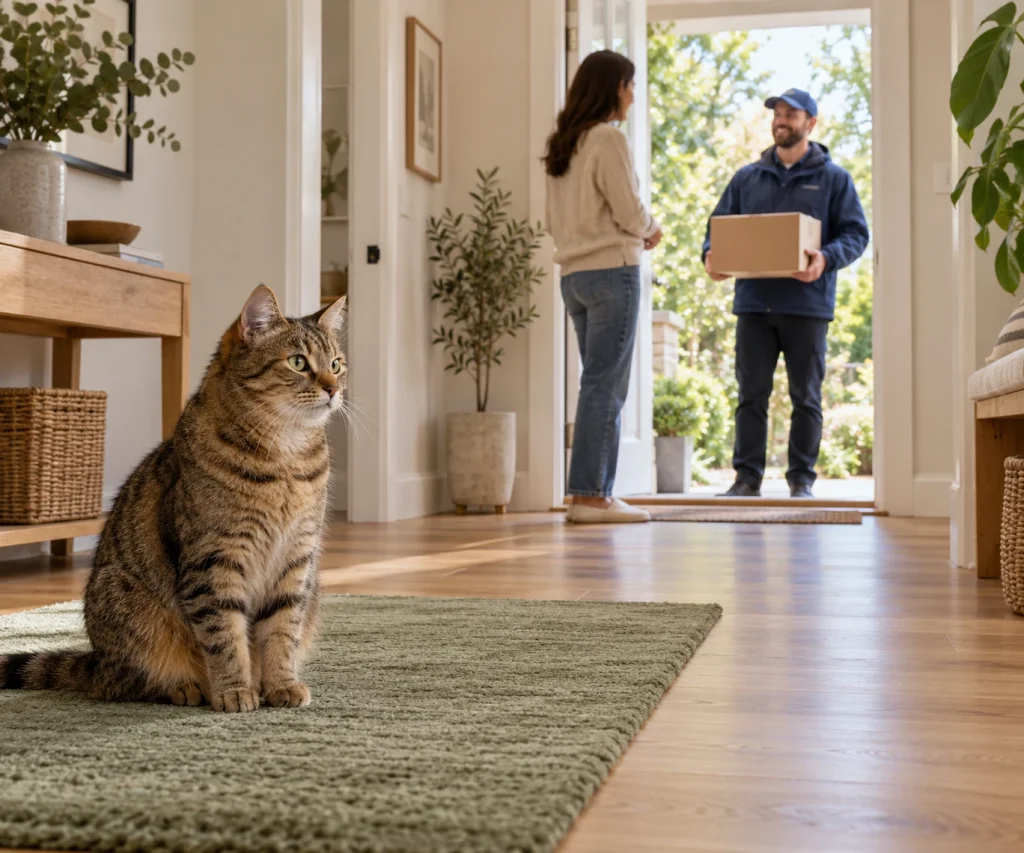
- Parcel deliveries and takeaways
- Taking out the bins or carrying shopping in
For busy moments, such as a party or a house move, use management instead of training: keep your cat in a quiet room with food, water, a litter box and a bed, and put a note on the door so guests know to keep it shut. Our guide on cat anxiety has more ideas for keeping cats calm during busy or stressful times.
Quick Guide: Everyday Door Situations
| Situation | What to do | What to avoid |
|---|---|---|
| Leaving the house | Cue the station, leave a puzzle feeder there, toss treats away from the door as you go | Long goodbyes at the door |
| Coming home | Use a shield at your feet, walk past calmly, greet your cat at the station | Fussing over your cat at the doorway |
| Visitors arriving | Put your cat in a quiet room or behind a closed inner door | Relying on guests to watch for the cat |
| Covert darter hiding nearby | Check hiding spots before opening, block gaps under furniture by the door | Assuming your cat is asleep elsewhere |
| Cat crying at the door | Add play, enrichment and window time; check with your vet | Opening the door to stop the crying |
What About Door Mats and Deterrents?
Some shelters suggest placing a surface cats dislike walking on near the door, such as a plastic carpet runner turned nub-side up. The Humane Society of Huron Valley mentions this option for particularly persistent cats. If you try something like this, choose a texture that cannot hurt your cat, and use it only alongside training.
Avoid anything that sprays, startles, shocks or frightens your cat. The AAFP toolkit warns that deterrents such as scat mats are likely to cause fear and anxiety, and at a door, a frightened cat is more likely to bolt. A deterrent tells your cat where not to go; the station tells them where to go instead.
If Your Cat Does Get Out
Even with good training, mistakes happen. If your indoor cat slips out:
- Stay calm and do not chase. Chasing can push a frightened cat further away or into hiding.
- Search close to home first. In a 2018 study in Animals, researchers surveyed owners of 1,210 cats that had gone missing. Overall, 75% of cats were found within 500 metres of where they escaped, and indoor-only cats travelled shorter distances than cats with outdoor access. The authors concluded that a thorough physical search, carried out within the first week, is a useful strategy.
- Look carefully in hiding spots such as under decks, porches, sheds, bushes and parked cars, and ask neighbours to check garages and outbuildings.
- Call softly and shake a familiar treat bag. If you have practised recall, use your cue. Our cat recall training guide explains how to build a reliable response.
- Contact your microchip registry and local shelters and vets, and make sure your details are current.
When your cat comes home, welcome them calmly, reward them, and check for injuries. Then review what happened at the door so you can close the gap in your routine.
Troubleshooting
My cat ignores treats near the door
The door is more exciting than the reward. Go back to practising with the door closed, use a higher-value treat or play, and make sure your cat is a little hungry, for example before a meal.
My cat goes outside on a harness and now rushes the door
If your cat walks on a harness, the door may now predict adventure. Consider carrying your cat out in their carrier, or through a different door, so the front door does not become the start of every outing. Our guides on cat leash training and cat carrier training can help.
I have more than one cat
Train each cat separately at first. Then give each cat their own station, so no one has to compete, and practise together once each cat knows the routine.
My cat cries at the door all day
Increase daily play and enrichment, add window views and safe climbing spaces, and stick to a predictable routine. Make sure your cat is neutered and healthy. Avoid opening the door to quieten them, which rewards the crying. If the behavior is intense or sudden, talk to your vet.
Stage 7: Keep the Habit Going
Once your cat reliably waits at the station, you can reduce treats gradually, but do not stop rewarding altogether. Keep an occasional treat, toy or chin scratch at the station for arrivals and departures, and keep up the simple safety habits: know where your cat is before you open the door, use the inner door when you can, and keep their microchip details current.
There is no fixed timeline. Some cats learn the routine quickly; others, especially experienced escape artists, need weeks of patient practice. No method can promise your cat will never try the door again, so training and management always work best together.
Frequently Asked Questions
Why does my indoor cat keep trying to get outside?
Usually because the outdoors is interesting and the door has become exciting. Curiosity, hunting instinct, boredom, past escapes, and hormones in unneutered cats are common reasons. Sudden changes in an older cat are worth discussing with your vet.
Can you really stop a cat from running out the door?
Many cats can learn to wait on a station instead of rushing the door when greetings move away from the entrance and the station is rewarded consistently. Results vary, so keep management in place, such as inner doors and checking where your cat is, even after training.
Should I just let my cat out so they stop trying?
That is a decision about your cat’s safety and your local environment, and it is worth discussing with your vet. If your cat lives indoors, focus on meeting their needs for play, climbing, scratching and exploring inside, and consider safe options such as a secure enclosure or supervised harness walks.
Is a spray bottle OK to stop door-dashing?
No. The AAFP warns that punishment such as squirt bottles can increase fear and damage your relationship with your cat. At a door, a frightened cat may bolt, so rewarding a safe waiting spot is the better approach.
More From MyyCat
For more training help, see our guides on how to stop a cat from biting and cat separation anxiety training. If you are planning time away, read how long you can leave a cat alone, or explore our free cat care tools.
This article is for general information and is not a substitute for professional veterinary advice. If your cat’s behavior changes suddenly, please contact your veterinarian. Read our full veterinary disclaimer.
Sources & References
- American Association of Feline Practitioners: Positive Reinforcement Training Educational Toolkit, Addressing Undesirable Behavior
- AAFP and ISFM Feline Environmental Needs Guidelines
- AAFP Cat Friendly Homes: Cat Training Techniques for Caregivers
- Huang L, et al. Search Methods Used to Locate Missing Cats and Locations Where Missing Cats Are Found. Animals, 2018
- American Veterinary Medical Association: Microchipping FAQ
- ASPCA: Reasons to Spay and Neuter
- Cornell Feline Health Center: Hyperthyroidism in Cats
- Humane Society of Huron Valley: How to Help Your Door-Dashing Cat
- Cat Behavior Associates: Door Darting Behavior in Cats
- Vetstreet: Can I Teach My Cat Not to Dash Out the Door?
[…] schedule generator can help you set a routine. If your cat tries to slip out as the door opens, our door-dashing training plan can help, and our guide to cat night behavior explains why cats are so active around […]