
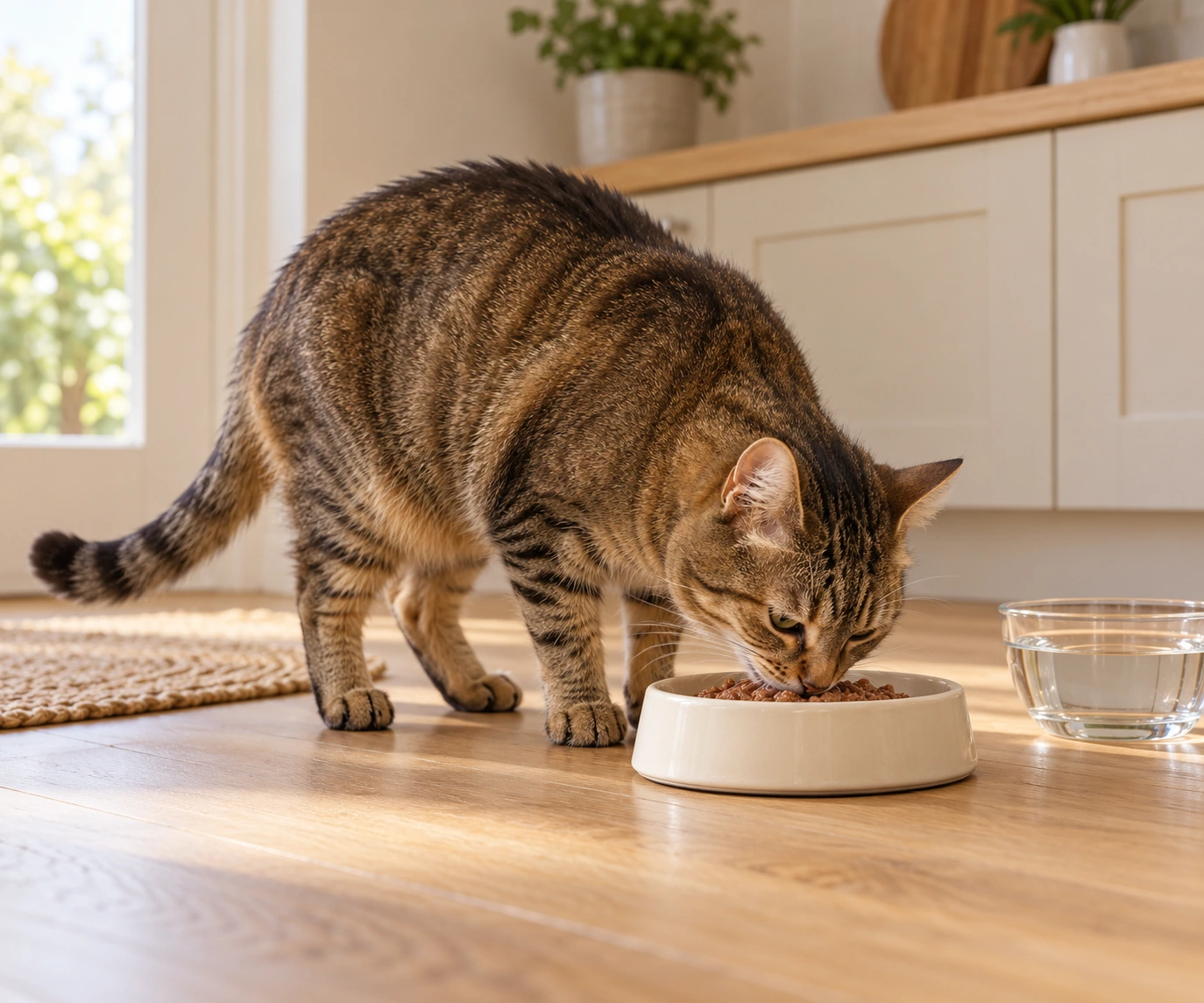

If you are wondering what to feed a senior cat, the short answer is usually a complete and balanced food your cat eats well, with enough calories and good-quality protein to hold on to weight and muscle, served in smaller, more frequent meals with plenty of water. A bag that says “senior” is optional. What matters more is how your individual cat is ageing: some older cats gain weight, while many cats in their teens start to lose it.
This guide explains when a cat counts as a senior, how digestion, calorie needs and muscle change with age, what the evidence says about “senior” cat food and protein, how much and how often to feed, practical ways to make meals easier, and which changes in eating or weight mean it is time to see a vet. MyyCat’s calculators can help with the numbers along the way.
Table of Contents
The short answer
- Food: a complete and balanced commercial food that your cat accepts. It does not have to be labeled “senior”; there is no official senior nutrient profile.
- Protein: healthy older cats should not be put on low-protein food without a medical reason. Veterinary guidelines favor moderate to higher protein to protect muscle.
- Calories: adjust to the cat in front of you. Many middle-aged cats need fewer calories, but many cats over about 11–12 need more.
- Meals: smaller, more frequent portions, measured rather than free-fed, so you notice changes in appetite.
- Water: several fresh water sources, and wet food if your cat likes it.
- Watch: weight, muscle and appetite. Unexplained weight loss in an older cat should always be checked by a vet.
When is a cat considered a senior?
The 2021 AAHA/AAFP Feline Life Stage Guidelines divide adulthood into a young adult stage (1 through 6 years), a mature adult stage (7 to 10 years) and a senior stage (over 10 years). The guidelines stress that these are arbitrary points on a spectrum: some cats over 10 are in excellent condition and can be treated like mature adults. Going the other way, the 2021 AAFP Feline Senior Care Guidelines note that some cats may be better described as senior from about 8 years, or earlier for some breeds.
For feeding purposes, the age on paper matters less than the changes you can see and measure: weight, muscle, appetite, teeth, mobility and health problems. If you are unsure where your cat sits, MyyCat’s Cat Life Stage Calculator gives an approximate life stage based on age.
How a cat’s nutritional needs change with age
Calories often fall in middle age, then rise again
Ageing cats do not follow a simple “older means fewer calories” rule. The AAFP senior guidelines state that cats aged roughly 7 to 11 years need fewer calories, while cats 12 years and older have increased daily energy requirements. The AAHA/AAFP life stage guidelines similarly suggest that a senior cat’s resting energy requirement may need to be increased by about 10–20%, and in some cases by as much as 25%. The 2023 AAHA Senior Care Guidelines add an important caveat: published data on how age affects energy needs in cats vary a lot, so these are starting points, not rules.
In practice this means two common senior pictures. A mature, less active cat may slowly gain weight on the same portion it ate at five. An older cat in its teens may need more food than before just to hold its weight. Feeding the same amount for years, or switching to a lower-calorie food simply because the cat had a birthday, can be the wrong move for either.
Digestion becomes less efficient
Older cats can absorb less of what they eat. According to the 2023 AAHA Senior Care Guidelines, protein is less digestible in about 20% of cats older than 11 years, and fat is less digestible in up to 33% of older cats. Because fat is the most concentrated source of calories, poorer fat digestion means a cat can eat a normal-looking amount and still come up short on energy. The AAFP guidelines also describe changes in gut motility and the gut microbiota with age that can contribute to reduced digestibility and gradual weight loss.
This is one reason both sets of guidelines point toward highly digestible, energy-dense food for older seniors, offered in smaller amounts more often.
Muscle loss (sarcopenia)
Sarcopenia is the loss of muscle mass and strength that comes with ageing itself, separate from disease. It can show up as a bonier back and hips, less jumping and less activity. The 2023 AAHA Senior Care Guidelines cite losses of lean body mass of up to a third between 10 and 15 years of age, and note that senior cats may need considerably more protein to slow muscle loss.
Muscle can shrink even while body weight stays the same, because fat can replace it. That is why vets assess both body condition (fat) and muscle condition. The AAFP guidelines recommend checking weight, body condition score and muscle condition score at every visit, and treating unexplained downward trends as a problem to investigate rather than “just age”. The WSAVA muscle condition score chart for cats illustrates how vets grade muscle from normal to severe loss.
Thirst, smell and teeth
- Thirst: cats already have a weak thirst drive, and VCA notes that ageing reduces it further, which raises the risk of dehydration. Our guide to cat hydration covers why this matters.
- Smell: the AAFP guidelines note that sense of smell declines with age. Because cats choose food largely by smell, warmed or more aromatic food can help a reluctant eater.
- Teeth and mouth: the risk of periodontal disease and tooth resorption rises with age, and dental pain often shows up only as subtle changes in eating, such as dropping food, chewing on one side or preferring soft food.
What to feed a senior cat: choosing the right food
Do you need a “senior” cat food?
Not necessarily. The Association of American Feed Control Officials (AAFCO) has nutrient profiles for growth and reproduction and for adult maintenance, but none for senior cats, as the AAHA senior care guidelines point out. So “senior”, “mature” or “7+” on a bag is a marketing description, and each manufacturer decides what it means.
A 2020 study by Summers and colleagues in the Journal of Veterinary Internal Medicine analysed 31 senior and 59 adult cat foods. Every senior food met AAFCO’s adult maintenance profile. The senior foods contained significantly more crude fiber on average, but there were no significant differences in protein, fat or mineral content compared with adult foods, and calorie density and nutrients varied widely from one senior product to another. The authors advised against blanket recommendations for senior foods and in favor of choosing based on the individual cat.
The practical takeaway: a senior label can be a reasonable choice, but it is not automatically better than the adult food your cat already thrives on. Choose by what the food actually provides and how your cat responds to it. A higher-fiber senior food, for instance, may suit a cat that tends to gain weight, but it is not ideal for an older cat that is already struggling to eat enough.
Protein: don’t cut it without a reason
Older advice often recommended lower protein for older cats to “protect the kidneys”. Current guidelines say the opposite for healthy cats. The AAHA/AAFP life stage guidelines state that healthy mature and senior cats should not be protein restricted, and recommend a moderate protein level with a minimum of 30–45% protein on a dry matter basis. Restricting protein in a cat whose ability to digest protein is already declining can speed up muscle loss.
The exception is a cat diagnosed with a condition such as chronic kidney disease, where a vet may recommend a prescription renal diet with controlled phosphorus and modified protein. That is a medical decision, not a general rule for older cats. To compare protein between foods fairly, including wet versus dry, MyyCat’s Cat Food Label Calculator converts label figures to a dry matter basis. Our guide to protein sources in cat food explains why animal protein matters so much for cats.
Wet, dry or both?
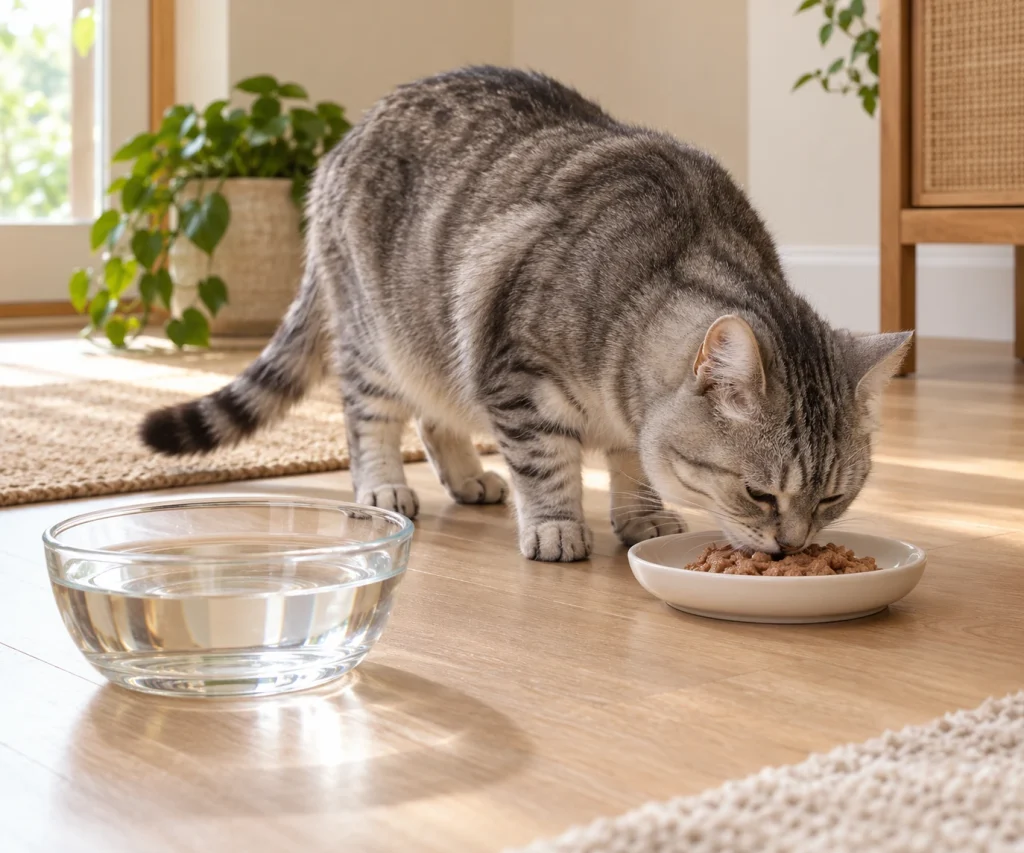
Both can be complete. For older cats, the choice often comes down to practical issues rather than one format being universally better:
| Wet food | Dry food | |
|---|---|---|
| Water intake | Adds substantial moisture; guidelines note canned food may improve overall water intake | Little moisture; fresh water is essential |
| Texture | Soft, easier for cats with sore mouths or missing teeth | Harder to chew for some older cats; can be softened with water |
| Smell and appeal | Usually more aromatic, especially warmed slightly | Less aromatic |
| Calories per bite | Lower; larger-looking portions | Higher; easy to overfeed by eye, or useful for small appetites |
| Practicalities | Spoils if left out; usually costs more per calorie | Easy to store, measure and use in food puzzles |
Many owners feed a mix. If your cat is used to only one texture, introducing another gradually now can make life easier later, for example if a vet recommends a particular wet diet. Our guide to choosing wet food for cats goes into more detail.
What to look for on the label
- A complete and balanced statement for adult maintenance or all life stages. Toppers and products for “intermittent or supplemental feeding” are not a full diet.
- Calorie content (kcal per can, pouch, cup or kg). This is what you need to set portions, and it varies widely between senior products.
- Protein on a dry matter basis, if your cat is healthy and losing muscle or weight.
- A food your cat will reliably eat. For an older cat, a food it actually eats beats a theoretically better food it ignores.
Some senior foods add omega-3 fatty acids and antioxidants. The AAFP guidelines mention that highly digestible diets rich in antioxidants and omega-3s, along with play and environmental enrichment, may help slow sarcopenia, but they are not a substitute for enough calories and protein. Raw diets add infection risks that are especially relevant to frail or ill cats; our article on the raw food diet for cats covers that evidence.
How much and how often to feed a senior cat
Start from your cat’s ideal weight and the calorie content of the food, not from the scoop size you have always used. MyyCat’s Cat Calorie Calculator estimates a daily calorie starting point, and the Cat Food Amount Calculator converts it into grams of your specific wet or dry food. Both are estimates; your cat’s weight and body condition over the following weeks tell you whether the amount is right. VCA advises not to rely on the package feeding chart for long, because it can overestimate how much a particular cat needs.
Meal frequency matters too. The AAFP guidelines note that older cats may eat smaller volumes at each meal and recommend calorie-dense, highly digestible food offered in smaller, more frequent meals for cats over 10. VCA suggests dividing the daily amount into two, three or four meals. Measured meals have another advantage over leaving a full bowl out all day: you notice quickly when your cat eats less. The Cat Feeding Schedule Generator can help you space meals around your day.
A simple monitoring routine for an older cat:
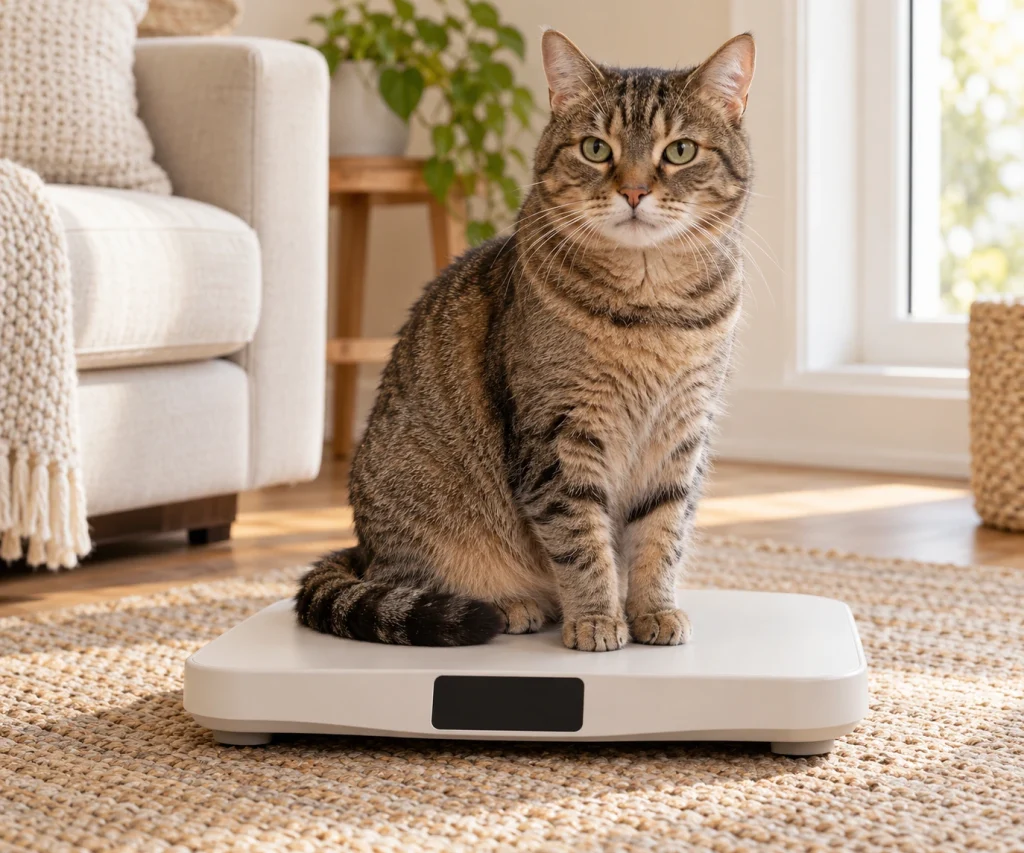
- Weigh regularly on the same scale, ideally monthly, and more often if your cat is thin or losing weight. The Cat Weight Calculator helps you put a number in context.
- Check body condition with the Cat Body Condition Score Calculator, and feel along the spine and hips for muscle loss.
- Note appetite and water intake. The Cat Water Intake Calculator gives a rough daily range to compare against.
- Count treats. They add up quickly in a small cat; our cat treats guide covers better choices.
For general portion principles that apply to adult cats of any age, see our guide to how much to feed a cat.
Making meals easier for an ageing cat
Some of the most useful changes for an older cat have nothing to do with the food itself. The AAFP Senior Care Guidelines suggest:
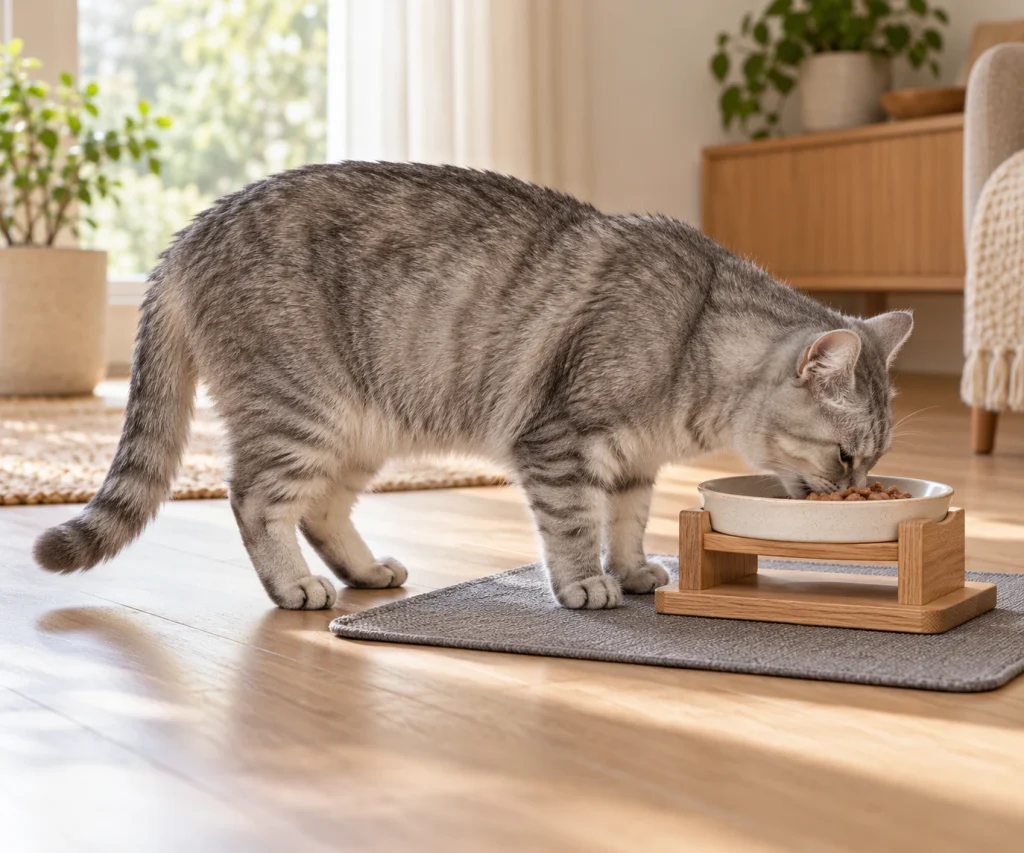
- Low-sided, wide bowls that do not press on the whiskers.
- Raised bowls for cats with stiff joints, so they do not have to crouch. Arthritis is very common in older cats; the guidelines cite degenerative joint disease in up to 74% of cats aged 12 and over. Our cat arthritis guide explains the quiet signs.
- Easy access: food and water on the floor where the cat spends its time, with ramps or steps if it is used to eating somewhere high.
- A quiet spot with minimal interruptions. In multi-cat homes, feed an older cat separately so a younger, faster cat does not take its share.
- Warmed or aromatic food to tempt a cat whose sense of smell has dulled.
- Several water stations in different places, especially for cats with kidney disease or diabetes. Some cats prefer a fountain.
- Keep things where they are. For cats showing signs of cognitive decline, the guidelines advise not rearranging food, water and litter locations.
When you do change food, go slowly. The AAHA/AAFP guidelines describe a gradual transition over 7–10 days and suggest offering a new food in a separate dish next to the usual one, rather than swapping it outright, so the cat can choose. Our guide on how to change cat food safely walks through the process.
The overweight senior and the thin senior
Weight problems at both ends of the scale matter in older cats. Obesity is linked to a shorter lifespan, but the AAFP guidelines note that weight loss becomes more common with advancing age, and that body condition scores below 5 out of 9, as well as 9 out of 9, are associated with poorer survival. The 2023 AAHA guidelines add that a body condition score up to 6 out of 9 can be associated with longer life in cats, while underweight cats have higher risks of illness and death.
| Overweight senior | Thin or losing weight | |
|---|---|---|
| Common pattern | Mature cats (roughly 7–11) who are less active on the same food | Cats in their teens, or cats of any age with an underlying illness |
| Feeding approach | Gradual, vet-guided calorie reduction while keeping protein adequate | Find the cause first; then more energy-dense, highly digestible, appealing food in small, frequent meals |
| Avoid | Crash dieting; cats should never be starved to lose weight | Assuming it is “just old age” or switching to a high-fiber, low-calorie senior food |
If your senior cat needs to lose weight, our step-by-step guide to helping a cat lose weight safely explains how to do it without losing muscle. If your cat is losing weight, the first step is a vet check, not a new food.
When health conditions change the diet
Many older cats live with one or more chronic conditions, and diet is often part of managing them. These decisions belong with your vet, but it helps to know why the advice may change:
- Chronic kidney disease: the AAFP guidelines note that phosphorus-restricted renal diets have been shown to improve outcomes and survival in cats with kidney disease, and that wet food helps hydration. See our guide to kidney disease in cats.
- Hyperthyroidism: the AAFP guidelines report that it affects about 10% of cats over 10. Weight loss despite a big appetite is a classic sign. Read more in our cat hyperthyroidism guide.
- Diabetes: low-carbohydrate, high-protein canned food can help some diabetic cats, alongside treatment. See diabetes in cats.
- Constipation: slower gut transit can make older cats prone to hard, dry stools; extra moisture helps, and some cats need specific diets. See cat constipation.
- Dental disease: a cat with a painful mouth may eat less or prefer soft food. Treating the mouth often improves eating more than any change of food.
If your cat has more than one condition, the right diet is a compromise your vet can help you work out. Avoid adding supplements or switching to a home-made diet without advice, because older cats with chronic disease have less room for error.
Signs your senior cat needs a vet
Changes in eating are often the first sign of illness in older cats, who tend to hide discomfort. Contact your vet if your cat:
- is losing weight or muscle without a planned diet, even if it is still eating well
- eats noticeably less, or stops eating (see our guide to a cat not eating)
- is suddenly much hungrier or thirstier than usual, or is urinating more
- drops food, chews on one side, drools or paws at its mouth
- vomits repeatedly or has ongoing diarrhea or constipation (see cat vomiting)
- seems less active, stops jumping, or grooms less
A cat that has stopped eating entirely, cannot keep food down, or seems weak or unwell should be seen promptly. Regular checkups matter too: the AAHA/AAFP guidelines recommend that senior cats see a vet at least every six months. Our guide to the warning signs that a cat is sick covers other changes to watch for. This article is general information and not a substitute for veterinary advice; see our veterinary disclaimer.
Frequently asked questions
At what age should I switch my cat to senior food?
There is no required age, because there is no official senior nutrient standard. Many senior foods are labeled for cats from 7 or 11 years. A healthy cat doing well on its current complete food can stay on it. Consider a change when your cat’s weight, muscle, appetite or health changes, and discuss it with your vet.
Is senior cat food better for older cats?
Not automatically. A 2020 study of 31 senior and 59 adult cat foods found that senior foods had more fiber on average but did not differ significantly in protein, fat or minerals, and varied widely in calories and nutrients. Judge a food by its calorie content, protein and how your cat responds, not by the label.
Should senior cats eat less protein?
Healthy senior cats should not be protein restricted, according to the AAHA/AAFP guidelines. Older cats tend to lose muscle and digest protein less efficiently, so adequate protein is important. Cats with diagnosed kidney disease are different; follow your vet’s diet advice.
Why is my old cat always hungry but losing weight?
This combination needs a vet visit. Hyperthyroidism and diabetes are common causes in older cats, and reduced ability to digest food can also play a part. Don’t just increase portions without finding out why.
Is wet food better for senior cats?
Wet food helps with water intake and is easier for cats with dental problems, which suits many older cats. Dry food can still be part of a healthy diet if the cat drinks well and eats it comfortably. Many owners feed a mix.
How many times a day should I feed a senior cat?
Smaller, more frequent meals usually suit older cats better. Dividing the daily amount into two to four measured meals is a practical approach, and it makes changes in appetite easier to spot.
Sources
- American Animal Hospital Association and American Association of Feline Practitioners. 2021 AAHA/AAFP Feline Life Stage Guidelines: feline life stage definitions.
- American Animal Hospital Association and American Association of Feline Practitioners. 2021 AAHA/AAFP Feline Life Stage Guidelines: nutrition and weight, mature adult and senior cats.
- Ray M, Carney HC, Boynton B, et al. 2021 AAFP Feline Senior Care Guidelines. Journal of Feline Medicine and Surgery. 2021;23:613–638. Also available from the Feline Veterinary Medical Association.
- American Animal Hospital Association. 2023 AAHA Senior Care Guidelines for Dogs and Cats: nutrition.
- Summers SC, Stockman J, Larsen JA, et al. Evaluation of nutrient content and caloric density in commercially available foods formulated for senior cats. Journal of Veterinary Internal Medicine. 2020.
- VCA Animal Hospitals. Feeding senior cats.
- World Small Animal Veterinary Association Global Nutrition Committee. Muscle condition score chart for cats.