
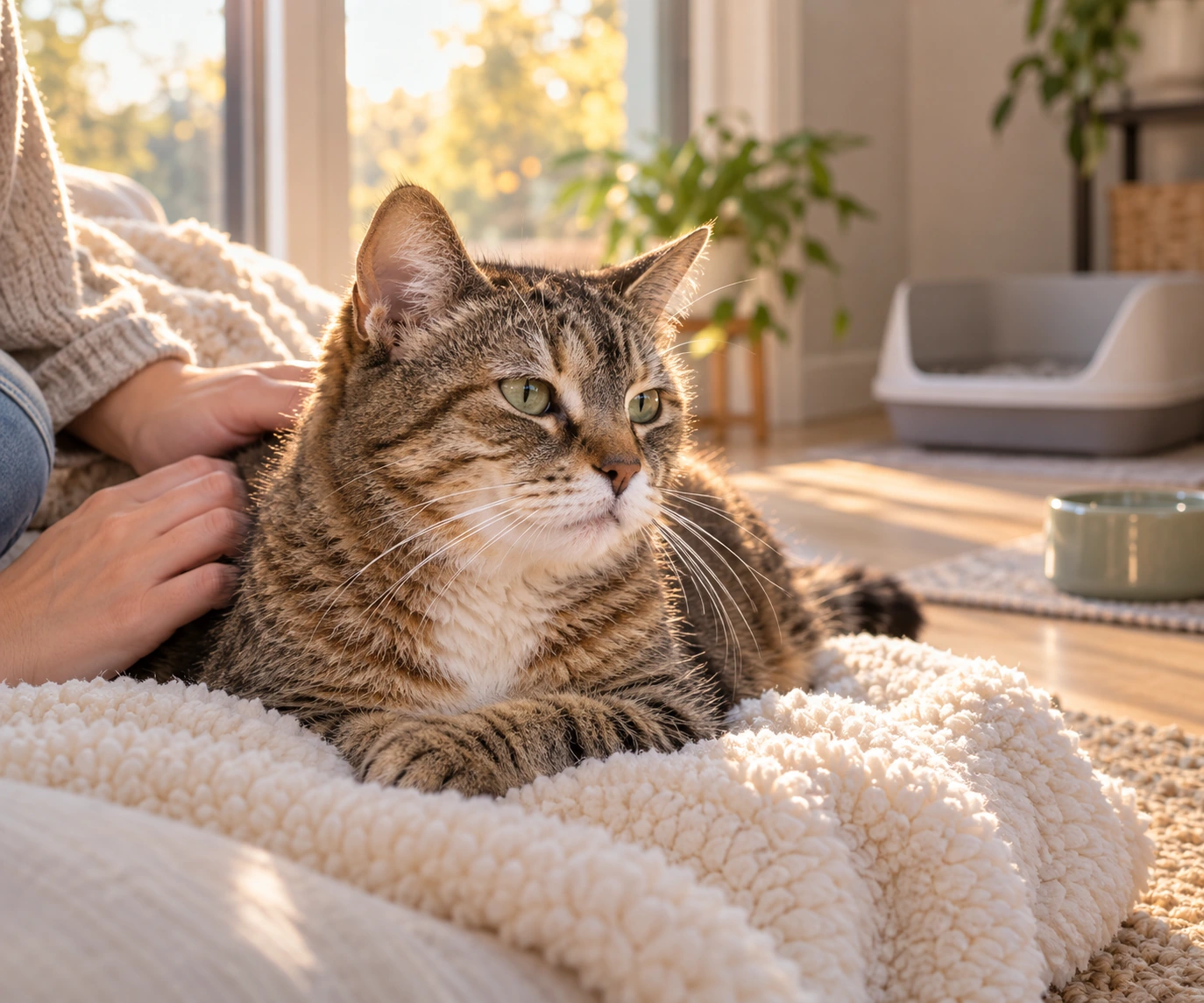

Cat dementia, known to vets as cognitive dysfunction syndrome, is a gradual decline in brain function that affects some older cats. It can show up as loud yowling at night, confusion, litter box accidents, changes in sleep, or a cat who seems clingier or more irritable than before. It cannot be cured, but the right veterinary checks and a few changes at home can make life much easier for an older cat and for you.
The difficult part is that many other common illnesses in older cats, such as high blood pressure, an overactive thyroid, kidney disease and hidden pain, cause almost identical changes, and several of them are very treatable. That is why cat dementia is diagnosed only after a vet has ruled those conditions out. This guide explains the signs, what is happening in the brain, what your vet will check, the treatment options and how to support a cat with dementia at home. It draws on the Merck Veterinary Manual, the Cornell Feline Health Center, the 2021 AAFP Feline Senior Care Guidelines and peer-reviewed research.
Table of Contents
Cat dementia at a glance
- Who gets it: older cats. Cornell notes that signs tend to become noticeable from around 10 years of age, and studies show they become more common with age.
- Common signs: increased vocalizing, especially at night, disorientation, changes in sleep, house soiling, and changes in how a cat interacts with people and other pets.
- Diagnosis: there is no single test. Vets diagnose it by ruling out other conditions that cause the same signs.
- Treatment: no cure, but environmental changes, enrichment, certain diets or supplements and, in some cases, medication may help.
- Urgent warning: sudden changes are not typical of dementia. Sudden blindness, seizures, collapse or straining to urinate need a vet straight away.
What is cat dementia?
Cognitive dysfunction syndrome (CDS) is an age-related, progressive decline in mental abilities such as memory, learning, awareness and perception. The Merck Veterinary Manual notes that it resembles the early stages of Alzheimer’s disease in people, both in its signs and in some of the changes seen in the brain. Many owners put these changes down to normal old age, which is one reason the condition is thought to be under-reported.
What happens in a cat’s brain
Research on ageing cat brains has found shrinkage of brain tissue, deposits of a protein called beta-amyloid, abnormal forms of another protein called tau, and damage linked to oxidative stress. A 2010 review in the Journal of Feline Medicine and Surgery noted, however, that the amount of beta-amyloid does not consistently match how severe a cat’s signs are.
A 2025 University of Edinburgh study, published in the European Journal of Neuroscience and summarized by the UK Dementia Research Institute, examined the brains of 25 cats after death. It found beta-amyloid building up inside synapses, the connections between brain cells, in older cats and cats with dementia, and found support cells in the brain engulfing those synapses. The researchers suggest cats may be a useful natural model for studying Alzheimer’s disease.
How common is it in older cats?
Estimates vary, partly because studies define and count signs differently and some include cats that also had other illnesses. Here is what the main sources report:
- A study by Moffat and Landsberg, cited in the 2010 review above, found behavior changes in 28 percent of cats aged 11 to 14 and in 50 percent of cats over 15.
- The Merck Veterinary Manual cites a study in which about 35 percent of cats over 11 showed at least one sign of CDS, and 50 percent of cats over 15 showed two or more.
- The 2021 AAFP Feline Senior Care Guidelines state that in over 25 percent of cats aged 11 or older, these behavior changes have no recognized medical cause.
Whatever the exact figure, the message is the same: changes in behavior are common in senior cats and become more common with age, so they are worth discussing with your vet rather than accepting as old age.
Signs of cat dementia
Vets often use a memory aid to group the signs. The Merck Veterinary Manual uses VISHDAAL, while older papers use the shorter DISHA. The letters differ, but the signs they describe are largely the same.
| Sign group | What you may notice |
|---|---|
| Vocalization | Loud meowing or yowling, often at night or for no obvious reason |
| Interactions | More clingy and attention-seeking, or more withdrawn, irritable or less tolerant of other pets |
| Sleep-wake changes | Sleeping more during the day and being awake and restless at night |
| House soiling | Urinating or defecating outside the litter box |
| Disorientation | Getting stuck in corners, staring at walls, seeming lost in familiar rooms |
| Activity changes | Aimless wandering or pacing, or less interest in play and exploring |
| Anxiety | Seeming more fearful, restless or easily upset |
| Learning and memory | Forgetting familiar routines or learned habits |
Cornell also lists reduced interest in food and water, and the 2010 review adds reduced grooming. Most signs develop slowly, so it helps to compare your cat’s behavior now with how they behaved a year or two ago.
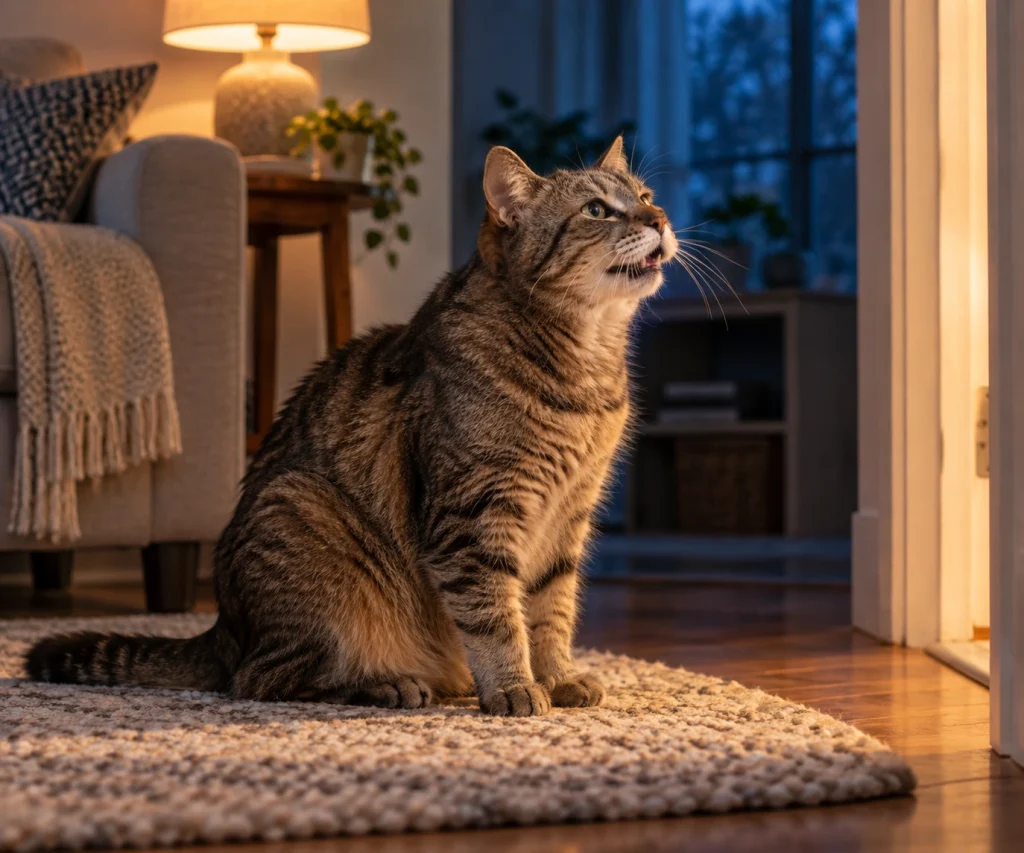
Night-time yowling and vocalizing
According to the Merck Veterinary Manual, increased vocalization is the most frequently reported sign of CDS in multiple studies. However, hyperthyroidism and high blood pressure are also linked to night-time vocalizing, so these need to be checked first. Our guides on why cats meow so much and cat night behavior cover other possible reasons.
Litter box accidents
A cat with dementia may forget where the litter box is or struggle to reach it in time. But house soiling in older cats has many causes, including kidney disease, diabetes, urinary tract problems and arthritis that makes climbing into a high-sided box painful. Our guide to cats peeing outside the litter box explains how to work through the possibilities.
Confusion and personality changes
Owners often describe a cat who seems to be in a world of its own: staring into space, getting stuck behind furniture, walking into a room and appearing to forget why, or reacting differently to familiar people. Some cats become more affectionate and dependent, a change that owners may welcome and therefore overlook. Others become grumpier or less tolerant of being handled, which can also be a sign of pain.
When to see a vet urgently
Cat dementia develops gradually. A sudden change is more likely to have another cause that needs prompt treatment. Contact your vet the same day, or an emergency clinic, if your cat:
- suddenly seems blind, bumps into things or has widely dilated pupils, which can be a sign of high blood pressure
- has a seizure, collapses, or suddenly develops a head tilt, circling or loss of balance
- strains in the litter box and passes little or no urine, especially if male, which can be a urinary blockage and is an emergency
- has difficulty breathing
- suddenly stops eating, or has not eaten for a day or more; see our guide on a cat not eating
For gradual changes over weeks or months, book a regular appointment soon rather than waiting for the next annual check. Our guide on how to tell if your cat is sick covers other early warning signs.
Conditions that can look like dementia
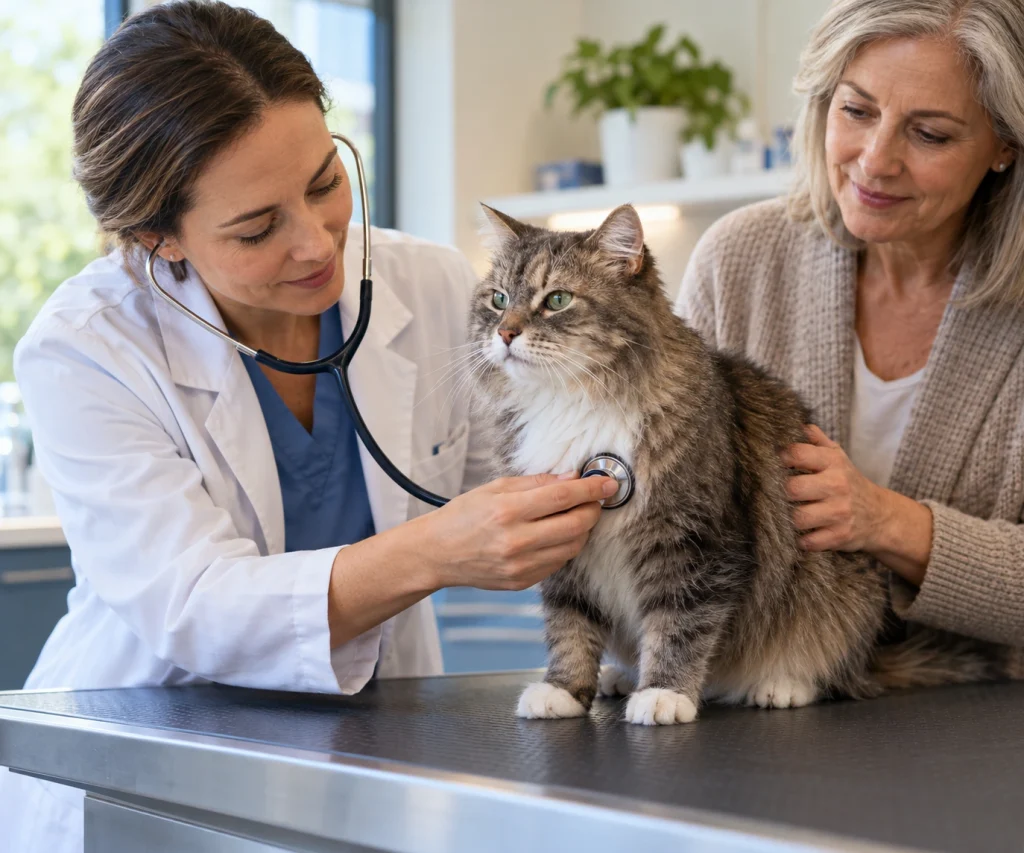
Because CDS is diagnosed by exclusion, the first job is to look for other problems. The Merck Veterinary Manual, Cornell and the 2010 review all list similar conditions. Cats can also have dementia and one or more of these conditions at the same time.
| Condition | Overlapping signs |
|---|---|
| High blood pressure | Night-time vocalizing, confusion, sudden blindness that can cause anxiety and disorientation |
| Hyperthyroidism | Restlessness, night-time vocalizing, increased appetite and food-seeking |
| Kidney disease | Drinking and urinating more, litter box accidents |
| Arthritis and other pain | Slowing down, reluctance to jump or use stairs, difficulty getting into the litter box |
| Dental disease | Reduced enthusiasm for eating |
| Loss of sight or hearing | Disorientation, being easily startled, changes in sleep and interactions |
| Brain disease such as tumors or inflammation | Disorientation, behavior change, seizures |
| Diabetes, urinary tract disease or liver disease | Changes in thirst, urination and litter box use |
Pain deserves special attention. In AAHA’s Trends magazine, feline specialist Danielle Gunn-Moore is quoted as saying that all older cats have pain, and arthritis is very common in older cats. Our guides to cat arthritis and dental disease in cats describe the quieter signs to look for.
How vets diagnose cat dementia
There is no blood test or scan that confirms cat dementia. The 2021 AAFP guidelines describe it as a diagnosis of exclusion, made once medical and environmental causes for the behavior have been ruled out. Your observations are a key part of the process, because many changes only happen at home or at night.
What to bring to the appointment
- A short list of the changes you have noticed and roughly when each one started
- Notes on when the behavior happens, for example at night, after meals or when you leave the room
- Videos of the behavior on your phone, especially night-time yowling or episodes of confusion
- Details of any litter box changes, including where accidents happen and whether they are urine or feces
- Any changes in appetite, drinking, weight, grooming or mobility
- A list of all medications, supplements and diets your cat is on
Tests your vet may suggest
A typical work-up includes a detailed history and a full physical and neurological examination, including the eyes, mobility and the thyroid gland. Blood pressure measurement, blood tests including thyroid hormone, and a urine test are usually part of the investigation. If the signs suggest a structural problem in the brain, Cornell notes that MRI and analysis of the fluid around the brain may be considered.
Your vet may also suggest a trial of pain relief. AAHA’s Trends article describes how improvement in behavior during a short course of pain medication can show that pain was contributing to the changes.
Treatment options for cat dementia
There is no cure for cat dementia, and it is generally considered progressive. The aim of treatment is to slow the decline where possible, reduce distress and keep your cat’s quality of life as good as possible. In practice, a combination of approaches is usually used.
Treating other conditions first
Any other illness found during the work-up should be treated first. This may resolve some or all of the signs. For example, AAHA’s Trends article notes that treating high blood pressure may resolve dementia-like signs caused by hypertension, although it will not resolve changes caused by dementia itself.
Diets and supplements
The Merck Veterinary Manual reports that S-adenosylmethionine (SAMe) and a commercial diet containing antioxidants, arginine, B vitamins and fish oil have improved learning and memory in older cats. The 2021 AAFP guidelines suggest essential fatty acids, antioxidants, B vitamins and pheromones as part of management. The 2010 review cautioned that evidence for specific supplements in cats is limited, and it warned that alpha-lipoic acid, an antioxidant used in some supplements, is potentially toxic to cats.
Ask your vet before starting any diet change or supplement, and only use products made for cats. Some ingredients that are safe for dogs or people are not safe for cats. Our guide on what to feed a senior cat covers nutrition for older cats more broadly.
Medications
According to the Merck Veterinary Manual, no medications are licensed for cognitive dysfunction in cats. Some vets prescribe selegiline off-label, and the AAFP guidelines mention it as a possible option if other measures do not help. Cornell notes that it is not approved for cats. Merck reports very little evidence for another drug, propentofylline. Vets may also prescribe medication to reduce anxiety in some cats.
Only give medication prescribed for your cat, at the dose and schedule your vet gives. Never give human or dog medications, as some are dangerous to cats and some should not be combined. If your cat takes several medications, MyyCat’s free Cat Medication Schedule Generator can help you keep track.
How to help a cat with dementia at home
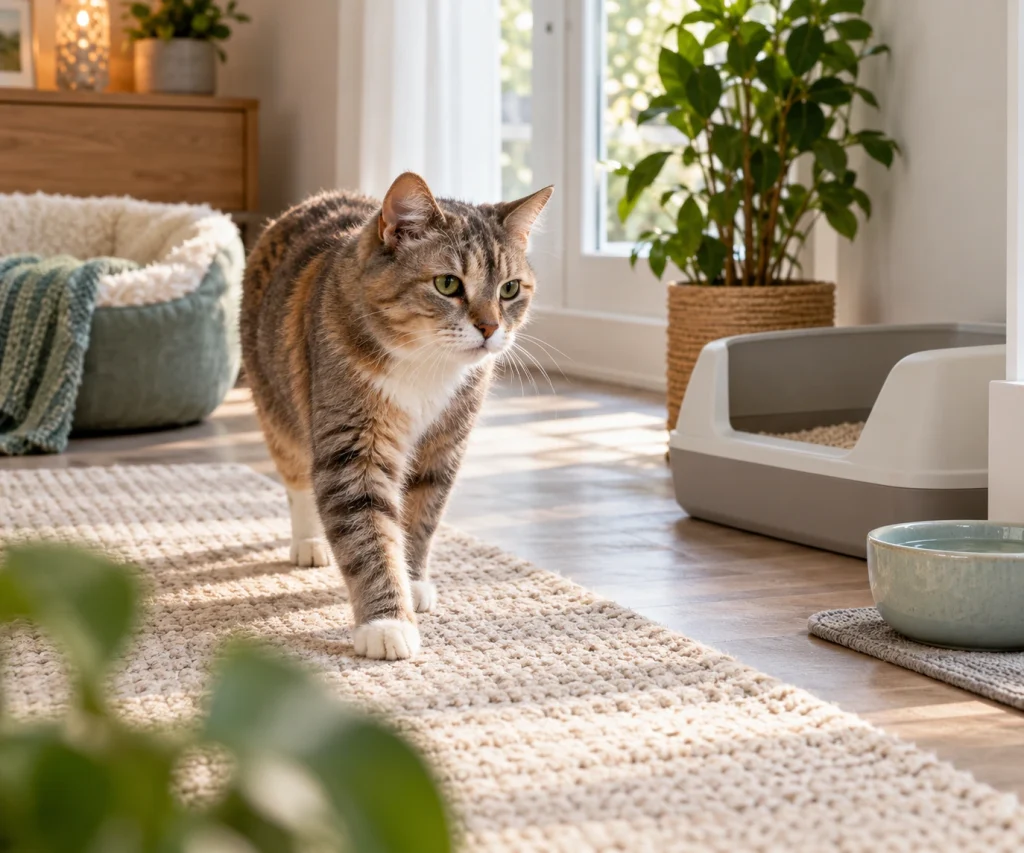
Changes at home are the foundation of care, and they can make a real difference to a confused or anxious older cat. Make changes gradually, because sudden upheaval can add to the confusion.
Keep routines predictable
Feed, play and settle your cat at the same times each day. Keep furniture, beds, food and water in the same places. Cornell advises against introducing a new pet that could cause stress. Some cats with more advanced dementia cope better when their world is made smaller, for example a single quiet room with everything they need, especially at night.
Make essentials easy to reach
- Put food, water, a bed and a litter box on each level of the home your cat uses, so they never have far to go.
- Use a litter box with a low entry. In a 2018 Vet Times article, veterinarian Sarah Caney recommends a litter box for all cats aged 11 and older, even those that previously toileted outdoors. MyyCat’s Cat Litter Box Calculator can help you check whether you have enough boxes.
- Add ramps or steps to favorite resting spots if your cat struggles to jump, as Cornell suggests.
- AAHA’s Trends article suggests raising food and water bowls and placing them away from walls.
Keep the mind active
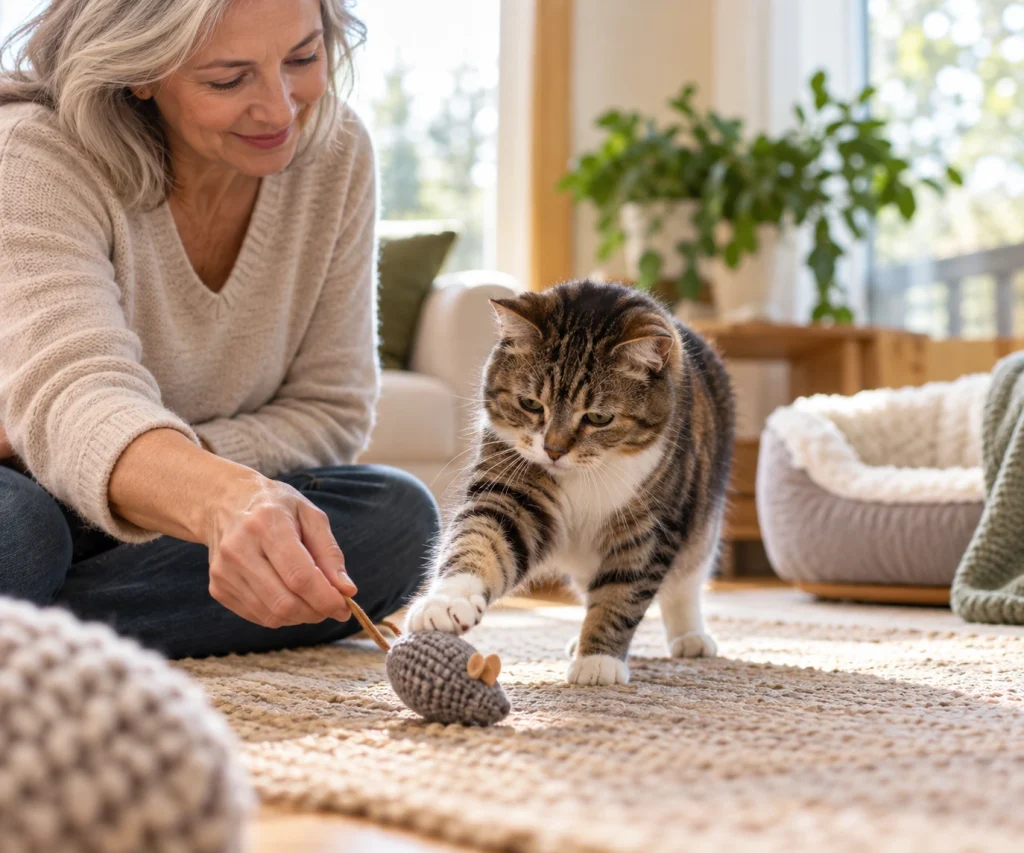
Gentle mental and physical activity is widely recommended. Short play sessions, food puzzle toys and gentle hunt-and-chase games encourage your cat to move and think. The Merck Veterinary Manual recommends reward-based training rather than punishment. Go at your cat’s pace. Caney notes that play can become stressful for badly affected cats, who may be happier with a calm, stable routine.
Managing night-time yowling
- Ask your vet to check for medical causes first, including blood pressure, thyroid disease, pain and loss of sight or hearing.
- Keep your cat more active during the day with play and food puzzles, so they are more ready to sleep at night.
- Consider settling your cat in a comfortable room at night with food, water, a litter box and a bed.
- Avoid rewarding yowling with attention or food, and reward calm behavior instead, as the 2010 review recommends.
- Never punish your cat. A confused cat cannot understand punishment, and it will only increase anxiety. Our cat anxiety guide has more ideas for creating a calm home.
What to avoid
- Punishment or startling your cat, including spray bottles
- Sudden changes to the home, routine or household
- Supplements or remedies not made for cats, especially products containing alpha-lipoic acid
- Human or dog medications of any kind
- Assuming new signs are just dementia without checking with your vet
Can cat dementia be prevented?
There is no proven way to prevent cat dementia. What you can do is spot changes early. The Merck Veterinary Manual advises that early detection offers the best chance to slow decline, and that vets should ask about behavior at every visit. The 2021 AAFP guidelines recommend more than one examination a year for senior cats, with baseline diagnostic tests at least yearly from around 7 to 10 years of age.
Keeping your cat mentally and physically active throughout life, feeding a complete and balanced diet suited to their age, and treating other illnesses promptly are all sensible steps for an ageing cat’s overall health. If you are not sure whether your cat counts as senior, MyyCat’s Cat Life Stage Calculator can help.
Quality of life and difficult decisions
With support, the aim is for a cat with cognitive decline to keep a good quality of life for as long as possible. As the condition progresses, however, some cats become persistently anxious or distressed, or can no longer eat, sleep or use the litter box normally. AAHA’s Trends article encourages vets to discuss quality of life, and end-of-life options, with owners early, so that decisions are not made in a crisis.
Keeping a simple daily record of good and bad days, appetite, sleep and litter box use can help you and your vet judge how your cat is coping over time.
When to see a vet
Book an appointment if your senior cat develops any new or worsening behavior change, such as night-time yowling, confusion, litter box accidents, changes in sleep or appetite, or changes in personality. Seek urgent care for sudden blindness, seizures, collapse, loss of balance, breathing difficulty or straining to urinate. This article is general information and not a substitute for advice from your veterinarian; see our veterinary disclaimer.
Frequently asked questions
At what age do cats get dementia?
Signs usually appear in older cats. Cornell notes they tend to become noticeable from around 10 years of age, and studies consistently find signs become more common in cats over 15. Behavior changes in a younger cat are more likely to have another cause.
Is cat dementia painful?
Cognitive decline mainly affects behavior and awareness, but confusion and anxiety can be distressing. Pain from conditions such as arthritis and dental disease is common in older cats and can cause very similar changes, which is why vets check for pain before diagnosing dementia.
How long can a cat live with dementia?
There are no reliable figures for life expectancy. Sources describe cognitive dysfunction as progressive but do not give a typical timeline, and older cats often have other conditions that affect their outlook. Your vet can help you monitor your cat’s quality of life over time.
Why does my old cat yowl at night?
Night-time yowling in a senior cat can be a sign of dementia, but it is also linked to hyperthyroidism, high blood pressure, loss of sight or hearing, and pain. A vet check is the best first step, followed by changes at home such as more daytime activity and a comfortable night-time routine.
Can cat dementia come on suddenly?
Dementia usually develops gradually over months or years. A sudden change in behavior, awareness, vision or balance is more likely to have another cause, such as high blood pressure, seizures or another illness, and needs a vet promptly.
Is cat dementia the same as Alzheimer’s disease?
It is not the same condition, but it shares important features. The Merck Veterinary Manual notes that feline cognitive dysfunction resembles the early stages of Alzheimer’s disease in people, and the 2025 Edinburgh study found beta-amyloid building up at the connections between brain cells in cats with dementia.
Sources
- Kim SA. Behavior Problems of Cats. Merck Veterinary Manual, professional version. Reviewed July 2025.
- Cornell Feline Health Center. Cognitive Dysfunction. Reviewed 2024.
- Ray M, Carney HC, Boynton B, et al. 2021 AAFP Feline Senior Care Guidelines. Journal of Feline Medicine and Surgery. 2021;23(7):613-638.
- Landsberg GM, Denenberg S, Araujo JA. Cognitive dysfunction in cats: a syndrome we used to dismiss as old age. Journal of Feline Medicine and Surgery. 2010;12(11):837-848. Open-access copy.
- Kase C. A compassionate approach to feline cognitive dysfunction. AAHA Trends. December 2025.
- Caney S. Diagnosis and management of cognitive dysfunction syndrome. Vet Times. October 2018.
- UK Dementia Research Institute. News release on the Edinburgh feline dementia study. August 2025. Reporting McGeachan R, Spires-Jones T, et al. European Journal of Neuroscience. 2025;62(3):e70180.