
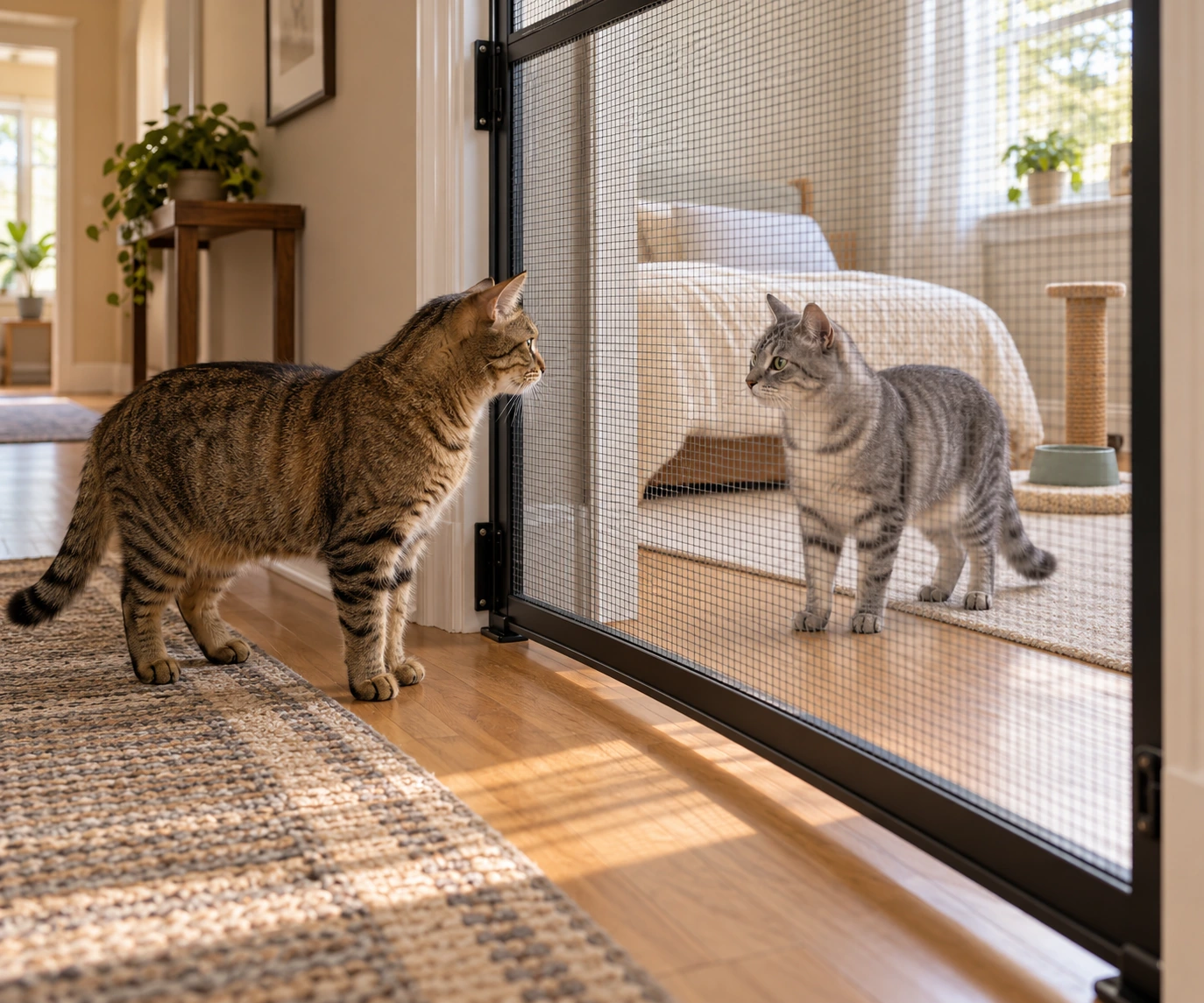

If you are wondering how to introduce cats without starting a feud, the short version is this: slowly, in stages, and at the pace of the more nervous cat. Give the newcomer a room of their own, let the cats get used to each other’s scent before they see each other, then move to brief meetings through a barrier and only later to supervised time in the same space. Most introductions take weeks rather than days, and some take months.
This guide sets out that process step by step, using the 2024 intercat tension guidelines from the American Association of Feline Practitioners (AAFP) as its backbone. It also explains what owner surveys have found about how introductions really go, including a 2025 Danish study suggesting the best approach may depend on the cats’ ages. You will also find how to read the signs that things are going well or badly, what to do if a fight breaks out, and when a problem needs your vet.
Table of Contents
The short answer
The recommended way to introduce a new cat to your cat is a gradual, staged process in which neither cat is pushed into fear. In outline:
- Prepare first: health checks for every cat, a closed base room for the newcomer and extra resources around the home.
- Let the new cat settle in the base room before the cats meet in any way.
- Introduce scent before sight by swapping bedding and scent cloths, and play with each cat on its own side of the door.
- Swap spaces so each cat explores where the other lives without meeting.
- Allow short visual contact through glass, a screen or a tall gate, rewarding calm behavior.
- Supervise brief time together, then slowly lengthen it and step back.
Move forward only when every cat is relaxed at the current stage. If tension appears, go back a step. Expect the whole process to take weeks, and possibly months, and remember that peaceful tolerance is a perfectly good outcome. Not every pair of cats becomes inseparable.
What research says about introducing cats
Most online advice on introductions is presented as settled fact. The real evidence is thinner and more interesting than that, and it helps to know what it does and doesn’t show before you start.
New cats are the most common trigger for tension
Friction between cats who share a home is common, and it often starts on day one. The 2024 AAFP guidelines note that surveys put the share of multi-cat households with some intercat tension at between 62.2% and 87.7%. In one large survey of 2,492 multi-cat households (Elzerman and colleagues, 2020), 87.7% reported signs of tension, and 73.3% of respondents said those signs began when a new cat was introduced. Much of that tension was quiet rather than dramatic: staring was the most commonly reported sign, ahead of chasing, stalking and hissing.
That is the strongest reason to take introductions seriously. A relationship that starts badly can be hard to repair, and the AAFP points out that cats have few of the reconciliation behaviors that social species such as dogs use to patch things up after a conflict.
First meetings matter, but studies of methods are mixed
An early study by Levine and colleagues, published in 2005, surveyed people who had adopted a cat from an animal shelter in New York State. Of 375 questionnaires, 252 were returned, and 128 came from households with more than one cat.
Half of those multi-cat households reported fighting, defined as scratching or biting, when the new cat arrived, and roughly half of owners had simply put the cats together straight away. Fighting that was still happening two to twelve months later was associated with scratching or biting at the cats’ first meeting, with outdoor access, and with the owner describing that first meeting as unfriendly. The cats’ age, sex and the number of cats in the home were not associated with ongoing fighting.
That finding is often quoted as proof that a bad first meeting causes lasting problems. The study can’t show that. It is equally possible that some pairs were poorly matched from the start, and the first meeting simply revealed it.
The most detailed study so far is a 2025 survey of a representative sample of Danish cat owners by Hoff and colleagues. Of 1,507 cat owners, 308 had introduced a new cat to one or more resident cats. Despite professional advice, 56% put the cats together immediately. In the first month, friendly behavior was more common than unfriendly behavior, and curiosity was the most common reaction on both sides. New cats more often started play, while resident cats were more likely to hiss. Unfriendly reactions became more likely as cats got older.
The surprising result concerned age. When both cats were young, several standard techniques, including separation, barrier meetings, scent swapping and calming products, were linked with more unfriendly behavior. When both cats were about five or older, gradual introductions were linked with more friendly behavior. The authors stress that these associations were weak, that owners may have chosen gradual methods because they expected trouble or had already seen it, and that the results relied on owners’ memories. The number of older pairs was also small.
What this means in practice
No study shows that a slow introduction guarantees friendship, or that a quick one dooms it. Taken together, though, the evidence points in a sensible direction. Bad first meetings are linked with lasting conflict, older cats seem to cope less well with sudden social change, and a careful introduction costs you nothing but time. That is why veterinary behavior guidelines still recommend a gradual, stepwise approach to how to introduce cats, adjusted to how your particular cats respond. Young, sociable cats may move through the stages quickly. A nervous adult may need much longer. The cats set the pace, not the calendar.
Before you bring a new cat home
Is another cat right for your cat?
Cats are often described as either solitary or social. The AAFP guidelines describe them instead as socially flexible: many cats form close bonds with other cats, some prefer to live alone, and most fall somewhere in between. The same guidelines list “cats get lonely and need a companion” as a myth. A resident cat may be happier as an only cat, and a mismatched housemate can be a source of long-term stress rather than company.
If you do decide to add a cat, think about the match before you think about the method:
- Temperament and history. Ask the shelter or rescue whether the cat has lived happily with other cats. A calm, cat-friendly newcomer usually integrates more easily than a cat with a history of conflict.
- Energy and play drive. The AAFP notes that cats with a high play drive often bother older or more timid cats.
- Relatedness. Related cats are more likely to stay bonded. In a small, preliminary study of cats living in pairs in catteries, Bradshaw and Hall found that littermate pairs were more affiliative than unrelated pairs. If you plan to adopt two cats at once, a pair that is already bonded is the safer choice.
- Your resident cat’s health and age. The AAFP advises that owners generally should not adopt another cat if a resident cat is a senior with medical concerns.
- Your space. Can every cat have its own resting places, feeding spot and litter boxes without having to pass the other to reach them?
Health checks for every cat
The AAFP’s first step is to make sure the resident cat and the newcomer are healthy and have had recent veterinary care. That matters for two reasons. Cats can pass infections and parasites to each other, and pain or illness lowers a cat’s tolerance for social stress.
The AAFP’s retrovirus guidelines recommend that cats are tested for feline leukemia virus (FeLV) and feline immunodeficiency virus (FIV) as soon as possible after they are acquired, and the AAFP’s owner information advises testing a new cat before it is introduced to other cats in the household. Ask your vet about vaccinations for both cats (our cat vaccination schedule guide explains the core vaccines), and about parasite treatment, because fleas spread easily between cats sharing a home. If the new cat is sneezing or has discharge from the eyes or nose, talk to your vet before any contact. Signs like these can point to a respiratory infection.
Set up a base room and extra resources
The new cat needs a “base room” (the AAFP calls it a transition room) where it can live for the first part of the introduction. It should have a door that closes securely and contain everything the cat needs:
- food and water, placed away from the litter box
- a litter box
- hiding places, such as a covered bed or a box on its side
- somewhere to climb or perch at different heights
- a soft bed, a scratching post and toys
Remove anything fragile or dangerous, such as toxic plants, loose cords and strings.
Prepare the rest of the home too, ideally before the newcomer arrives, so the resident cat doesn’t suddenly find its world squeezed. The AAFP suggests at least one safe place per cat plus one extra, with some up high and some that allow a cat to hide with two ways in and out so it can’t be cornered. For litter boxes, the AAHA/AAFP life stage guidelines give a rule of thumb of one box per cat plus one, spread across different locations rather than lined up together.
MyyCat’s Cat Litter Box Calculator can help you work out how many boxes your household may need and where to place them. Plan separate feeding spots as well: the AAFP recommends that cats eat out of sight of each other, even when they get on well.
Keep your resident cat’s routine, sleeping places and feeding spot as unchanged as possible. If anything has to move, move it a week or two before the new cat arrives rather than on the same day.
Pheromone diffusers: helpful, not magic
The AAFP guidelines suggest plugging in synthetic feline pheromone diffusers in the main living area and the base room 24–48 hours before the new cat arrives. There is some supporting evidence: a small randomized, placebo-controlled pilot trial by DePorter and colleagues found that a cat-appeasing pheromone diffuser, combined with owner education, helped reduce aggression between cats in multi-cat homes. The AAFP is also clear that effects can be subtle and are easily overridden when a cat feels threatened. Treat a diffuser as a supporting tool. It doesn’t replace a gradual introduction or a well-resourced home.

How to introduce cats, step by step
The stages below show how to introduce cats using the sequence in the 2024 AAFP guidelines and the step-by-step owner guide published alongside them. The rule that runs through every stage is simple: move on only when every cat is relaxed at the current stage, meaning eating, grooming, playing, using the litter box and moving around normally. The AAFP warns that continuing to move forward while cats are tense can result in long-term tension, so going back a step is part of the process, not a failure.
Stage 1: Arrival and settling in
Carry the new cat in a covered carrier straight to the base room, close the door, then open the carrier and let the cat come out when it chooses. Don’t pull it out or lure it from a hiding place. Many newly adopted cats hide for the first days, which is normal (our guide to why cats hide explains how to help a shy cat feel safe).
Spend calm time in the room with the newcomer, but keep giving your resident cat its usual attention. The cats will already know about each other through smell and sound. That is fine. At this stage the aim is simply for the new cat to settle. You are ready for stage 2 when the new cat is eating, using the litter box, exploring its room and approaching you, which often takes a few days.
Stage 2: Scent swapping and play at the door
Cats rely heavily on smell, so the next step is to make each cat’s scent familiar before they ever see each other.
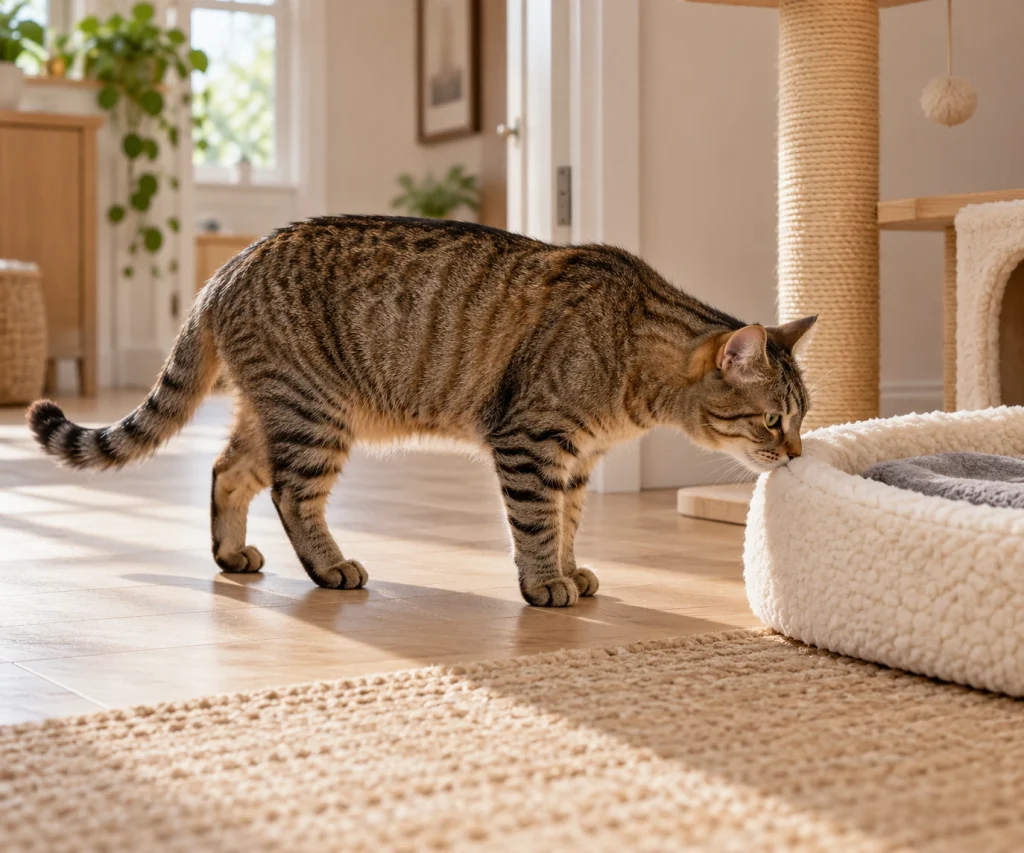
- Swap bedding. Once all the cats are relaxed, swap a piece of soft bedding between the base room and the resident cat’s areas. Repeat daily until no cat reacts negatively to the other’s smell. Hissing, growling, avoiding the item or marking near it all count as negative reactions.
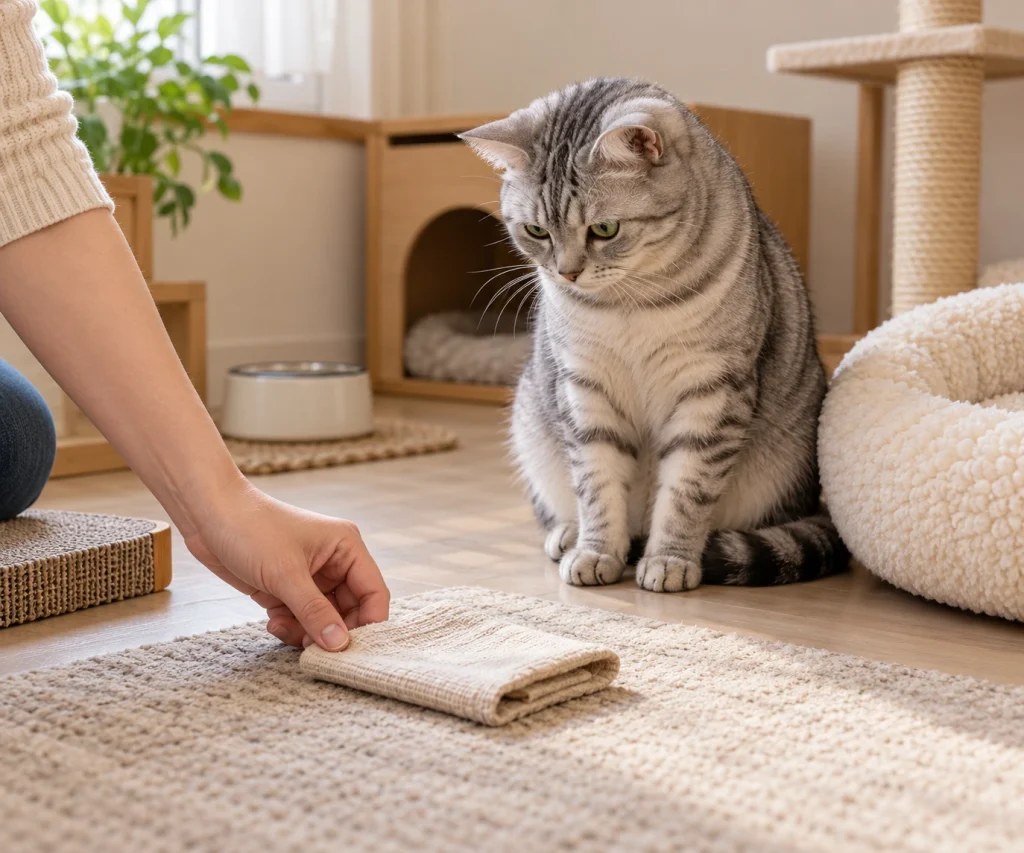
- Swap scent cloths. When the cats are relaxed with the bedding, gently rub a soft cloth around one cat’s cheeks and chin, where scent glands are concentrated, and leave it where the other cat can investigate it. Do the same the other way round.
- Play on either side of the door. The AAFP suggests a “dumb-bell” toy: two toys tied to either end of a strong string, one on each side of the closed door, so each cat plays with the other cat on the far side without seeing it. Keep sessions to about 5–20 minutes, depending on how the cats respond, and stop before they lose interest.
Many guides suggest feeding the cats’ meals on either side of the closed door and moving the bowls closer each day. Use that idea with care. Food can build positive associations, but the AAFP recommends feeding cats out of sight of each other and avoids encouraging them to eat close together, because competition around food is a common source of tension. A gentler alternative is to give a favorite treat or a short play session on each side of the door, while keeping daily meals in each cat’s own quiet spot. If your cats currently free-feed, moving to set mealtimes makes treats more valuable as rewards. MyyCat’s Cat Feeding Schedule Generator can help you plan a routine.
If one cat hisses or growls persistently at the door, don’t scold it. Make the door area less intense instead, for example by blocking the hallway in front of it with a screen or boxes, and slow the pace.
Stage 3: Swapping spaces
When the new cat is settled and the cats are comfortable with each other’s scent, shut the resident cat in another room and let the newcomer explore the shared areas of the home for a short time. Then return the new cat to its base room and give the resident cat the choice of investigating where the newcomer has been.
Swapping spaces spreads both cats’ scent around the home naturally. It also lets the newcomer learn the layout, including escape routes and where the litter boxes are, without the pressure of meeting another cat. Repeat over several days, lengthening the exploration time as long as both cats stay relaxed.
Stage 4: Seeing each other through a barrier
Now allow short sessions in which the cats can see but not reach each other. Options include a glass door, a mesh screen door, an extra-tall pet gate or a door strap that holds the door slightly open. Cats Protection suggests starting with glass and moving to a mesh barrier if that goes well, so the cats can then smell as well as see each other. If your cat is already comfortable in a carrier, a partly covered carrier can be used for this step. Our cat carrier training guide explains how to build that comfort first.
Keep sessions short. Reward calm glances, sniffing and relaxed body language with treats or play, and end on a good note. A brief look followed by ignoring each other is a good result. If either cat fixes its stare, crouches, flattens its ears, lashes its tail, growls or hisses repeatedly, block the view with a towel or a piece of cardboard, end the session and go back to stages 2 and 3 for a few more days.
Stage 5: Short, supervised time together
When the cats are relaxed seeing each other, try brief, supervised time in the same space. The AAFP suggests using a harness and leash, or keeping one cat in a partly covered carrier while the other explores. Both only work if the cats have been trained to accept them beforehand. Our cat leash training guide covers harness training. With confident, relaxed cats, many owners instead use a large room with plenty of high places, hiding spots and more than one exit.
- Scatter toys around the room and keep treats ready, both as rewards and as distractions.
- Have a large towel, a cushion or a sheet of cardboard within reach so you can block eye contact if tension rises.
- Don’t pick up, stroke or reach for a cat that is hissing, growling, flicking its tail or otherwise aroused. The AAFP warns that a cat who can’t reach the cat it is focused on may redirect its frustration onto the nearest target, which can be you.
- Keep early sessions short and finish while both cats are still calm.
Stage 6: Gradually stepping back
As sessions go well, gradually lengthen the time the cats spend together and reduce how closely you supervise. Keep separating them overnight and when you are out until you have seen many calm days in a row. Keep the extra resources in place permanently, not just during the introduction. Cats who share a home still need their own places to eat, rest and toilet without having to negotiate with each other.
Don’t expect the cats to want to spend all their time together. The AAFP guidelines cite a study of 60 pairs of neutered, indoor-only cats in which the cats spent 48–50% of their time out of each other’s sight. Time apart is normal and is not a sign of failure.
How long does it take for cats to get along?
There is no reliable number of days. The AAFP tells owners to be prepared for integration to take many weeks, if not months, and to expect to go back one or more steps along the way. Some pairs move faster: in both owner surveys described above, many owners put cats together quickly and plenty of those cats settled. Others take far longer, and the AAFP notes that reintroducing cats who already have a tense relationship can take from a few weeks to a year or more.
Any website that promises cats will be friends in “one to two weeks” is guessing. A more useful way to think about time is in terms of milestones: each cat eating and sleeping normally, ignoring the other’s scent, glancing at the other through a barrier without tension, sharing a room without staring or hiding, and finally resting in the same room on their own terms. Progress at your cats’ speed, not to a deadline.
It also helps to define success realistically. The AAFP lists toleration, where cats live together without much friendly or unfriendly interaction, as an acceptable outcome. Two cats who pass in the hallway, share a sofa at opposite ends or use the same windowsill at different times of day are living together successfully, even if they never groom each other.
Reading the signs: is the introduction going well?
Judge progress by patterns over several sessions, not by a single moment. The table below draws on the AAFP guidelines and the signs of tension reported by owners in the Elzerman survey. Treat it as a guide to pacing rather than a strict rulebook.
| Going well: keep going | Mild tension: slow down | Clear conflict: stop and separate |
|---|---|---|
| Sniffing, then walking away | A short hiss or growl, followed by moving away | Repeated hissing, growling or screaming |
| Relaxed body, ears forward, slow movements | Ears turned sideways, tail flicking | Crouching with a fixed stare, flattened ears, puffed fur |
| Eating, grooming or playing near the barrier | Brief staring that breaks off | Stalking or chasing that only goes one way |
| Approaching with the tail up | Eating less or avoiding the barrier area | Swatting, biting or fur flying |
| Curious looks, then ignoring each other | Hiding a little more than usual | One cat blocking the other’s way to food, litter or a doorway |
| Later: resting in the same room, nose-touching, rubbing | Grooming more than usual after sessions | Peeing outside the box, hiding most of the time or stopping eating |
An occasional hiss is not a disaster. A hiss is a distance-increasing signal, and in the Danish survey resident cats commonly hissed even though curiosity was the most frequent reaction. What matters is the trend. Hissing that fades over days is a good sign. Hissing that becomes more frequent, or turns into staring and blocking, means you have moved too fast.
Watch for the quiet signs too. The AAFP identifies staring, walking away, hiding and blocking as the most common signs of intercat tension, and they are easy to miss because nothing looks like a fight. On the positive side, the clearest markers of a real bond are mutual grooming, rubbing against each other, nose-touching and sleeping while touching. If you are unsure whether rough interactions are play or conflict, our guide to whether your cats are playing or fighting covers the differences in detail.
Kittens, adult cats and senior cats
Age changes the picture more than most introduction guides admit. If you aren’t sure which life stage your cat is in, MyyCat’s Cat Life Stage Calculator gives an approximate answer.
Introducing a kitten to an older cat
Cats Protection notes that introducing a kitten to an adult cat can sometimes be easier than introducing two adults, and in the Danish survey younger cats tended to react more positively. A kitten brings its own challenge, though: energy. Constant pouncing can wear down an adult cat, especially an older or quieter one. The AAFP suggests channeling a playful cat’s energy with two or more owner-led play sessions a day of at least five minutes each, and making sure the older cat has high resting places the kitten can’t easily reach.
The Danish findings also suggest that very young cats may not need as long at each stage. Follow the same sequence, but let the cats’ behavior, not a fixed schedule, decide how quickly you move. Make sure the kitten’s vaccinations and parasite treatment are on track before any direct contact.
Introducing two adult cats
Adult introductions usually need the most patience. In the Danish survey, unfriendly reactions became more common with age, and gradual introductions were linked with friendlier behavior when both cats were around five or older. Plan to spend longer at the scent and barrier stages, keep sessions short, and pay close attention to quiet signs such as staring and blocking. An adult cat who has never lived with another cat may also take longer to adjust.
Senior or unwell resident cats
Think carefully before bringing a new cat into a home with an elderly or unwell resident. The AAFP advises that owners generally shouldn’t adopt another cat when a resident cat is a senior with medical concerns. Older cats often have stiff or painful joints, and a cat in pain has less patience for a pushy newcomer. If you go ahead, make sure the senior cat can reach its food, water, litter box and favorite resting places without climbing or passing the newcomer. Watch for signs of arthritis, such as reluctance to jump.
What to do if the introduction goes wrong
Even careful introductions can stall or go backwards. What you do next matters more than the setback itself.
If a fight breaks out, don’t reach in with your hands. Break the cats’ line of sight by sliding a cushion, a sheet of cardboard or a large towel between them, then let each cat move away, or guide them into separate rooms once they have calmed enough to do so safely. The AAFP notes that it may take anywhere from a few hours to a couple of days for cats to settle after an incident, so leave them separated and undisturbed until their normal routines return.
Check for injuries. Cat bites can become infected even when the wound looks small, so any bite or scratch that breaks the skin, on a cat or a person, is worth showing to a vet or doctor.
Go back further than you think you need to. Return to the stage where both cats were last fully relaxed, often scent swapping, and work forward again more slowly. Reintroductions can take longer than first introductions because the cats now have a negative experience of each other.
Never punish either cat. Shouting, spraying water or throwing things increases fear and can damage the cat’s relationship with you, according to the AAFP. Fear is usually what drives the conflict in the first place.
Look for outside triggers. A cat who sees an unfamiliar cat through a window can redirect that frustration onto its housemate. If an outdoor cat visits, block the view, for example with frosted film on the lower part of the window.
If the cats are still in conflict after a sustained effort, it is time for professional help (see below). The AAFP is candid that not every case can be resolved. Some cats live best in separate parts of a home, and in some cases rehoming one cat into a home without other cats is the kindest option for everyone.
Common myths about introducing cats
Much of the popular advice about how to introduce cats rests on assumptions that don’t hold up well. Here are the ones most worth unlearning.
| Common belief | A more accurate view |
|---|---|
| “Just put them together and let them work it out.” | The AAFP says letting cats “work it out” impairs their welfare and is not an acceptable approach. |
| “Cats are solitary, so they’ll never really get along.” | Cats are socially flexible. Many form close bonds with other cats, others prefer to live alone. |
| “My cat is lonely and needs a friend.” | The AAFP lists this as a myth. Some cats are better off as only cats. |
| “There’s a boss cat, and you should let it establish dominance.” | The AAFP finds no evidence that tension comes from cats establishing a dominance hierarchy. Competition for resources and fear are more likely drivers. |
| “If they hiss, it has failed.” | Early hissing is common. Watch the trend over days rather than single moments. |
| “Two weeks is enough.” | Introductions can take many weeks or months, and some pairs need longer. |
| “A pheromone diffuser will sort it out.” | Diffusers may help a little, alongside a gradual plan and enough resources, but not on their own. |
| “Male and female cats get along best.” | In the Levine survey, the cats’ sex was not associated with ongoing fighting. Temperament, age and history with other cats matter more. |
When to get help from your vet
The AAFP recommends that any cat showing changes in behavior is checked by a vet to rule out medical problems. Pain, illness and stress can all make introductions harder. Contact your vet if:
- either cat has a bite wound, swelling, limping or any injury
- a cat stops eating or eats much less (see our guide to a cat not eating)
- a cat hides most of the time; the AAFP treats hiding more than half the time as a sign of significant tension
- a cat starts peeing outside the litter box, or strains or produces little urine, which needs urgent attention in male cats
- a cat starts overgrooming or develops bald patches
- there is no real progress after several weeks of patiently going back a step, or conflict is escalating
- cats who previously got on suddenly start fighting, which can be a sign that one of them is unwell or in pain
Your vet can examine both cats, look for pain or illness and, if needed, refer you to a veterinary behaviorist or a qualified feline behavior professional. In some cases a vet may suggest medication alongside behavior and environmental changes. The AAFP stresses that medication should only be used together with those changes, never instead of them. For a broader look at stress-related behavior, see our guides to cat anxiety and cat aggression, and for early signs of illness, how to tell if your cat is sick. This article is general information and not a substitute for veterinary advice. See our veterinary disclaimer.

Frequently asked questions
How long does it take to introduce two cats?
Usually weeks, sometimes months. The AAFP advises owners to be prepared for many weeks, if not months, and to go back a step whenever tension appears. Young, sociable cats may move faster, while nervous adults often need longer at each stage.
Is it normal for my cat to hiss at the new cat?
Yes, especially early on. In the 2025 Danish survey, resident cats commonly hissed at newcomers even though curiosity was the most common reaction. Hissing that fades over days is fine. Hissing that increases, or comes with staring, stalking or blocking, means you should slow down.
Should I let my cats work it out themselves?
No. The AAFP guidelines say letting cats “work it out” impairs their welfare. Cats have few ways to make up after a conflict, so early fights can harden into long-term tension. Separate them, block eye contact and return to an earlier stage instead.
Is it easier to introduce a kitten or an adult cat?
Often a kitten, because younger cats tend to react more positively and are less likely to be seen as a threat. A kitten’s energy can still overwhelm an older cat, though, so plan daily play sessions and give the adult cat high places to retreat to.
Can I introduce cats without a spare room?
It is harder, but possible. A bathroom, a bedroom you can give up for a while or a large, well-equipped pen can work as a base, as long as the newcomer has food, water, a litter box, a hiding place and a door or barrier the resident cat can’t get through.
Does the sex of the cats matter?
Probably less than people think. In a shelter-adopter survey, neither the cats’ sex nor their age was associated with fighting months after the introduction. Temperament, energy level, health and history with other cats are more useful things to consider. Neutering is still recommended.
What if my cats still don’t get along after months?
Ask your vet to check both cats for pain or illness, then consider a referral to a veterinary behaviorist. Many cats reach peaceful tolerance with more resources and a slower reintroduction. If conflict persists, separate living areas or rehoming one cat may be the kindest option.
Sources
- Rodan I, Ramos D, Carney H, DePorter T, Horwitz DF, Mills D, Vitale K. 2024 AAFP intercat tension guidelines: recognition, prevention and management. Journal of Feline Medicine and Surgery. 2024;26.
- American Association of Feline Practitioners. Step-by-step guide: How to introduce a new cat to other cats in your home.
- Hoff A, Czycholl I, Lund TB, Mills D, Serpell J, Sandøe P. Introducing new cats to multi-cat households: results of a representative survey of Danish cat owners. Applied Animal Behaviour Science. 2025;293:106855.
- Levine E, Perry P, Scarlett J, Houpt KA. Intercat aggression in households following the introduction of a new cat. Applied Animal Behaviour Science. 2005;90(3–4):325–336.
- Elzerman AL, DePorter TL, Beck A, Collin JF. Conflict and affiliative behavior frequency between cats in multi-cat households: a survey-based study. Journal of Feline Medicine and Surgery. 2020;22(8):705–717.
- DePorter TL, Bledsoe DL, Beck A, Ollivier E. Evaluation of the efficacy of an appeasing pheromone diffuser product vs placebo for management of feline aggression in multi-cat households: a pilot study. Journal of Feline Medicine and Surgery. 2019;21(4).
- Bradshaw JWS, Hall SL. Affiliative behaviour of related and unrelated pairs of cats in catteries: a preliminary report. Applied Animal Behaviour Science. 1999;63:251–255.
- Little S, Levy J, Hartmann K, et al. 2020 AAFP Feline Retrovirus Testing and Management Guidelines. Journal of Feline Medicine and Surgery. 2020;22(1):5–30.
- American Animal Hospital Association and AAFP. 2021 AAHA/AAFP Feline Life Stage Guidelines: general litter box considerations.
- Cats Protection. Introducing cats to other cats or kittens.